This Is Why Shark’s ChillPill Is My Handheld Fan of the Summer


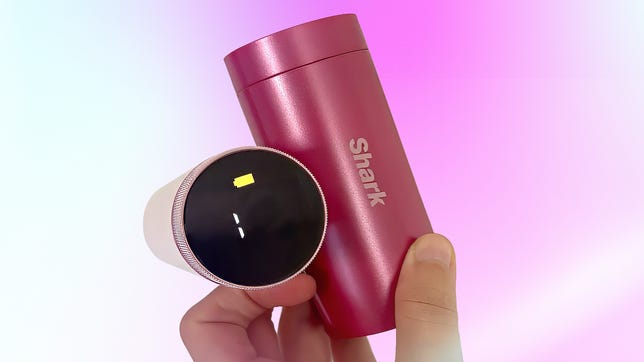
A hand holding the pink Shark ChillPill fan over a pink and blue gradient background.

Pros

  • Bladeless fan has 10 speeds
  • Comes with cooling plate and water mister attachments
  • Can be used three ways
  • Lightweight at 0.77 pounds
  • Comes in 8 colors
  • Battery runs up to 11 hours

Cons

  • Pricey at full price of $150
  • Accessories sold separately, from $10 to $40
  • Loud at higher speeds, up to 74.6 dBA

CNET’s key takeaways 

  • At a full price of $150, the Shark ChillPill is pricey, but it could be worth it for those who want a device that functions as more than a handheld fan.
  • I’m especially impressed with the ChillPill’s dry-touch mister and cooling plate, which can reduce skin temperature by up to 16 degrees Fahrenheit.
  • I did occasionally experience issues pressing the display to activate the device. I also don’t love that all its accessories are sold separately, from $10 to $40.

On elementary school field days, when classes would gather for outdoor events on what felt like the hottest day of the year, I used to get jealous of the kids who had those handheld fans that doubled as water misters. Shark’s new ChillPill personal fan reminds me of them, but in a more modern, high-tech form. 

The ChillPill is three-in-one, in both what it does and how it can be used. 

The pink Shark ChillPill over a multicolored pink and blue background.

Along with being a portable, handheld fan, the ChillPill is also a cooling plate and water mister.

Shark/Jeffrey Hazelwood/CNET

As a wellness editor who tests the latest health tech for CNET, and as someone who runs hot, I was excited to try the ChillPill as summer approaches, and during heat waves. Especially since I also have Dyson’s new HushJet Mini Cool, its first portable fan, and two popular JisuLife fans, the Ultra2 and Pro1 Mini, to compare it to. 

The ChillPill combines a bladeless 10-speed fan with airflow up to 17 mph, a dry-touch evaporative mister that won’t leave you soaked and a cryotherapy-inspired cooling plate that drops skin temperature up to 16 degrees Fahrenheit. The latter measurement was calculated from controlled testing at 77 degrees F, with the plate applied to the neck at its highest setting.

Lightweight at 12.3 ounces, the ChillPill can be worn on your person as a wristlet or crossbody, clipped to a jacket or purse strap, twisted to rest on a tabletop or clamped onto a stroller or workout machine.

The pink Shark ChillPill fan on a wood tabletop with the mister and cooling plate attachments.

Turn the ChillPill into a mister or cooling plate by swapping out the 10-speed fan attachment.

Anna Gragert/CNET

My time with the Shark ChillPill

I started using the ChillPill when temperatures climbed over 90 degrees Fahrenheit here in Los Angeles, and I can confirm that it made a difference. Unlike traditional portable fans, having the mister and cooling plate is particularly helpful.

The cooling plate is simple, but mighty cool

The cooling plate is my favorite ChillPill attachment, and it has two modes: level 1 (best for indoor use) and level 2 (for both indoor and outdoor use). I could actually feel a difference between the two. 

I love placing it on the back of my neck for instant cooling. While this isn’t its intended use, I also enjoy putting it on level 1 under my eyes to reduce puffiness. 

The cooling plate was easy to clean with an alcohol wipe, keeping things hygienic. To clean the device’s exterior, wipe it down with a soft, damp cloth, avoiding moisture in the fan inlet, outlet and charging port. 

The pink Shark ChillPill on a wood surface with the cooling plate and display facing up.

Between level 1 and 2, the ChillPill’s cooling plate will help you chill out (literally).

Anna Gragert/CNET

The mister won’t leave you soaking wet

As for the mist pod, it uses dry-touch evaporative misting, leaving you feeling refreshed, not wet. Definitely an upgrade from those field day fans that are also water spray bottles. It has two modes, constant or interval. 

I appreciate that the mister comes with three replacement moisture wicks (normally $5 for three), which act like straws to bring water to the misting outlet, regardless of the device’s angle. Depending on how often you use it, the wicks should be replaced monthly. 

The pink ChillPill misting pod, open and showing the white wick.

The white wick inside the misting pod.

Anna Gragert/CNET

You’ll want to empty the water reservoir and allow it to air dry after each use. A weekly clean soak with undiluted distilled white vinegar is recommended, and instructions are available here.

The misting attachment’s reservoir holds about 14 milliliters of water, which can be sprayed continuously or in an interval mode to extend the water’s duration. (Just make sure you rotate the attachment’s cap to open its protective cover.) 

You can also use the 10 speeds with this feature. In constant mode, water lasts up to 5 minutes; in interval mode, up to 10 minutes. So make sure you have a water bottle on hand if you plan to refill away from a sink.

The pink Shark ChillPill mister spraying a stream of water in front of gray fabric.

In constant or internal mode, the mist pod’s dry-touch evaporative misting won’t leave you dripping.

Anna Gragert/CNET

The fan could better balance speed and quiet

At up to 17 mph, I found the ChillPill’s fan sufficient, but it’s about a third of the speed of Dyson’s HushJet Mini Cool, which goes up to 55 mph in boost mode. It’s also less than half the speed of the 38-mph JisuLife Ultra2.

When I used the Decibel X app to measure loudness in the quietest area of my apartment, the ChillPill’s speed 10 reached a maximum of 74.6 dBA (A-weighted decibels). As for the HushJet Mini Cool, its boost mode reached 77.5 dBA.

As a reference point, the American Speech-Language-Hearing Association reports that a group conversation, a vacuum cleaner and an alarm clock are around 70 dBA. Noise at 85dBA can lead to hearing loss if you listen to it for more than 8 hours. 

While its lower speeds aren’t as noticeable, I would say that the ChillPill’s speed 10 is a bit too loud for quiet, shared indoor spaces, but could easily be used outdoors.

The ChillPill’s rainbow of colors

The ChillPill is available in eight colors: heat (red), rose gold, haze (purple), carbon (black), dragon fruit (pink), matcha (green), iced latte (brown) and glacier (teal). One barrel has a lighter version of the color, while the other is darker.

The HushJet Mini Cool, by comparison, only comes in three colors: stone/blush (blush pink), ink/cobalt (blue) and carnelian/sky (red and light blue).

The pink Shark ChillPill lying with the travel lock facing up.

The ChillPill’s dragon fruit (pink) is my favorite out of the array of colors, but I also love the matcha (green) variant.

Anna Gragert/CNET

Battery life and charging time compared

On low speed, the ChillPill’s battery runs up to 11 hours on fan mode; at max power, up to 1.5 hours. Using the included USB-C charging cable, it charges in 3.5 hours. 

For comparison’s sake, the 40-watt Dyson HushJet Mini Cool runs for up to 6 hours (5 hours less than the ChillPill) on speed 1. It’s fully charged in 3 hours, which is 30 minutes less than the 15-watt ChillPill. 

The 4.25-watt JisuLife Pro1 Mini, on the other hand, can be fully charged in at least 2 hours and lasts up to 30 hours on speed 1, while the 18-watt Ultra2 charges in 2.5 hours and runs up to 25 hours on speed 1. 

If battery life is what you’re after, then the 30-hour JisuLife Pro1 Mini would be your best option. Between the ChillPill and the HushJet Mini cool, go for the ChillPill.

A hand holding the pink Shark ChillPill while it displays speed 1 and a yellow battery.

Battery life is displayed on the LED screen that doubles as an on/off button.

Anna Gragert/CNET

The display button was my only setback

The ChillPill’s circular LED display shows the speed, misting settings, cooling plate levels and battery life. After you unlock the travel lock (which I kept forgetting to do), you press the display to turn the device on and off and change the attachment settings. Turn the dial to increase or decrease the fan speed. 

Occasionally, I’d have to press the display several times to get it to work, which was the only issue I encountered while using the device. 

Attachments are easy to use, but not travel-friendly

The attachments are also easy to swap on and off by aligning each one with the circle icon on the ChillPill’s barrel, then rotating until it clicks into place. 

Two attachments will fit in the included travel pouch, but the entire device will not. Carrying both the device and attachments can be a lot, and I find that the HushJet Mini Cool’s slim profile makes it easier to throw in a bag when on the go.

Three pink Shark ChillPill attachments (fan, cooling plate and mister) on a wood surface.

The three ChillPill attachments: fan, cooling plate and mister.

Anna Gragert/CNET

ChillPill accessories are pricey and sold separately

I wish the ChillPill came with at least one of its accessories, like the crossbody strap or clip attachment. Instead, all are sold separately for these prices:

  • Wristlet: $10
  • Crossbody strap: $25
  • Clamp: $40
  • Clip: $30

On top of ChillPill’s $150 full price, those accessory prices seem high. Yet, I do understand that they were created especially for the ChillPill, and being proprietary is likely what makes them more expensive. 

Though also not cheap, Dyson’s HushJet Mini Cool is $100 and comes with a lanyard, a travel pouch that fits the entire device and a charging stand. Other accessories will be available soon and sold separately. 

Yes, the ChillPill has the two misting and cooling plate attachments, but I’m not sure that makes it worth the extra $50, plus the cost of the other accessories. 

I received the clamp attachment to test out, and although I don’t have a stroller or workout machine, I was able to clamp it onto my balcony railing. Sitting on the balcony, enjoying the sun, was especially nice while having the ChillPill fan cool me down. 

The pink Shark ChillPill clamped onto a black balcony railing.

The ChillPill clamped onto my balcony railing.

Anna Gragert/CNET

Shark ChillPill vs Dyson HushJet Mini Cool

Specs 

Shark ChillPill

Dyson HushJet Mini Cool

Full price

$150

$100

Core functions

Fan, misting, cooling plate

Fan

Max airflow

Up to 17 mph

Up to 55 mph (boost mode)

Max sound level (dBA)

74.6

77.5

Wattage

15

40

Battery life (low speed)

Up to 11 hours

Up to 6 hours

Charge time (hours)

3.5

3

Weight (pounds)

0.77

0.46

Colors available

8

3

The specs

  • Full price: $150
  • Speeds: 10, up to 17 mph
  • Sound level (speed 10): 74.6 dBA
  • Attachments: Three (fan, misting and cooling plate)
  • Warranty: Two-year limited
  • Weight: 0.77 pounds
  • Dimensions: 1.77×3.31×4.41 inches
  • Wattage: 15 watts
  • Battery life: 11 hours
  • Battery charge time: 3.5 hours
  • Included in box: device, fan cap, misting pod, cooling plate, USB-C charging cable, three replacement misting wicks

CNET’s buying advice

  • If you’re looking for a personal fan with extra functionality (such as a misting pod and cooling plate), the Shark ChillPill is the perfect choice. 
  • While it’s expensive at a full price of $150, the ChillPill is the only personal fan on the market (that I’m aware of) that also triples as a cooling plate and mister. However, I’m not sure it’s worth it when you include the price of accessories that range from $10 to $40. 
  • If you’re simply looking for a personal fan, I’d consider the $100 Dyson HushJet Mini Cool, the even more affordable JisuLife Ultra2 ($79, which also doubles as a flashlight and power bank) or the Pro1 Mini ($56, which comes with a magnetic aroma pod).


Source link

Leave a Reply

Subscribe to Our Newsletter

Get our latest articles delivered straight to your inbox. No spam, we promise.

Recent Reviews


Travel is easier to book than ever before, yet somehow many vacations still go sideways.

With endless apps, social media inspiration, AI trip planners, and online booking tools, modern travelers have more resources than any generation before them. Yet people still routinely return home feeling overscheduled, overstimulated, over budget, or disappointed that their dream trip somehow did not feel as magical as expected.

The issue usually is not where they went. More often, it is how they planned.

After years of exploring everything from luxury safari camps in Tanzania and glacier adventures in Alaska to winter city escapes, iconic national parks, road trips, and high-end mountain resorts, one lesson has become increasingly clear: smart travel is not about doing more. It is about making better decisions.

The difference between an exhausting vacation and an unforgettable one often comes down to avoiding a handful of surprisingly common mistakes.

If you want better trips, fewer regrets, and experiences that actually feel rewarding, these are the travel pitfalls worth sidestepping.

Mistake #1: Trying to Do Too Much

Choosing Meaning Over Miles-Couple with map
Photo Credit: Deposit Photos.

Many travelers build itineraries like they are preparing for a competitive event.

They pack in:

  • Multiple cities
  • Back-to-back tours
  • Tight transportation schedules
  • Early mornings
  • Late nights
  • Minimal recovery time

While this may seem efficient, it often produces burnout rather than fulfillment.

Some of the most memorable travel moments happen when there is room to linger. A long dinner overlooking vineyards, an unexpected wildlife sighting, a scenic drive that turns into multiple spontaneous stops, or an afternoon wandering through a historic district can become more meaningful than a dozen rushed attractions.

Travel should not feel like a checklist. It should feel like an experience.

Mistake #2: Choosing Cheap Over Strategic

Couple planning budget
Photo Credit: Deposit Photos.

Budget matters, but cheapest rarely means best.

Low-cost hotels may be far from the action. Discount flights may involve brutal layovers. Bargain tours may sacrifice quality, comfort, or time.

Saving money upfront can sometimes cost more in:

  • Transportation hassles
  • Lost vacation time
  • Frustration
  • Poor service
  • Missed opportunities

Experienced travelers focus on value, not just price.

Sometimes paying slightly more creates a dramatically better trip.

Mistake #3: Following Peak Season Crowds Without Question

Crowded tourist site via Canva

Peak season often seems like the obvious choice, but it frequently comes with trade-offs:

  • Higher rates
  • Larger crowds
  • Limited availability
  • Reduced flexibility
  • More tourist-heavy experiences

Shoulder seasons can offer some of the best travel opportunities.

Think national parks in early fall, mountain towns in summer, Europe in late winter, or tropical destinations just outside holiday surges.

Better pricing, fewer people, and more breathing room often create a more enjoyable overall experience.

Mistake #4: Packing for Aesthetic Instead of Reality

Teenage boy struggling to close suitcase
Photo Credit: Deposit Photos.

Vacation photos may inspire your wardrobe, but destination conditions should shape your suitcase.

Too many travelers prioritize style while overlooking practical essentials like:

  • Supportive shoes
  • Weatherproof layers
  • Functional bags
  • Activity-specific gear
  • Climate versatility

This becomes especially important when exploring destinations with changing conditions, such as mountainous regions, safari environments, winter cities, or outdoor-heavy itineraries.

Comfort creates flexibility, and flexibility often leads to better adventures.

Mistake #5: Underestimating the Importance of Where You Stay

Courtyard King Kamehameha's Kona Beach Hotel Hawaii
Photo Credit: Jenn Coleman.

Accommodations influence more than sleep.

Your hotel, lodge, or rental impacts:

  • Daily convenience
  • Walkability
  • Scenic access
  • Stress levels
  • Overall atmosphere

A centrally located boutique property can transform an urban trip. A remote wilderness lodge can create total immersion. A thoughtfully chosen resort can simplify logistics while enhancing comfort.

Where you stay often shapes how you experience the destination itself.

Mistake #6: Skipping Guided Experiences Entirely

Our Guide Ben on Root Glacier Hike McCarthy, Alaska
Photo Credit: Jenn Coleman.

Independent exploration has its place, but avoiding guides altogether can mean missing out on depth, efficiency, and hidden opportunities.

Exceptional guides can provide:

  • Cultural insight
  • Safety expertise
  • Priority access
  • Local knowledge
  • Storytelling

Whether it is wildlife viewing, glacier excursions, historical walking tours, culinary experiences, or backcountry adventures, the right guide can elevate a trip beyond surface-level tourism.

Mistake #7: Letting Social Media Overbuild Expectations

Social Media
Photo Credit: Deposit Photos.

Social platforms are excellent for inspiration, but they often highlight perfection rather than reality.

What you may not see:

  • Crowds
  • Long waits
  • Seasonal limitations
  • Edited visuals
  • Overhyped attractions

Savvy travelers use social content as one research tool among many, balancing it with practical logistics, independent reviews, and destination-specific expertise.

Not every viral destination delivers meaningful travel value.

Mistake #8: Ignoring Transportation Strategy

Photo Credit: Jenn Coleman.

Flights are only one part of travel logistics.

Airport choice, train routes, rental cars, ferry systems, and transfer times all matter.

For example:

  • Regional airports can reduce stress
  • Scenic rail journeys can improve experiences
  • Strategic rental timing can save money
  • Alternative arrival points can improve flexibility

How you move shapes your trip almost as much as where you go.

Mistake #9: Overlooking Food as a Core Experience

Seafood tower Chute Eleven Yurt Deer Valley Resort Utah
Photo Credit: Jenn Coleman.

Food is often one of the most direct windows into culture.

Yet too many travelers default to convenience chains or overly curated tourist dining.

Prioritizing local cuisine through:

  • Markets
  • Neighborhood eateries
  • Regional specialties
  • Culinary tours
  • Family-owned establishments

can significantly deepen a trip.

Some destinations are best understood through flavor as much as scenery.

Mistake #10: Forgetting to Build in Downtime

Comfortable place for rest near window
Photo Credit: Deposit Photos.

Many vacations fail because travelers underestimate their own energy limits.

Constant movement, unfamiliar environments, weather, time changes, and decision fatigue can add up quickly.

Rest is not wasted vacation time.

In fact, strategic downtime often improves:

  • Mood
  • Flexibility
  • Energy
  • Spontaneity
  • Overall satisfaction

A well-paced trip feels more luxurious, regardless of budget.

Mistake #11: Splurging in the Wrong Places

money
Photo Credit: Deposit Photos.

Luxury is not always about spending more everywhere.

The smartest travelers often focus their budget on experiences that truly enhance the journey, such as:

  • Premium flight comfort on long-haul routes
  • Extraordinary excursions
  • Prime accommodations
  • Unique culinary moments
  • Seamless transfers

Meanwhile, they may save on less impactful categories.

Strategic splurging creates memorable travel without unnecessary excess.

Mistake #12: Treating Every Destination the Same

Levi Husky Park Post- Traditional Lodge
Photo Credit: Jenn Coleman.

Different destinations require different mindsets.

A safari is not a ski trip. A remote Alaskan adventure is not a European city break. A luxury beach stay is not a national park road trip.

Understanding what makes a destination special allows you to plan around its strengths instead of forcing generic travel habits onto unique places.

Adaptation improves experience.

Mistake #13: Focusing Too Much on “Must-Sees”

Trinidad, panoramic skyline with mountains and colonial houses. The village is a Unesco World Heritage and major tourist landmark in the Caribbean Island. Cuba.
Photo Credit: Deposit Photos.

Landmarks matter, but they are not everything.

Some of the richest experiences often come from:

  • Scenic detours
  • Local events
  • Hidden trails
  • Conversations
  • Neighborhood discoveries
  • Smaller cultural moments

Travel becomes more rewarding when you leave room for texture, not just headline attractions.

Mistake #14: Forgetting That Flexibility Is a Superpower

People in the rain climbing Mt. Kilimanjaro
Photo Credit: Altezza.

Weather changes. Energy shifts. Recommendations emerge. Opportunities appear unexpectedly.

Rigid travelers often miss some of the best moments because they are too locked into preplanned schedules.

Flexibility allows travel to feel alive.

Often, the best stories come from what was never on the itinerary.

Mistake #15: Losing Sight of Why You Travel

Couple lying on beach after snorkling
Photo Credit: Deposit Photos.

Somewhere between bookings, content creation, optimization, and bucket lists, many travelers lose focus on the true purpose of travel.

Travel should inspire.

It should refresh perspective, deepen connection, create wonder, and offer meaningful memories.

The best vacations are not necessarily the busiest or most expensive.

They are the ones that feel genuinely fulfilling.

Final Thoughts

Great-Pyramid-complex
Photo Credit: Jenn Coleman.

Travel mistakes are incredibly common, even among intelligent and experienced travelers.

Fortunately, most are avoidable.

When you prioritize value over cost, pace over pressure, authenticity over hype, and strategy over impulse, your trips become smoother, richer, and far more memorable.

Whether you are planning a luxury mountain retreat, international safari, national park adventure, winter city escape, or coastal road trip, better travel often comes down to better choices.

Because in the end, the smartest travelers are not the ones who simply go the farthest.

They are the ones who know how to travel well.

Hi! We are Jenn and Ed Coleman aka Coleman Concierge. In a nutshell, we are a Huntsville-based Gen X couple sharing our stories of amazing adventures through activity-driven transformational and experiential travel.


Source link