
ZDNET’s key takeaways
- iDealOS is an MXLinux-based distribution.
- You’ll get an easy-to-use DNS switcher and content filtering in Firefox.
- There’s plenty of preinstalled software, so you can hit the ground running.
Blink, and a new Linux distribution will have appeared on the market, which I find to be fantastic. Choice is good, and Linux embodies the spirit of choice on every conceivable level.
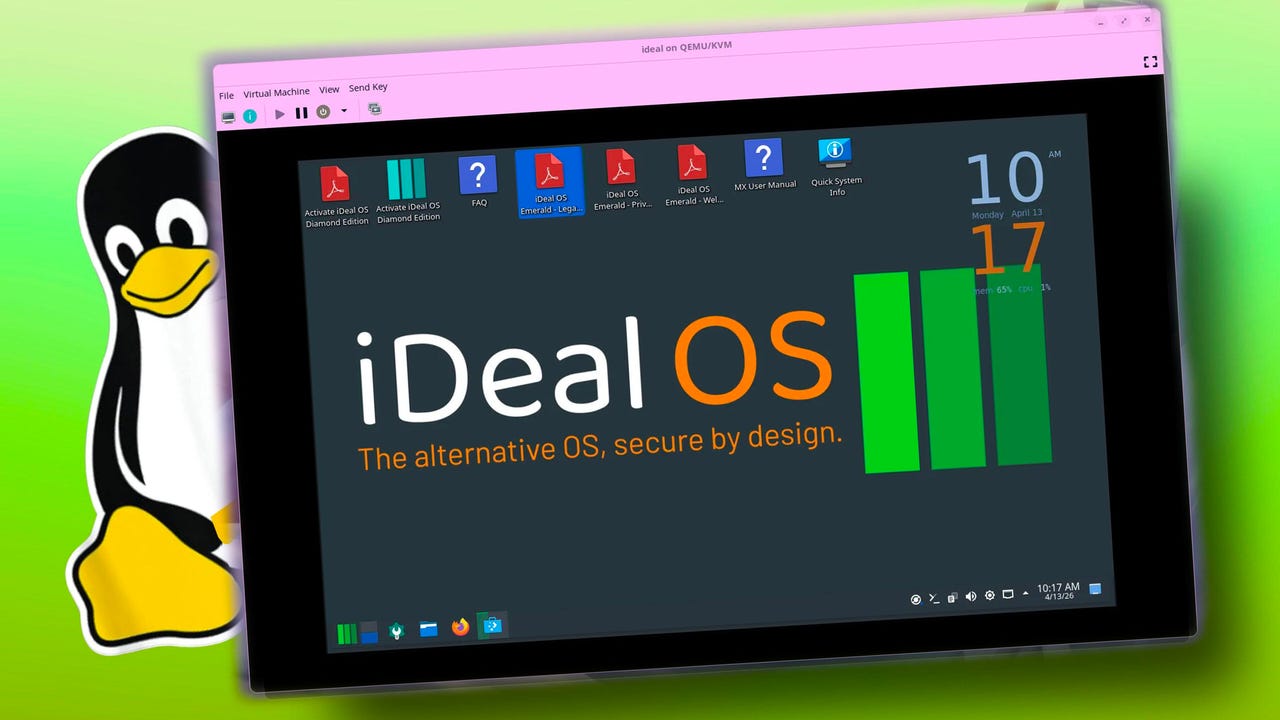
Take, iDealOS. This MXLinux-based distribution opts for the KDE Plasma desktop (in favor of Xfce), and offers two different versions: Emerald and Diamond. The difference is:
Emerald Edition is completely free and fully functional.
Diamond Edition is available to anyone who supports the project with a small donation. This version includes preinstalled applications for producing audio, video, and images, and professional tools to support your business, your imagination, and your creativity.
Also: The best Linux laptops
As far as I can tell, there is no difference between the two editions, other than that the Diamond flavor makes it easy to donate to the project.
After installing and texting iDealOS over the weekend, something came to me that’s less about the OS and more about the ideal.
Is paid Linux the future of the OS?
This is a challenging question to ask, especially given how open-source has functioned for as long as it’s been around. Open-source is free and open, and I firmly stand behind that. But does that mean it has to be free?
There are several distributions that I can think of that ask for donations up front or offer a paid option: elementaryOS, Elive, Zorin OS Pro, Archcraft Premium, RHELS, SLES, and now iDealOS.
I’m not saying that every distribution should adopt a paid model. But there are some options that I think could make those projects more viable for the future, such as:
- Premium editions that include features like optimized kernels, pre-installed audio/video codecs, and specialized editions (such as for Video editing, development, AI, etc.).
- Early access to new releases or access to beta versions.
- Editions with extra desktop layouts (or even desktop environments).
- Versions with extra features (such as extra themes, FX, etc.).
- Access to certain online forums/discussions where paid users can suggest new features, get help, or just interact with the development team.
There are different ways for Linux distributions to create revenue streams.
With that said, let’s get back to iDealOS. Here, you have a KDE Plasma desktop, one that does toss a bit of clutter onto the desktop (which can be moved or deleted with a right-click > “Move to trash”), a subtle but effective Conky configuration, and a unique collection of preinstalled software and even content filtering.
When you comb through the iDealOS menu, you’ll find a lot of preinstalled apps, some of which you’ve probably never heard of, and some that are specific to this distribution. Those iDealOS-specific apps include:
- iDeal DNS Switcher – to quickly change DNS providers.
- iDeal Safe File – easy file encryption.
If you have a need to encrypt files, this is an outstanding tool.
Jack Wallen/ZDNET
MX Tools – a large collection of tools, brought over from MX Linux, that range from a disk manager, MX Cleanup, MX Conky, MX Network Assistant, MX Samba Config, MX Snapshot, NVIDIA driver installer, and more. These tools make managing your iDealOS instance much easier (and give you considerable power, so use some of them with caution).
Also: The best Linux distros for beginners: You can do this!
There are quite a lot of apps available on iDealOS, some of which you’ll regularly use and others you may never touch. iDealOS also mentions content filtering, which is configured within the default web browser, Firefox. The developers of iDealOS have included the BlockNSFW — adult content blocker extension, which blocks adult websites and inappropriate/adult websites before they load. It also blocks NSFW keywords in titles, meta descriptions, and forums.
DNS takes center stage
If there’s one tool found on iDealOS that I really appreciate, it’s the iDeal DNS Switcher. This app allows you to change DNS providers on the fly. You can select from quite a number of DNS providers, some of which offer added features, such as ad and tracker blocking.
This makes switching DNS providers so easy.
Jack Wallen/ZDNET
This is one of those tools that I believe every distribution should offer. I will sometimes switch DNS providers, especially if the one I’m using slows down. With the iDeal DNS Switch, instead of editing your network connection, all you have to do is select the DNS provider you want to use from a drop-down.
That’s convenience, and it would make it possible for even users who are new to Linux or the importance of a good DNS provider to make use of such a feature.
Performance
Although I don’t believe that iDealOS has much in the way of unique performance enhancements, it’s still really fast. Some of that is brought about by KDE Plasma; I threw the usual kitchen sink at the OS, and it never once blinked.
Who is iDealOS for?
Truthfully, the best situation for iDealOS is a home environment where there are children who need to use a computer. With iDealOS, you can trust that they won’t be using the default web browser to view content they shouldn’t. That’s not to say that they can’t get around it. All you would have to do is install a different browser, and that NSFW content would be accessible.
Also: Want to save your aging computer? Try these 5 Linux distributions
Even so, the addition of the DNS Switcher is a nice addition, and with the amount of curated software, you can hit the ground running as soon as the OS is installed.
iDealOS might not be the ideal OS for everyone, but if you want an easy-to-use, family-friendly Linux distribution, this is the one to grab.
If you’re interested, download an ISO of iDealOS, burn it to a bootable USB drive, and install it on a spare PC to see if it’s right for you.