What Popular Baby Names Can Signal


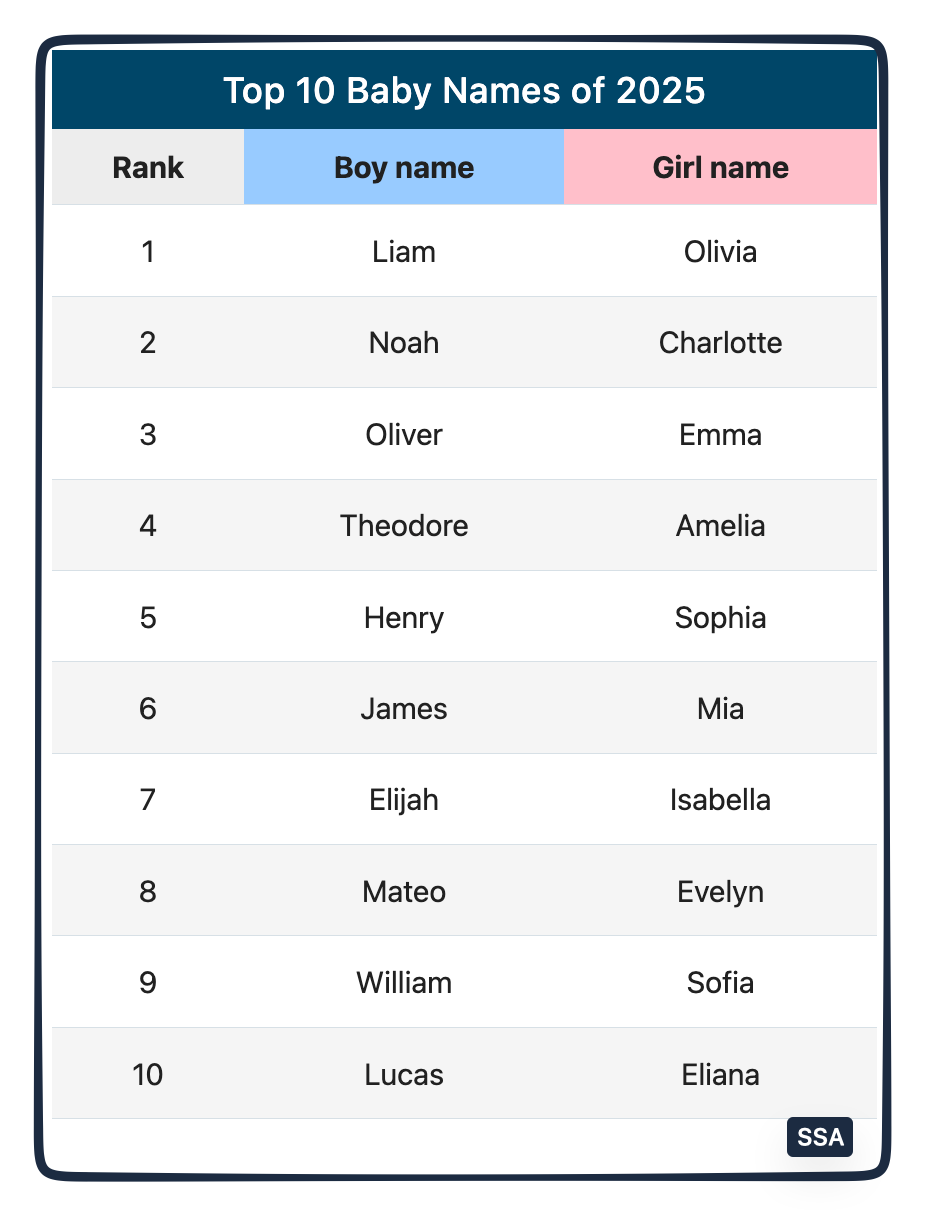
For Liam it was the ninth straight year and Olivia’s seventh as the most popular baby names in the United States:
most popular baby names 2026

When parents apply for their baby’s new Social Security card, the Social Security Administration (SSA) records the names. During 2025, 20,818 selected Liam and 13,544, Olivia. Meanwhile, among the girls, popularity surged for Ailany (from #101 to #14) and Sienna (#139 to #94). With boys, it was Eithan (#227 to #97) and Atlas (#101 to #75) that grabbed more parents.

Our question though is why, why do parents select certain names?

The Message From a Name

Referring to Washington D.C.’s new parents’ baby names, a consultant said they were “résumé-ready.” Classic, the names in the boys’ top 10 included Charles and John while conservative names like Francis, Helen, Ann, and Rose were more popular in D.C. than elsewhere.

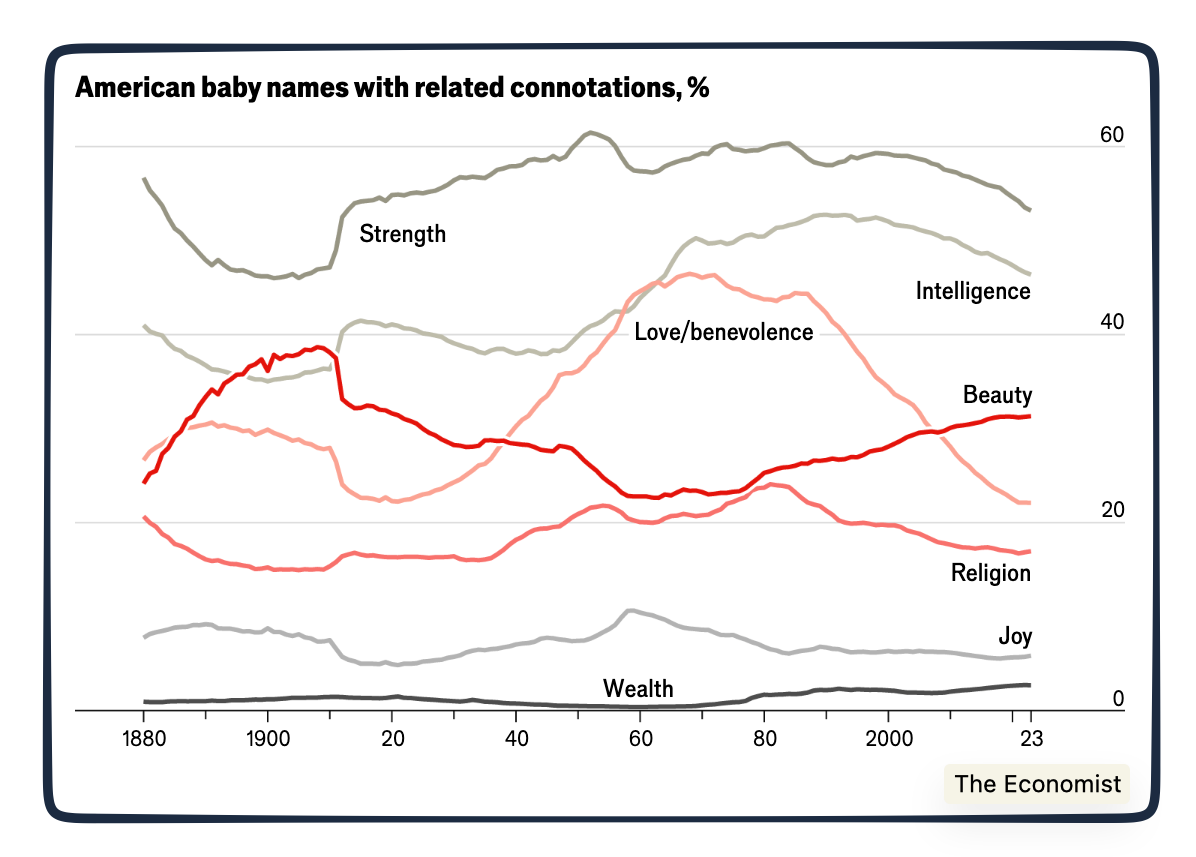
Curious about what names tell us, The Economist used AI to analyze 143 years of nearly 400 million baby names in the U.S. and Great Britain. To see the connotations, they used word clusters. The results indicated that Olivia, Emma, and Charlotte evoke elegant associations while boys’ names like Liam and Noah tilt to power and strength. And a few parents (thinking of luxury?) selected Aston (#3723 in U.S. births) for their boy or girl.

You can see below that beauty and money are on the upswing. By contrast, names that connect to religion, love, and joy plunged in popularity:
popular baby names


Our Bottom Line: Signaling

While I am not sure about the academic rigor for some of the baby naming research, I do believe that many parents say something through their children’s names. A behavioral economist would say that they send a signal.

By signaling, we are using a very specific act to convey a much broader message. Politicians vote for the death penalty to show they are tough on crime. Someone shops at Annye’s Organics to demonstrate concern about the environment. And you name your little boy Stirling to display his monetary future.

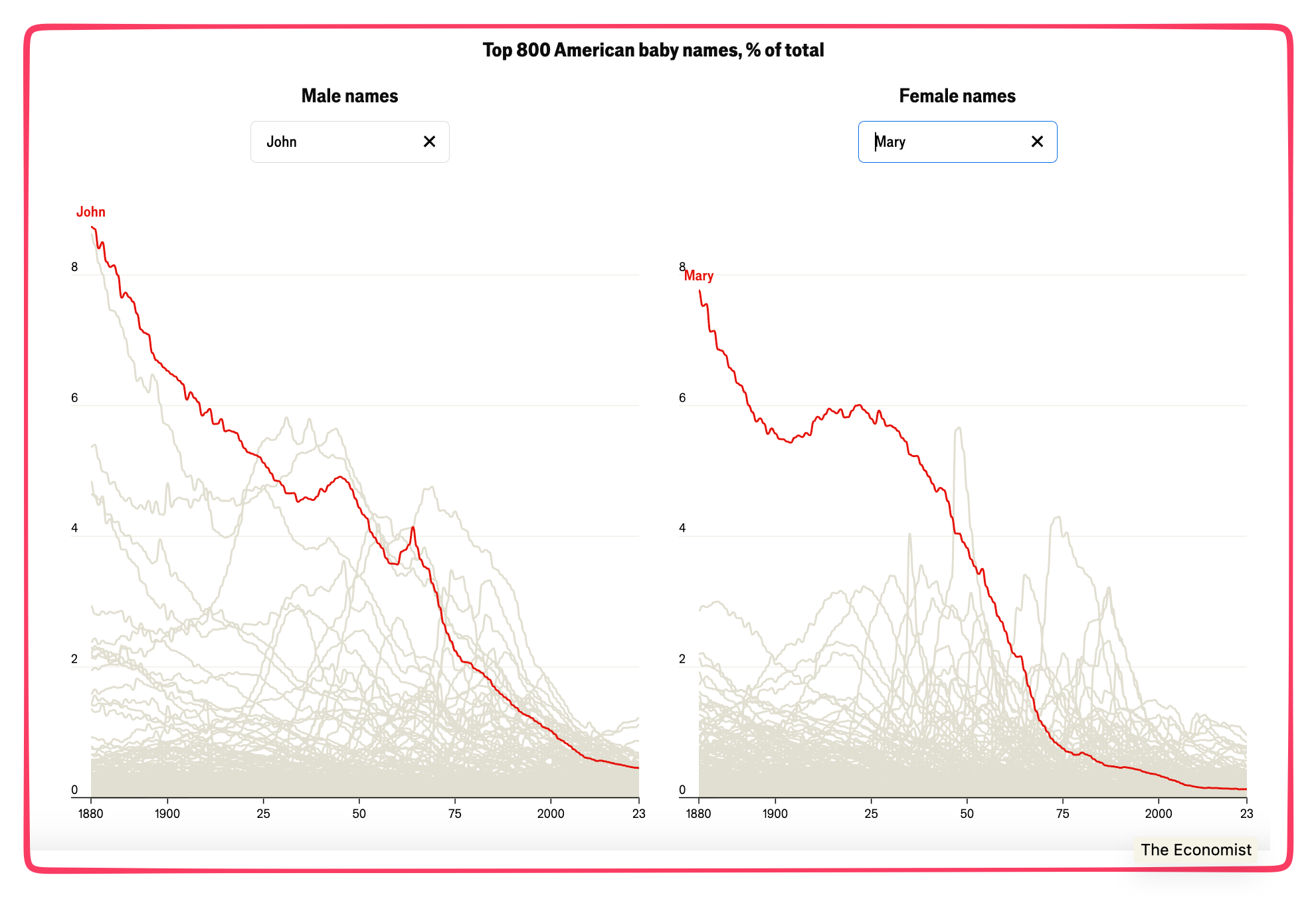
Perhaps not what the parents of future entrepreneurs want to signal, John and Mary will always convey a classic conservatism:
popular baby names


My sources and more: While SSA was the logical starting place for today’s post, there is so much more. After the basic baby name list, we went to The Hill, The Economist, The Washington Post, and Yahoo. But best of all, I recommend returning to the Freakonomics podcast, “How Much Does Your Name Matter?”

I did want to add (and am not sure of the significance) that, with Texas, NJ, and NY selecting Emma as #1, sometimes red and blue states do agree.


Source link

Leave a Reply

Subscribe to Our Newsletter

Get our latest articles delivered straight to your inbox. No spam, we promise.

Recent Reviews


Google is experimenting with a new policy restricting the amount of free storage provided to some accounts. New Google accounts (including new Gmail accounts) created in certain regions will be limited to 5GB of free storage when they’re first set up. That’s only one-third of the amount of storage that has been typically offered. There is a way of increasing the amount of free storage you get when setting up a new account, though: you can unlock it by linking your phone number.

When approached for comment by Android Authority, a Google spokesperson confirmed that the new policy was being tested to “help us continue to provide a high-quality storage service to our users, while encouraging users to improve their account security and data recovery.” The statement didn’t clarify which regions the policy is being tested in, nor for how long the testing period will last.

Notably, a Google One Help support page about account storage has been updated to state that each Google account contains “up to 15 GB of storage”, as noted by 9to5Google. Previously, the page didn’t say “up to”; it simply stated that accounts come with 15 GB of storage. So far, the experiment doesn’t appear to stretch to pre-existing accounts.

Per a screenshot shared by Reddit user Sungusungu on R/DeGoogle (a subreddit dedicated to finding alternatives to Google services and products) Google is collecting phone numbers to make sure that the full 15 GB of storage is only redeemed once per person. Of course, that’s easily evaded by using a burner phone to set up multiple accounts, should you want to. The pop-up directs users to a webpage to learn more about storage management. However, at the time of writing, the link redirects to the help center landing page instead.

How to link your Google account with a phone number

If you’re in the process of setting up a new Google account in an impacted region, then you might be prompted with the option of unlocking an extra 10 GB of storage using your phone number via a simple pop-up menu. If so, you can go ahead and follow those steps. However, if you want to link your phone number with a pre-existing Google account, then here’s what you need to do. Using your computer, you need to:

  1. Open your browser and head to myaccount.google.com, then navigate to “Security and sign in” on the left-hand toolbar. This should open a list of security options.

  2. Select “Use your phone to sign in” and then “Set it up”. 

  3. Add a phone number using the “Recovery phone” option.

  4. Follow the on-screen steps to verify your number and finish linking it to your account.

Your options might look a little different if you already have a recovery number set up with your account.

Alternatively, you can connect a phone number to your Google account from your Android device, iPhone, or iPad. Much like on a computer, you connect your number by adding it as a recovery phone. First, head over to myaccount.google.com. Then select “Personal info”, followed by “Phone”. From there, you should be able to add or edit your phone number by navigating to the “Recovery phone” section.


Source link