When Speedy Deliveries Accelerated


During January, the Indian government asked online retailers to eliminate their 10-minute delivery guarantees. Although customers liked it, gig workers complained that their safety was jeopardized.

Speedy Deliveries

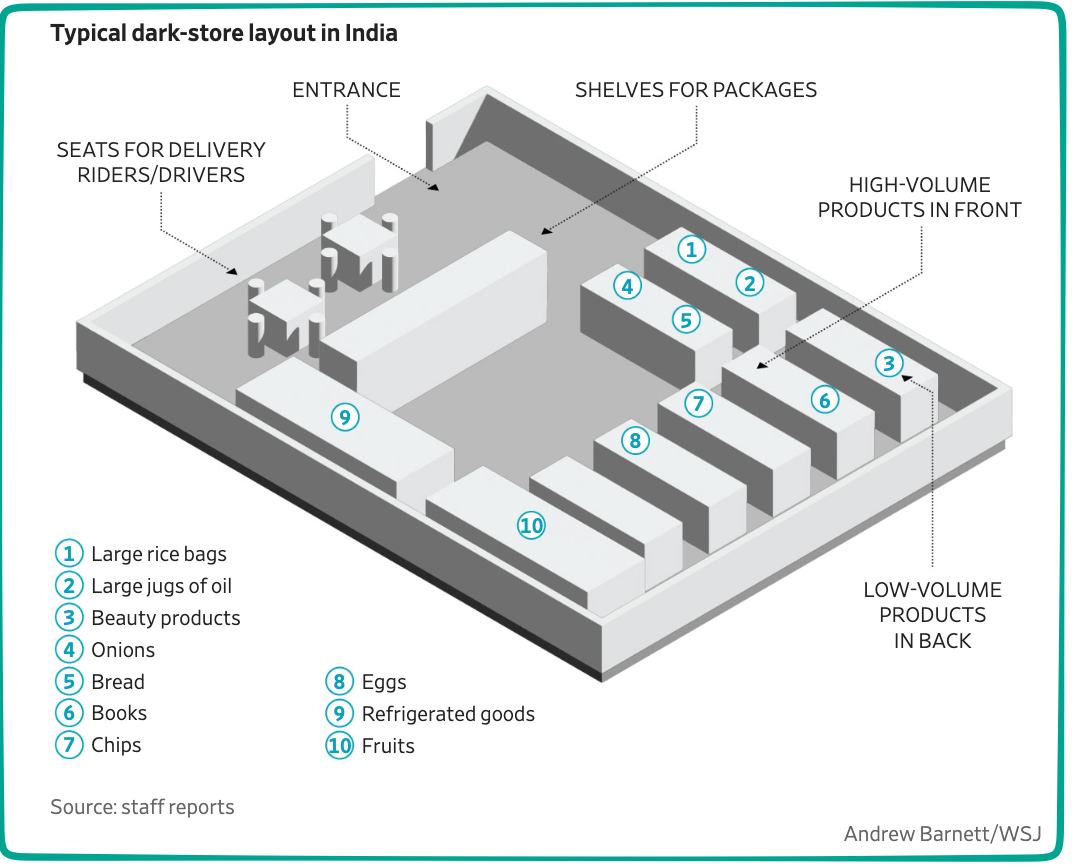
With its dense cities and large labor force, India is ideal for fast delivery. Locally positioned, the system depends on a network of micro-fulfillment centers that are known as “dark stores.” With a delivery radius of 1 to 2 miles, they can respond within minutes. Consequently, cities like New Delhi would need at least two hundred 3,000 to 10,000 square foot mini-warehouses. By contrast, Amazon’s normal fulfillment centers are 40,000 square feet.

Visiting a dark store, you would see pickers pluck orders that are rapidly handed off to drivers on scooters:
speedy deliveries

Copying the Indian prototype, Amazon has quick commerce pilot programs in Seattle and Philadelphia.

Our Bottom Line: Reference Points

When most of us thought two-day delivery was fast, Amazon created Prime:
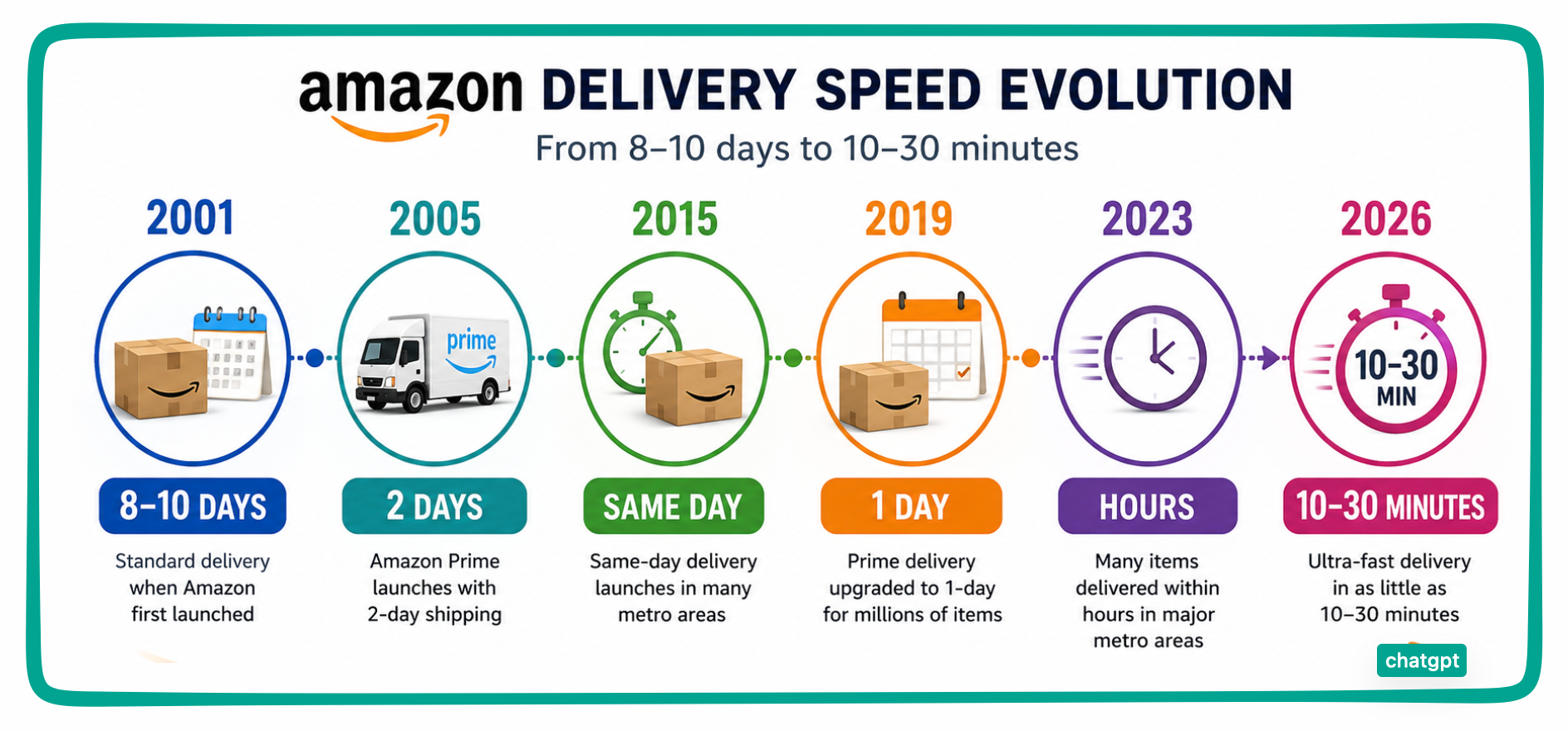
speedier deliveries

A behavioral economist would tell us that Amazon had transformed our online shipping reference points. A reference point influences our opinion. With gasoline, for example, a previous week’s price of $4.00 a gallon becomes a reference point that signals $3.50 is a bargain. But if the price beforehand had been $3.00, then $3.50 looks astronomical. Similarly, at work, when an associate gets a 7% raise, 5% makes us miserable. If our stock portfolio plunges, we don’t feel so bad knowing that the benchmark S&P declined even more.

Like gas prices and wages, when delivery times accelerated, our reference points changed.

Recently, I received a t-shirt order in 3 days and wondered why it was so slow. However, 23 years ago, I paid Amazon $9.48 to receive an online order in what I thought was a speedy 2 days. So yes, my reference points have changed.

My sources and more: For some delivery time history, we looked back at econlife. From there, leaping to now, India was our focus, here and here. But if you want the behavioral side of reference points and framing and anchors, do go to economics Nobel Laureate Daniel Kahneman’s superb book, Thinking Fast and Slow.

The drone in our featured image could speed up delivery times.

Please note that several of today’s sentences were in a previous econlife post.


Source link

Leave a Reply

Subscribe to Our Newsletter

Get our latest articles delivered straight to your inbox. No spam, we promise.

Recent Reviews


Researchers in South Korea developed a wearable system that uses seven smart rings to read finger and hand motions to translate American Sign Language and International Sign Language into text. The purpose is to make communicating easier between those who sign and nonsigners without needing a separate human interpreter. 

AI Atlas

According to the study, published Friday in the journal Science Advances, the system reliably recognized 100 ASL and ISL words during testing. It also performed well with users the system had not seen before, and it didn’t require recalibration for each person. Because the system detects words in sequence, it can produce sentence-level translations without extra training on grammar. 

ASL and ISL are the everyday languages of more than 72 million deaf and hard-of-hearing people. However, most hearing people do not know any words in these languages or have a very basic understanding. That gap makes certain tasks, like ordering at a restaurant or asking for help, much more difficult. 

A graphic shows two illustrated people talking in sign language, ASL and ISL. The graphic also shows the different components of the ring as well as pictures of hands modeling the rings.

A concept of how the rings work in the real world. 

American Association for the Advancement of Science (AAAS)

Existing sign language translator prototypes often rely on bulky gloves that can distract from or block natural hand movement or feel uncomfortable for the wearer, which limits real word adaption. Camera-based technologies can work well in controlled environments but are often limited to those places where a camera can be set up with a clear line of sight, the researchers wrote. 

To solve these problems, the researchers designed sensing rings for each finger that can capture precise motion and finger position while letting the hands move naturally. The rings can detect both signs that involve movement, like the words for “dance,” “fly” and “sun,” and signs that are held still, like “I” and “you.”

“These advances suggest that [the device could enable] barrier-free public translation systems for unseen users and unrestricted daily assistive interfaces,” the authors wrote in the study. 

The authors are affiliated with Yonsei University, Hankuk University of Foreign Studies and the Korea Institute of Science and Technology, among others. While the technology is still experimental, the authors wrote that the technology has the potential to ease communication difficulties. The underlying idea could also help improve controls for other systems, like virtual or augmented reality.

“Beyond sign language translation, the ring-type, wireless, and modular architecture of (wirelessly connected, ring-type sign language translators) may also be extended to other gesture-driven applications such as virtual or augmented reality control, touchless device interfaces, or rehabilitation monitoring systems where fine-grained hand movement tracking is essential,” they wrote.


Source link