
Like the U.S. Federal Reserve, we could say the earth’s economic policymakers have a dual mandate. They too want stable prices and the high employment that accompanies growth.
Unlike Goldilocks, none of the alternatives is just right.
Global Economic Projections
Until recently, the world was on the right trajectory with fourth quarter 2025 growth at 3.9%. Now though, even if the Iran war is limited, the IMF expects growth to slow to 3.1% and inflation to increase. Even worse, absorbing more of the impact of trade barriers and wartime constraints, developed nations can expect 1.8% growth. On the other hand, emerging markets and Asia would likely experience 3.9% growth.
However, it all depends on which IMF scenario you base your predictions. Describing three possibilities, their projections are what we would expect.
- The Benign Scenario: The best scenario depicts a weeks-long conflict from which the global economy soon returns to normalcy. Still though, growth is slower than it would have been.
- The Adverse Scenario: Thinking of a war with a greater duration, depth, and scope, the adverse alternative brings world oil prices up 80%. Peaking in Europe and Asia at a 160% increase, after though, they glide downward with growth at 2.5%.
- The Severe Scenario: Worse, the severe war scenario looks to oil prices going up by 100% while in Europe, gas prices could rise a whopping 200%; Correspondingly, by 2027, food and commodity prices climb as high as 10% and growth sinks to 1.3%
With all three, the developing and emerging economies are hit the hardest.
Our Bottom Line: Global Petrol Prices
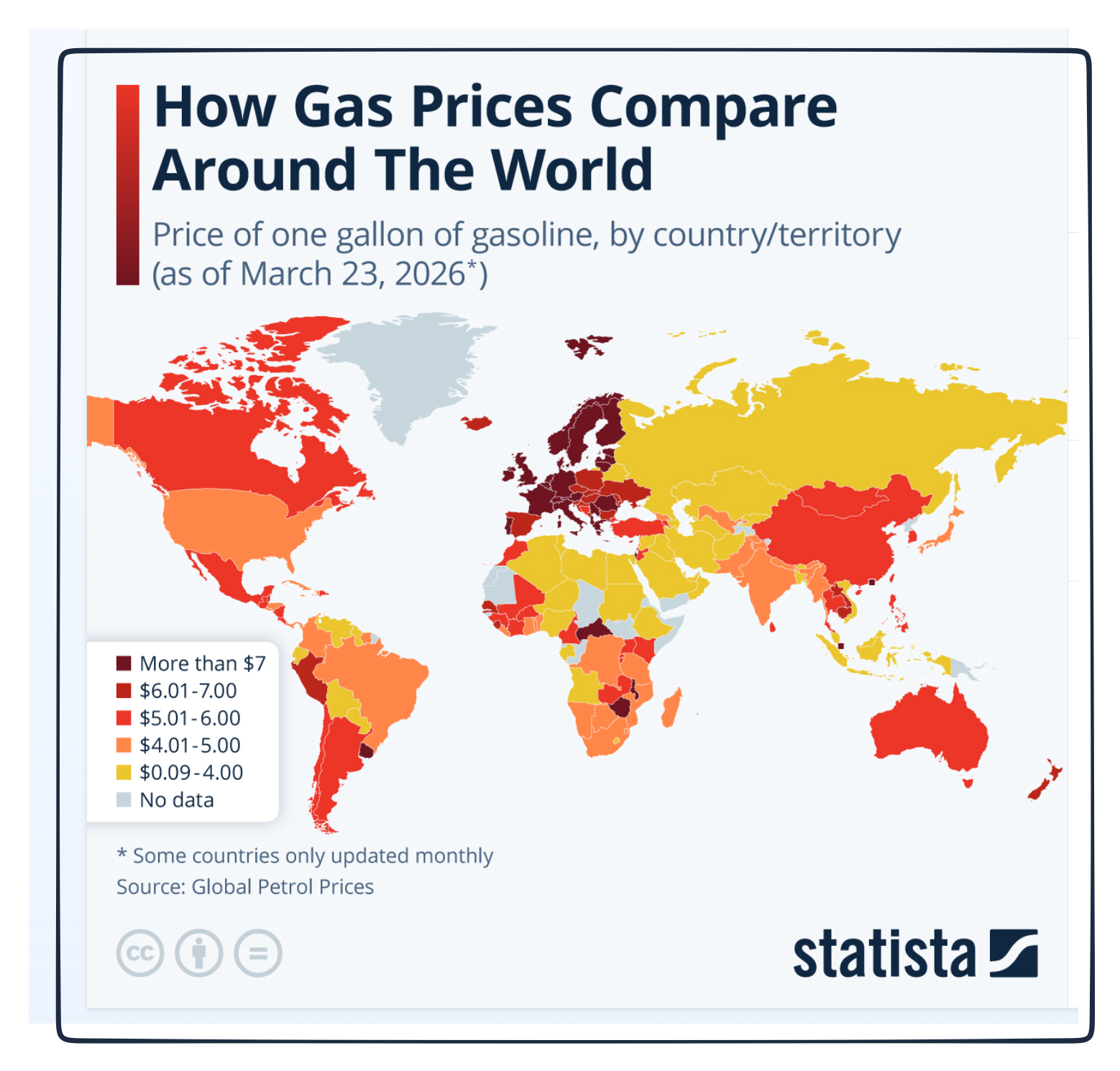
Elevated petrol prices are fueling the global decline:
But the prices are only half the story.
We should conclude by noting how much they have already risen. And that takes us to Global Petrol Prices, a website that provides our snapshot of the different gasoline and diesel prices that countries cope with. Citing only several, we can note that, since February 23, 2026, gasoline and diesel prices are slightly down or unchanged in India, Kuwait, the Ivory Coast, and Kenya. Much more typical, the increase of gasoline and diesel for the U.S. is 45.1% (g) and 37.25% (d), in Laos, it’s 45.6% (g) and 169.5% (d) while for France gasoline has been up 19.8% and diesel, 40.3%.
While Goldilocks means not too high, not too low, but just right, our three possibilities are neither.
My sources and more: As we have seen in the past, gasoline prices take us far beyond the United States. For an economic baseline, The IMF’s World Economic Report 2026 came in handy. Then, global petrol prices and Statista became the ideal complement.

Nicole Byers is an entertainment enthusiast! Nicole is an entertainment journalist for the Maple Grove Report.