Wireless Chargers Use More Power Than Wired, But Is It Enough To Care About?


Smartphones are getting better, and they’ve experienced quite the advancement in the past two decades since the launch of the first iPhone in 2007. One of the bigger advancements to these devices, but also often a controversial one, is wireless charging. As the name implies, there’s no cable — the chargers themselves have a coil, the phone has a coil, and touching the two together allows for energy to be transferred without the need of a cable. In this case, that energy is used to charge the battery.

Wireless charging has been getting better and better over the years, with the recent Qi2 standard essentially democratizing a version of MagSafe for Android users, and faster and faster wireless chargers popping up everywhere. As you may be aware, wireless chargers, although convenient, are a lot less energy efficient than regular cables. Energy losses will always happen, and that’s also the case with wireless charging. The difference in energy usage can be up to 40%, but does it really matter?

The importance of wireless charging efficiency
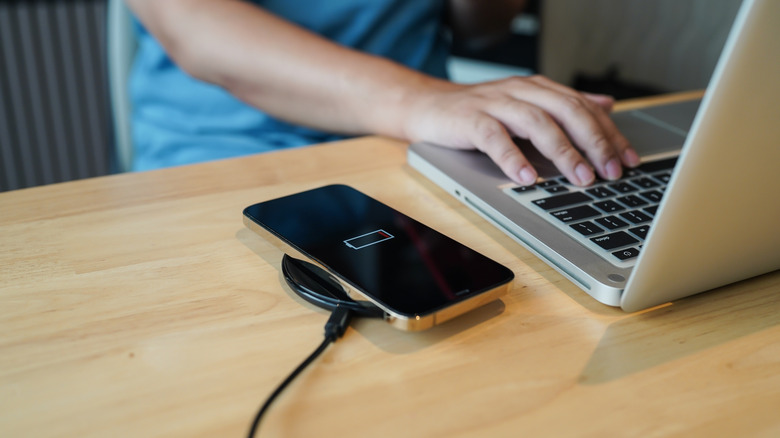
Whether or not the comparative inefficiency of a wireless charger is important is up to you. Let’s start by having a look at the differences in efficiency. Engadget calculated that charging a phone from a dead battery to 100% charge would use 15Wh of energy, whereas a wireless charger would use 21Wh. As mentioned before, that’s a difference of about 40%, and if you don’t really look at the bigger picture, the comparison ends there. However, if every smartphone in the world charged wirelessly, that’s a lot more electricity that’s being used, and if the electricity doesn’t come from a green source, it could harm the environment in some way.

If you’ve ever used a wireless charger, you’re aware of one of wireless charging’s biggest cons: the heat. Especially in higher temperatures, wirelessly charging a smartphone causes both the charger and the device to heat up significantly, and most phones have safety measures in the software that stops them from charging so they don’t overheat and so the internal components don’t get damaged, temporarily rendering the wireless charger useless.

If both devices’ thermal management isn’t up to snuff, regular wireless charging could lead to faster battery degradation, although wireless chargers themselves aren’t inherently bad for your battery. With all of that in mind, using a wireless charger with a fan, or charging a device with stellar thermal efficiency, or in a well climate-controlled area, won’t do all that much harm, and it’s convenient if you don’t want to fumble with a cable on some occasions. However, if you care about excessive use of electricity and its effects on the environment, it’s a better idea to stick to wired.


Source link

Leave a Reply

Subscribe to Our Newsletter

Get our latest articles delivered straight to your inbox. No spam, we promise.

Recent Reviews


To paraphrase a famous superhero, flying is, statistically speaking, the safest way to travel. It is, of course, also one of the more expensive modes of transportation available to travelers. And yes, if you’ve rolled a suitcase into an airport any time in the past couple of decades, you know travelers are required to adhere to dozens of rules and regulations before they board a plane, and even more while they’re up in the air.

Most of those rules are put in place by the Transportation Security Administration (TSA) and the Federal Aviation Administration (FAA), the government agencies tasked with overseeing and regulating transportation and civil aviation in the United States, respectively. Apart from the myriad rules drawn up by those factions, many major airlines have added to the list with regulations that their passengers must adhere to in-flight, and yes, you agree to those terms anytime you buy a ticket by way of a “contract of carriage.”

United Airlines just added a pretty major new rule to its CoC that requires all passengers to use headphones when enjoying content with audio from a personal device like a laptop, tablet, or mobile phone. The rule is intended to limit environmental noise in the plane’s cabin, thereby ensuring a more pleasurable flight for both passengers and crew. Still, you may be surprised just how far United is threatening to go in punishing those who refuse to adhere.  

United may take its headphones policy to extreme measures in some cases

If you’ve ever been seated near someone who isn’t using headphones (which is one of the necessary in-flight gadgets) while watching a movie, listening to music, or even scrolling through social media in flight, you no doubt agree that United’s new headphones rule is one that’s very much worth enforcing. In fact, many other airlines already have similar policies in their own contracts of carriage. Even still, none of those policies are quite as severe as United’s, with the airline’s new CoC amendment stating that failure to adhere to the headphones rule could ultimately result in your removal from the flight.

That CoC goes on to state that not only might you be removed from the flight you’re on if you refuse to use headphones, but you may also be permanently banned from flying with United Airlines. As travel expert Scott Keyes told CBS, United is the first major airline to take such a hardline stance on the matter of headphones, but it wouldn’t be surprising to see its competitors quickly adopt similar policies.

Interestingly enough, it is not made entirely clear just how far United is prepared to go in enforcing the rule. For instance, it would be relatively easy to remove a passenger from the plane prior to takeoff. It’s much harder to imagine that United would go so far as to land a plane mid-flight to the same end. But perhaps that is where the threat of a permanent ban comes into play. Only time will tell.


Source link