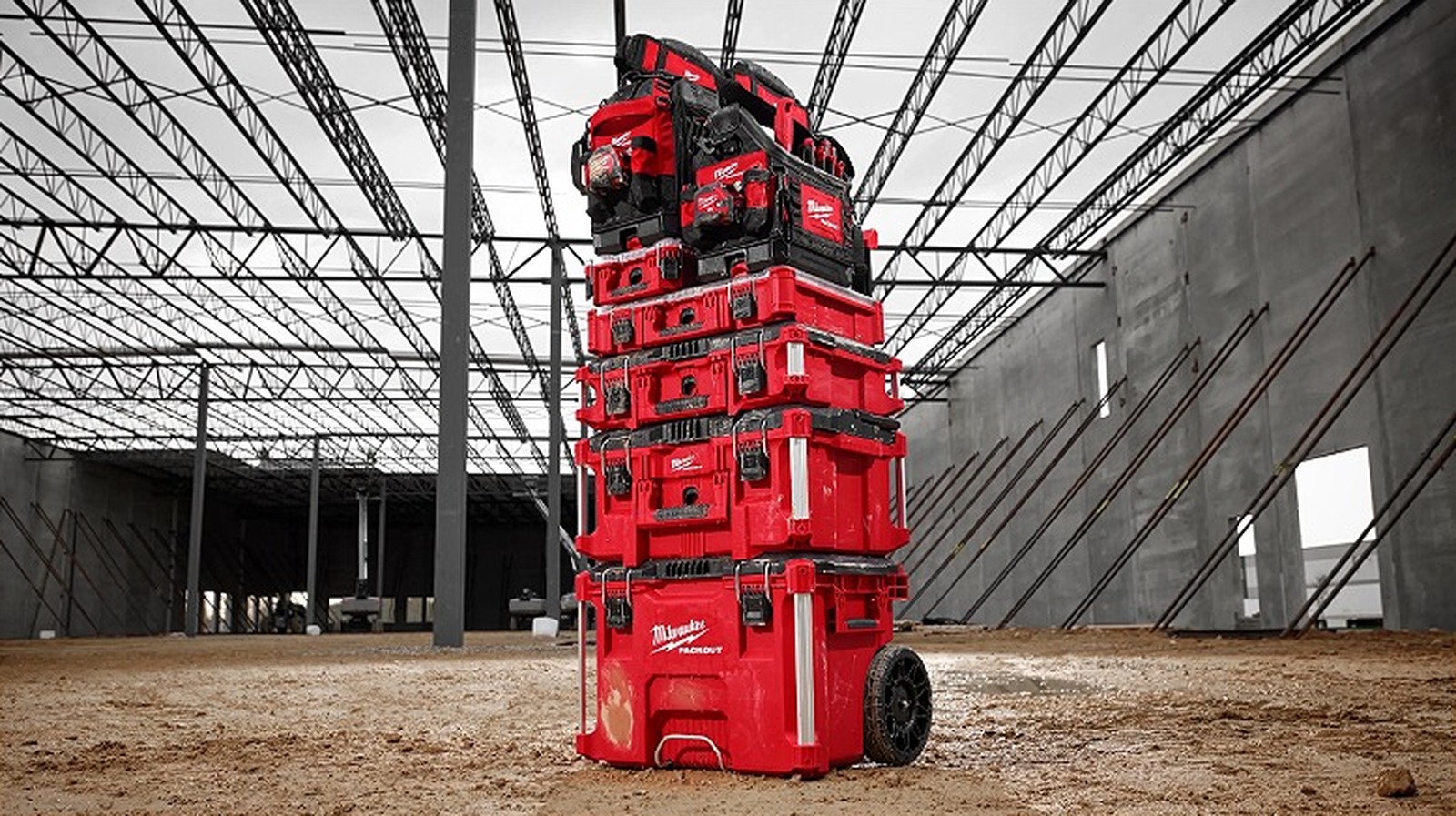

Milwaukee, one of the major tool brands offering a range of hand and power tools, is a go-to name for professionals and hobbyists alike when they want to build or upgrade their tool collection. The same brand offers a Packout collection, which is basically a range of interstackable toolboxes, organizers, and accessories that feature locking cleats on the bottom and slots on the top to bring you a full-fledged modular storage solution. These toolboxes and rolling tool chests also allow for efficient transportation of tools from one place to another via trucks and other transit vehicles.
While the Milwaukee Packout collection offers a wide variety of storage options, some can really keep your tools organized. Hence, we compiled a list of Milwaukee Packout tools you can use to maintain a tidy workspace by keeping them in their dedicated spaces. Most of these products are made of high-quality polymer to add durability and can be stacked with other toolboxes and chests in the range for better usage.
Packout Rack Kit
The Milwaukee Packout Rack Kit is an open-drawer-style standing rack with a durable steel body that holds all types of tools without damage. You can also install this rack inside transit vans, enclosed trailers, and more for when you want to transport bulky tools from one place to another. Each drawer can be set to a desired height, allowing you to adjust the space in each compartment to suit your requirements.
You can use the rack to store multiple toolboxes and organizers from the Packout collection, serving as a haven for all your jobsite tools. All of these are easy to access by sliding the drawers out, rather than unstacking several toolboxes to grab the required tool. Being a great product for transporters and those with full-fledged automotive workspaces, this Packout Rack Kit includes four drawers, one upper rack, one lower rack, and a rack frame, allowing adjustments to leg height.
Packout Rolling Tool Chest
Offering a 250-pound holding capacity, the Packout Rolling Tool Chest is made with impact-resistant polymers, along with an industrial-grade extension handle for durability. There are two nine-inch all-terrain wheels on the back, making it easy to transport to the job site while keeping all your work tools in one place. Plus, it can withstand rough outdoor conditions thanks to its water- and debris-resistant design.
There’s an interior storage tray for keeping the smaller tools, like pliers, screwdrivers, and more, while the deeper compartment below can organize the bulkier power tools like impact drivers and saws. Everything stays securely inside the chest once you lock this organizer via metal-reinforced locking points, which won’t open even during transit. Moreover, there’s a locking lid support for the top lid so it stays firmly in place while you search for the desired tool inside the box.
For neater organization of your tools in the garage or workshop, you can stack other toolboxes on top of this tool chest since it is compatible with the range to create an ultimate Packout setup.
Packout Tilt Bin Organizer
With the Packout Tilt Bin Organizer, you can say goodbye to the hassle of sorting through a mess of screws, nuts, and bolts to find the right part for the job. The organizer comes with two large and eight small bins where you can store all the small parts and accessories with proper labels for careful organization. Each bin can be removed from its compartment for easy access and can hold about 40 pounds of material. The bins lock in place via security bars so they stay in place even during transport. Plus, the impact-resistant polymer body ensures minimal vibration and movement inside the bins for absolute security.
You can either stack this tilt bin on top of other Packout toolboxes or hang it in your space using the handle on top of the design, which also enables smooth handling, by the way. The large bins also have dividers in case you wish to use them for two separate types of accessories. Consequently, it is one of the most useful Milwaukee Packout storage options available.
Packout XL Tool Box
If you are someone whose job includes working outdoors, for instance, a construction worker or an on-site automotive professional, the Packout XL Tool Box can be your go-to storage solution. Being the biggest toolbox in the line, this Milwaukee Packout toolbox will keep all your large and bulky tools in place, like circular saws and rotary hammers, in a deep chest built with a 100-pound holding capacity. Besides, there’s an organizational tray for storing small parts and accessories. The reason it can survive harsh jobsite conditions is the inclusion of an IP65 weather rating, which keeps the toolbox and its contents safe against rain and other weather elements.
Moreover, the impact-resistant polymer body paired with metal-reinforced corners can tolerate shocks and vibrations that occur during transit. You can secure the tools by locking the toolbox with heavy-duty latches and metal-reinforced locking points. The top handle allows for easy movement, and you can also stack other boxes on top.
Packout Structured Tote
The Packout Structured Tote features 39 pockets and can withstand a combined weight of 50 pounds while maintaining its structured shape, thanks to tear-resistant ballistic material in its construction. There’s an impact-resistant molded base that allows the tote to connect seamlessly with other products in the modular collection through locking cleats. Moreover, the all-metal hardwire also helps store larger hand and power tools in the half-open front pocket. Here, you can store the most commonly used tools to keep them within reach.
For comfortable carrying, the tote comes with a padded shoulder strap that goes easy against your shoulders, while the high-quality handle makes it easy to lift. Consequently, the tote can be best used by electricians and plumbers who need their tools visible and well-organized when working away from the shop, for instance, at a customer’s home.

Stephan is the sports journalist for the Maple Grove Report.