
We may receive a commission on purchases made from links.
One of the biggest advantages of being a Ryobi fan is that the brand’s interchangeable batteries power so many different types of gadgets and gear. One day, an 18V One+ battery could be used to power a drill for a DIY project, then the next, it could be used in one of the brand’s carpet cleaners. Following that, it could be used to power a hedge trimmer, then on the weekend, it could serve as the power source for all kinds of camping equipment. It isn’t just the brand’s 18V batteries that are so useful either, since the USB Lithium and 40V lines are similarly versatile.
To make full use of that versatility, you’ll want to make sure you have enough Ryobi products to serve you well both during the week and for those weekend camping trips. Of course, not every piece of Ryobi camping gear is worth spending your money on, but reviews from previous customers can help separate the worthwhile kit from the duds. Based on current review scores, these eight top picks should all be worth spending your money on, although you might want to steer clear of the two less well-reviewed products listed below.
Worth Buying: Ryobi USB Lithium Clamp Fan Kit
Browse through Ryobi’s lineup of recreational products and you’ll find plenty of options to keep you cool over summer. Some get better ratings from reviewers than others, and the USB Lithium clamp fan kit is one of the best rated of the bunch. Unlike some larger fans from the brand’s 18V One+ and 40V lines, the USB Lithium fan comes with everything you’ll need to use it. Alongside the fan itself, Ryobi includes a 2Ah battery and a charging cable.
According to the brand, when the battery is fully charged, it should be able to surpass seven hours of runtime before it goes flat, assuming it’s run on its lower speed setting. Switching it to its higher speed setting drops the runtime to two hours, but it significantly boosts airflow. At its peak, Ryobi says the fan delivers an airflow of 135 CFM. The clamp that’s built into the base makes it particularly useful for camping, since it can be easily attached to tent poles, chair arms, or backpacks.
Just like Ryobi’s other USB Lithium products, the clamp fan kit is covered by two years of warranty as standard. The warranty covers both the fan itself and the included battery and charging cable. Buyers can purchase the kit at Home Depot for $39.97, with a limit of five kits per order.
Worth Buying: Ryobi 18V One+ High Volume Inflator Kit
As well as offering a range of different fans, Ryobi also sells multiple inflators. Campers looking to inflate air mattresses in record time should consider the 18V One+ high volume inflator, which retails as part of a kit for $99. Ryobi claims that it can inflate as many as 55 air mattresses on a single charge, and it takes just 90 seconds to inflate a queen size mattress.
While it’s safe to assume that no campers are actually going to test that first claim, it’s a good way to illustrate just how little battery life a single mattress inflation will consume. If you’re bringing just the one battery on a camping trip, you’ll still be able to use it with multiple other 18V One+ products without worrying about it going flat.
It might not be one of Ryobi’s most popular products, but it’s still one that many users swear by. It gets consistently good reviews at Home Depot, and if you purchase the kit, Ryobi also throws in the 2Ah battery you’ll need to run the tool, as well as a charger.
Worth Buying: Ryobi USB Lithium Cordless Compact Area Light Kit
Even during the longest summer days, all campers will need to keep some kind of lighting handy for when it starts to get dark. If you’re packing light while on a hike, this can be a problem. After all, no-one wants to be carrying around bulky lighting that they won’t use for most of their day. That’s where Ryobi’s USB Lithium compact area light kit comes in.
It’s designed to walk the fine line between delivering enough lighting power and being small enough to attach to the back of a backpack, and reviewers say it gets the balance just right. It’s capable of emitting 300 lumens and can run for up to 52 hours on a charge, but it still measures only a few inches across. The light is IP54 rated too, and so it can withstand adverse weather conditions.
The light kit retails for $29.97 at Home Depot, and like the other USB Lithium products here, it ships with a battery and charging cable. When it’s not needed, the light can be stored on a Link workshop wall, thanks to its Link compatibility, while the included battery can be used to charge smartphones and other electronic devices via its USB-C port.
Worth Buying: Ryobi 18V One+ Verse Clamp Speaker Kit
Whether you prefer a playlist of your favorite songs or relaxing with a podcast, having the right soundtrack is a great way to unwind at a campsite. Anyone who often camps with a large group of friends might assume that a big speaker is the best way to make sure that soundtrack can be heard around the campsite, but Ryobi’s Verse system proves that isn’t always the case. Any Verse speaker can be connected with another for cross-campsite coverage, with Ryobi claiming each speaker can be up to 150 feet apart.
The Ryobi 18V One+ Verse clamp speaker kit is one of several speakers that the brand offers. Not every Ryobi speaker comes highly recommended, but this one does. It’s available for $99.97 and comes with a 1.5Ah battery, which Ryobi says is big enough for up to 32 hours of runtime. The clamp at the base of the speaker means it can be attached to a variety of surfaces, including tables and chairs. When you’re home from the trip, it’ll attach to most workbenches too, since the clamp has up to 1-¾ inch of capacity.
Worth Buying: Ryobi 18V One+ 150-Watt Power Source
It may be compatible used with lots of Ryobi tools, but an 18V One+ battery isn’t much use for anything else on its own. However, with the 150-watt Portable Battery Inverter Power Source, an 18V Ryobi battery can also serve as a means of charging electronic devices and can even power a small TV. The power source connects to the top of the battery pack and features two USB-A ports and a 120V outlet. As long as the combined output stays below 150 watts, all three can be used at once.
While the power source will work with any 18V One+ battery, it’s most useful for anyone who has a high capacity Ryobi battery already to hand. The brand says that a 4Ah battery should be enough to provide a full charge for a laptop, while a 9Ah battery will charge the same laptop more than twice. The same battery could be used to fully charge a smartphone 14 times. The Battery Inverter Power Source retails for $49 at Home Depot in tool-only form.
Worth Buying: Ryobi USB Lithium Verse Compact Speaker Kit
Some campsite-ready Ryobi speakers run using the brand’s 18V One+ battery line, while others are powered by its USB Lithium batteries. The USB Lithium Verse compact speaker kit is one of the best rated products in the second category, and it retails for $99.
It’s one of Ryobi’s toughest speakers, too, with an IP67 rating against dust and water ingress. In theory, that means you could fully submerge the speaker in water for a moment and it won’t miss a beat. It’s not advisable to try it out, but it’s certainly reassuring to know that accidentally dropping it at the lake or at the beach won’t mean you’ll have to buy a new speaker.
The USB Lithium speaker is also equipped with Ryobi’s Verse technology, which means it can be linked with any other nearby compatible speaker. If it’s used at lower volume, the included 2Ah battery should provide 6 hours of runtime before it needs charging. When the battery gets low, the LED light on the device will flash red rather than green.
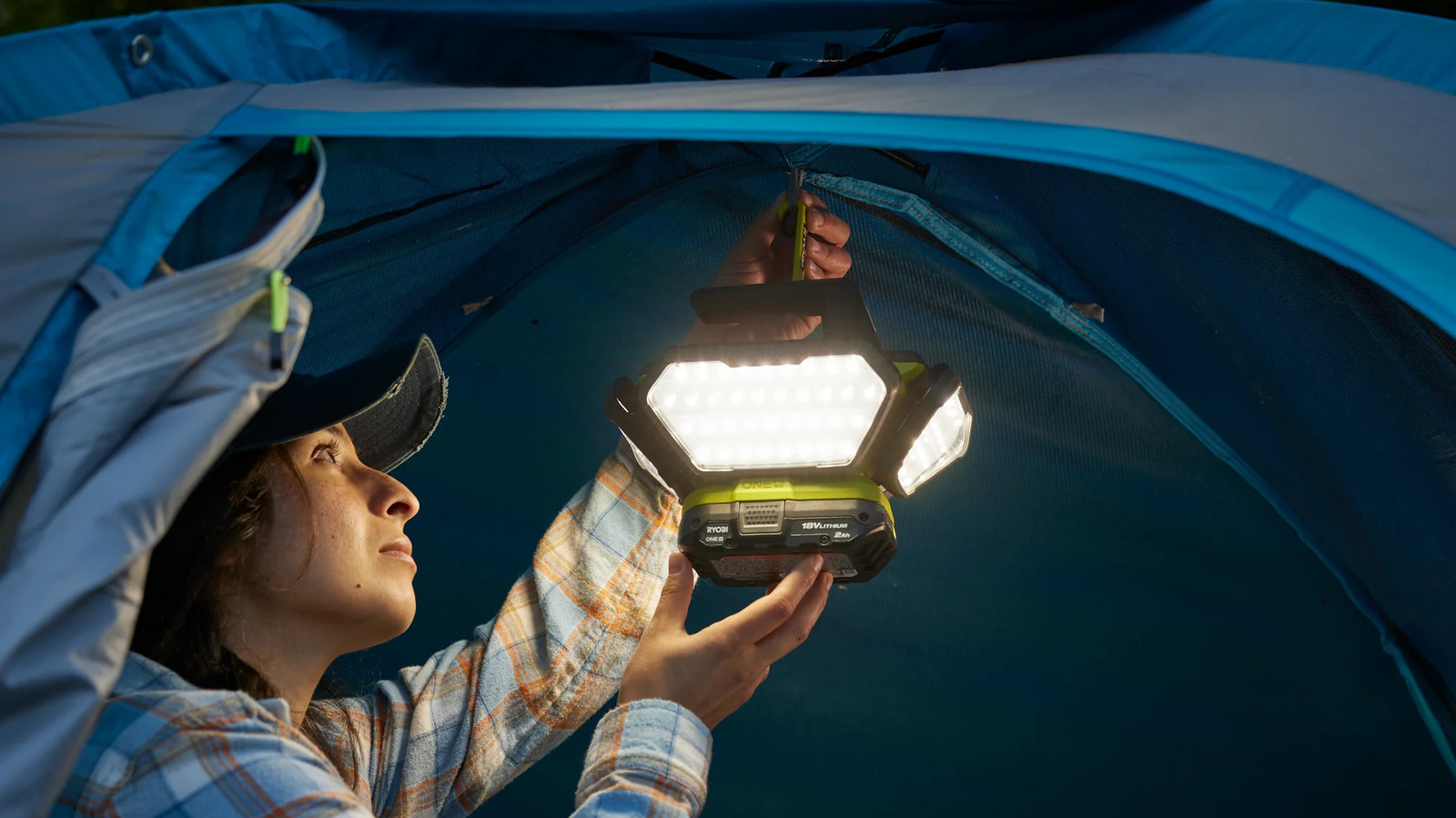
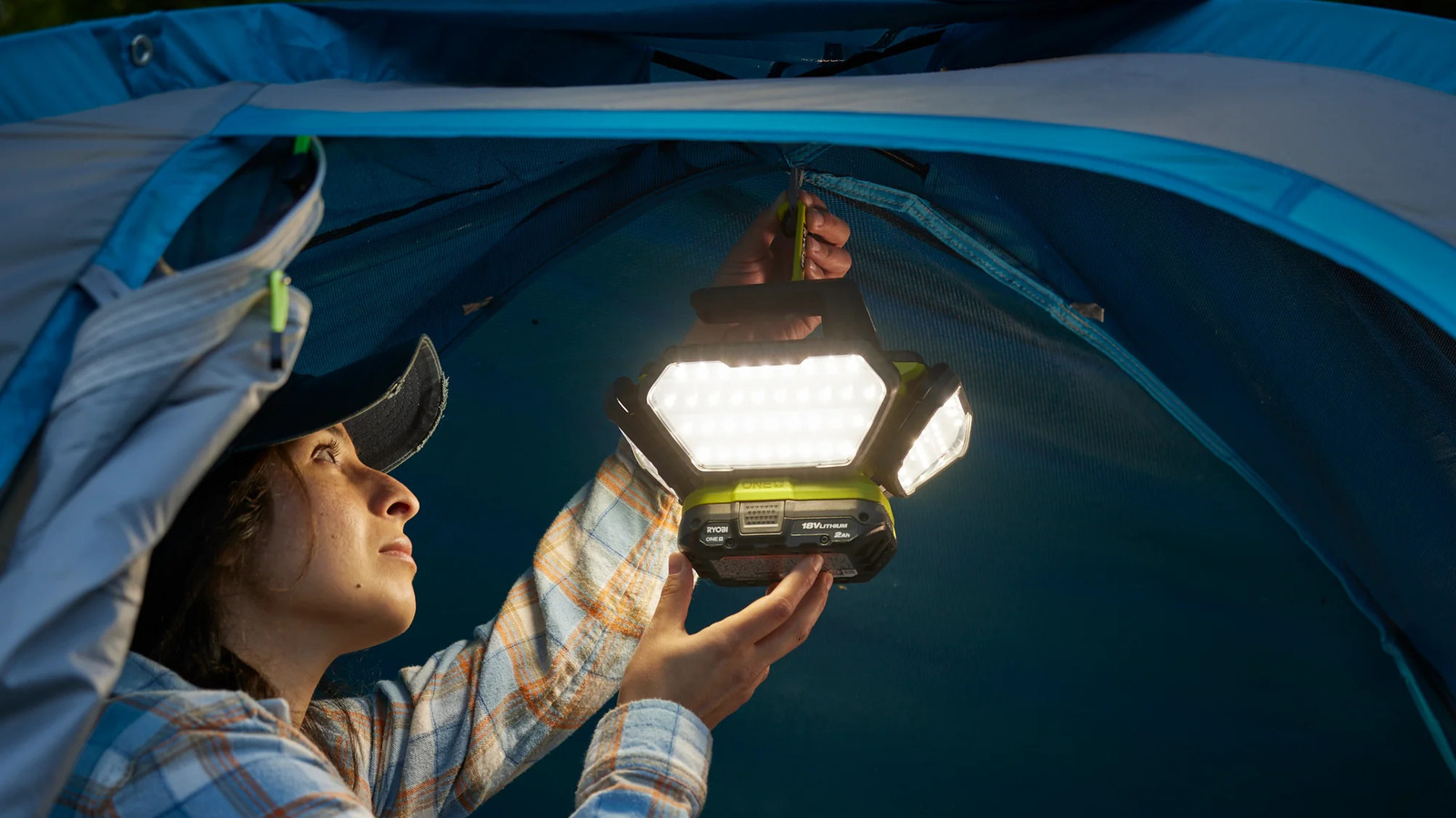
Worth Buying: Ryobi 18V One+ Cordless 360-degree Light Kit
A battery-powered area light is great for illuminating a campsite, but usually, their bulky shape makes them inconvenient to carry around for extended periods. A flashlight is much more convenient, but it can only illuminate a relatively narrow path. Ryobi sells both area lights and flashlights, but it also sells the 18V One+ 360° light for anyone who wants the best of both worlds.
Much like a conventional area light, the 360° light provides all-around illumination, but the carry handle at the top of the light makes it as easy to carry around as a flashlight. That means it’s a great companion for nighttime walks when visibility is limited, particularly if you have children or pets who you need to keep an eye on. Home Depot bundles the 360° light with a 2Ah battery for a retail price of $203, although it’s worth keeping in mind that the bundle does not include a charger.
Worth Buying: Ryobi 18V One+ 7-1/2 Inch Bucket Top Misting Fan
On the hottest days of summer, a simple fan can only do so much. Adding some mist into the mix can help keep things cooler, and that’s exactly where the Ryobi 18V One+ 7-½ inch misting fan can help. It sits on top of a five-gallon bucket (not included with the fan) and draws water up to be projected out of the fan as mist. If there’s a mains water connection nearby, it’ll also connect to a standard hose pipe as well.
Exactly how long the misting fan will last on a charge depends on several factors. A higher fan speed and higher mist setting will use more power and decrease runtime, but a larger capacity battery pack can help offset that extra power consumption. Ryobi recommends using a battery pack that’s no larger than 6Ah, otherwise its IPX4 splash resistance might be compromised.
With the largest recommended battery pack, the brand says the fan will run for over 5 hours on a full charge. It stops short of all-day coverage then, but reviewers have very few complaints about its runtime. In fact, they haven’t found much to dislike about any other aspect of the fan either. Many of those reviews were written when the fan retailed for $79, but it’s now even cheaper. It has received a permanent price cut to $69, cementing its status as one of the best power tool misting fans to keep you cool.
Avoid: Ryobi 18V One+ Compact Cordless Radio With Bluetooth
Many of Ryobi’s outdoors speakers are well liked, but not this one. The brand’s 18V One+ Cordless Compact Radio, product code PCL600B, gets far worse ratings than the rest, with an average user review rating of just 3.6 out of five stars at the time of writing. A string of reviewers claim that the radio in this compact radio doesn’t work well, and several of them say they previously owned an older version of the product that worked better.
At first glance, the radio’s spec sheet looks good. It reportedly runs for over 32 hours on a single charge, it can connect to Bluetooth-enabled devices up to 175 feet away, and it features a USB port for charging small electronic devices. However, none of that matters if its core radio function isn’t up to par. At a price of $59.97, it’s not like the Ryobi radio is especially cheap either, making it well worth avoiding if you’re planning on tuning into an FM station while you’re camping.
Avoid: Ryobi 40V 300-Watt Portable Power Source With 4Ah Battery
Another Ryobi product that receives mixed reviews is the 40V 300-watt portable power source, which Home Depot bundles with a 4Ah battery. At a retail price of $278, the bundle isn’t a small investment, which makes the minority of dissatisfied reviewers a little worrying.
The vast majority of negative reviews take aim at the included 4Ah battery, with many saying that the battery life can drop dramatically over a relatively short period of time. Some reviewers report that it only took a few charging cycles for the battery life after a full charge to drop below a useful level, making the battery itself useless.
The portable power source runs using a 40V battery, and it won’t be much use on a camping trip if the battery dies. Given its hefty price and questionable longevity, it’s best to steer clear of this particular pairing.
How we found these Ryobi camping products
When choosing top-rated camping products for this list, we prioritized picks that showcased the best of Ryobi’s innovation and value for money while also receiving consistently good feedback from Home Depot reviewers. Each pick that we deemed to be worth buying had an average score of at least 4.5 out of five stars from at least 200 reviews.
Conversely, each piece of Ryobi camping gear we thought was worth avoiding had an average rating lower than four stars, making them some of the worst-reviewed Ryobi products in its segment.

Stephan is the sports journalist for the Maple Grove Report.