In the car enthusiast world, it’s pretty common for popular or historically notable vehicles to have nicknames — which at times can become as well known as the car’s real model name. These names can be used intentionally by the manufacturer during the car’s marketing campaign, or others can spring up unofficially from owner communities or the automotive media.
Some of these nicknames have serious aura, as the kids might say today, helping to increase the car’s notoriety. This was the case, for example, for the Widowmaker Porsche 911 Turbo, the Mercedes-Benz AMG Hammer, and the Ford Mustang Cobra Terminator. One of most well-known of these unofficial nicknames is Godzilla, which enthusiasts have long dubbed the Nissan Skyline GT-R thanks to its Japanese roots and world-crushing performance.
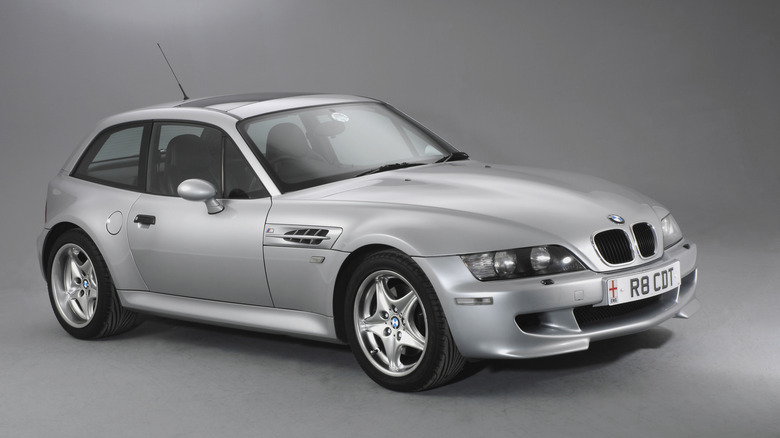
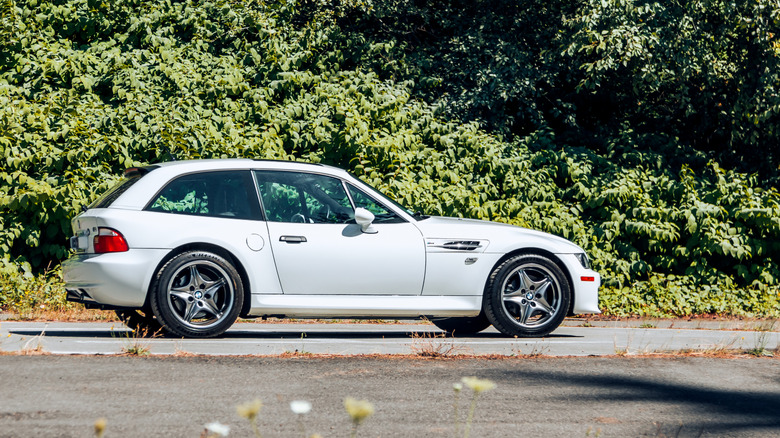
Sometimes, however, these unofficial nicknames don’t have quite the same ring to them. That brings us to the 1999-2002 BMW Z3 M Coupe, which has long been referred to by enthusiasts as the “Clown Shoe.” This nickname comes from the vehicle’s unusual side profile that looks like — well, a clown’s shoe. It’s a bit of a silly nickname, and certainly not one that would intimidate its competition. Nevertheless, the Z3 M Coupe’s abnormal look is a big part of what has made the car a certified modern classic.
This roadster became a unique hatchback
Even if the Z3 M Coupe’s shoe-like looks aren’t for everyone, there’s no denying that the car’s performance and the fascinating story behind the Z3 M’s secret development aren’t noteworthy. The car is based on the BMW Z3 sports car, first introduced in the 1990s as a two-seat, open-top roadster that, as its name suggests, uses BMW 3-Series underpinnings. As with the normal 3-Series, early, base versions of the car used a four-cylinder engine, with a more powerful inline-six coming a little later.
Then there was the Z3 M Roadster, which took the BMW M3’s drivetrain and dropped it into a more aggressive-looking Z3 — basically creating a smaller M3 with a convertible top. Yet, as an open-top Roadster, the Z3 didn’t have the same rigidity as a fixed-roof coupe, so a team of BMW engineers got together and decided to turn the Z3 into one. Typically, an existing coupe model is turned into a convertible — but with the Z3 Coupe, BMW did it the other way around.
Although it’s called a coupe, the fixed-roof Z3 M’s shoe-like profile is more akin to a hatchback, station wagon, or shooting brake than it is a traditional sports coupe. Still, its strange look had a very functional purpose, allowing for vastly improved rigidity from the roof structure, a strengthened windshield, and additional chassis reinforcements. Not to mention, the vehicle’s design permitted a near 50-50 weight distribution and a surprisingly roomy rear cargo area.
The BMW Z3 M Coupe had a silly name but was a serious car
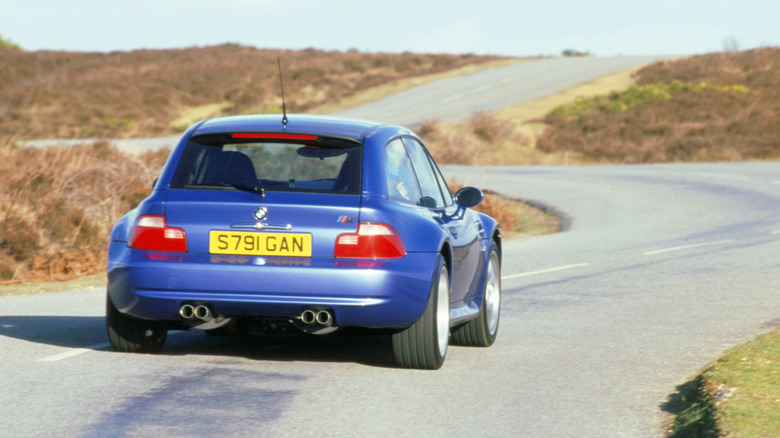
The later versions of the Clown Shoe are considered the most potent and desirable, as they use the E46 M3’s S54B32 inline-six engine, capable of making 325 horsepower. The Z3 M Coupe was an unusual experiment for BMW, but it was not the last of its kind. BMW would follow up the Clown Shoe with another, high-performance coupe based on the next-generation Z4 roadster — but that car had a more traditional, swooping fastback roofline rather than the Z3’s upright shooting brake profile.
Even with the Clown Shoe’s unconventional looks, the car’s improved performance and unmistakable profile have made it a favorite among BMW enthusiasts and collectors. With fewer than 6,300 examples built in total, and less than half of those sold in America, the Z3 M Coupe’s rarity is another big reason the car has emerged as a modern classic. Pristine, ultra-low-mileage examples of this vehicle are now going for over $100,000 at auction.
While the increasingly powerful open-top BMW Z4 has stuck around, the fixed roof, coupe variant of the Z4 was discontinued back in 2008. Interestingly then, it might be the modern Z4-based, fixed-roof Mk5 Toyota Supra that’s the closest spiritual successor to the original Z3 M Coupe. Just don’t expect the same unusual body shape and funny name to go along with your BMW-built Toyota.