


Maple Grove Daily

Maple Grove Daily

Subscribe to Our Newsletter

Get our latest articles delivered straight to your inbox. No spam, we promise.


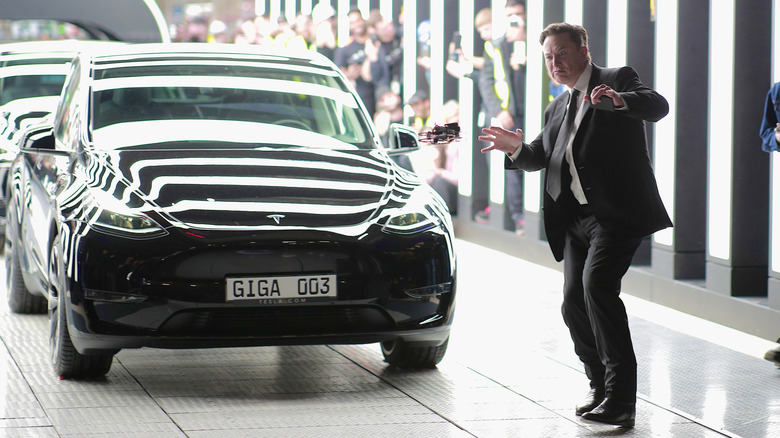
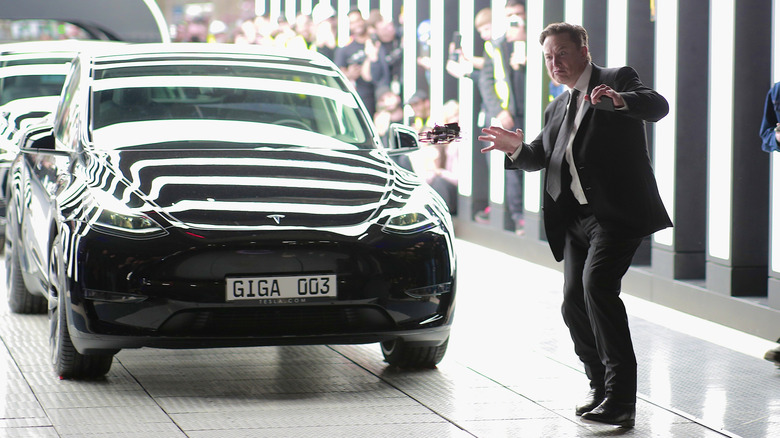
Elon Musk is many things — a billionaire, a rocket builder, a social media provocateur — but first, he’s a car guy. Long before he was running Tesla, he was spending his first big paycheck on a McLaren F1, which he believes is the best car in the world. Since then, his relationship with cars has only grown more complicated and mysterious.

Tesla, the company he joined in 2004 and has led since 2008, has grown from a single-model electric car startup into one of the most influential automakers on the planet. Its lineup has spanned the Model S, Model 3 Model X, Model Y, and the Cybertruck, though Tesla has since discontinued the Model S and the Model X. Regardless, Musk has driven, tested, or been spotted in most of them at one point or another.

So which Tesla vehicles does the CEO actually drive? Back in 2019, Musk revealed on X that his day-to-day rotation included the Model S Performance — equipped with the then-new Raven motor — along with the Model 3 Performance, and the Model X when he had his kids in tow. Since then, he’s been spotted in newer models, including a Cybertruck prototype in Austin.

While Musk rarely updates the public on his garage, the Model S remains the Tesla most closely associated with him, alongside more recent appearances in the Cybertruck. His most famous Tesla, however, is still the original Roadster that SpaceX launched into orbit aboard Falcon Heavy in 2018. These are the Tesla models Elon Musk actually drives or has driven.

A closer look at Elon’s Teslas

Musk’s relationship with the Model S goes back further than most people realize. As early as 2015, Time Magazine reported he said at Tesla’s annual shareholder meeting that “I’m testing the latest version of autopilot every week. Typically, two or three builds per week that I’m testing on my car.” By 2018, when he appeared on The Joe Rogan Experience #1169, he confirmed the Model S was still his go-to, saying directly: “Model S P100D. That’s the car that I drive.”

By 2019, he had upgraded. In the aforementioned 2019 post on X, Musk revealed his Model S had been fitted with an adaptive damping suspension in addition to the Raven motor, along with a development version of the FSD computer that had not yet been made available to the public. The Model X is also the Tesla with a most personal backstory behind it. During a 2012 interview with Autoblog, Musk criticized the Audi Q7 he owned at the time for its notoriously difficult third-row access, saying that “you need to be dwarf mountain climber to get into the back seat.”

That frustration directly shaped the Model X. Musk said in the same interview that the Falcon wing doors were his idea, born out of a need for a door that could open in tight spaces while still allowing access to the third row without moving the second-row seat. Although these Falcon doors have proven to be quite problematic, In his 2019 X post, he confirmed the Model X remains his go-to when driving with his kids.

Elon Musk’s car collection

Although information on the Tesla models Elon owns and drives is somewhat limited, his broader car collection is more publicized. Likely the most expensive car in Elon Musk’s collection was the McLaren F1 — and we say “was” deliberately, since Musk no longer owns it. After crashing it while uninsured, watching it catch fire, and having it undergo a complete rebuild by McLaren Special Operations, he sold the car in 2007.

One of the oldest cars in Musk’s collection was the 1920 Ford Model T reportedly gifted to him by one of his friends as a symbol of how it changed the automotive industry and how Musk does the same. A well-known vintage also owned by Musk is the 1967 Jaguar E-Type roadster. Likely one of the coolest cars in his collection is the 1976 Lotus Esprit “Wet Nellie,” a car used in the 1976 “The Spy Who Loved Me” James Bond movie.

Musk’s collection also included a few older German luxury cars like the 1974 BMW 320i (his first car), a Hamman-modified 2005 BMW M5, and the 2010 Audi Q7 he criticized when talking about Model X Falcon doors. Musk’s 2012 Porsche 911 Turbo was actually directly tied with his connection with Tesla. When Musk offered AC Propulsion’s Alan Cocconi $250,000 to convert his Porsche 911 Turbo to electric, Cocconi refused. 

It was then that AC Propulsion’s CEO Tom Gage suggested Musk speak with Martin Eberhard, who had just launched a small electric car startup called Tesla. In the same Joe Rogan podcast we mentioned above, Elon noted that the Jag and the Ford are the only two gasoline cars he owned at the time, meaning that the majority of the collection is no longer his.





Source link


Seven games into her nascent WNBA career, Olivia Miles strolled into the press conference room at Target Center last week as if it were her living room. It might as well be, given how often she’s in there to talk about her game, and her easy manner with reporters.

Suddenly, Miles stopped. “It’s cold in here!” she said, an understandable reaction from someone still in her game shorts and a black tank top. Like everything else with the flashy rookie point guard, this observation was spot on; the Lynx keep the room as cool as a supermarket dairy aisle. Then Miles took a seat on the riser next to veteran forward Natasha Howard and began fiddling with Howard’s left ear, like an annoying little sister.

“What’s wrong with you?” Howard said.

Honestly? Nothing. 

Five nights later, in Phoenix, Miles delivered her best performance yet, spurring the Lynx from the jump in a 111-77 blowout. She went 4-for-4 from the field and 3-for-3 from the foul line in an 11-point first quarter, pushing the Lynx to a 35-22 lead. Miles finished with 19 points, 10 assists, four rebounds and three steals, making her the only WNBA rookie besides Caitlin Clark to post a 19+ point/4+ rebound/3+ steal game, per the Lynx.

But even that stat line couldn’t adequately capture her impact. Coach Cheryl Reeve told reporters at the postgame press conference that some of Miles’s flashy passes elicited gasps from Lynx assistant coaches and support staff on the bench. Reeve didn’t specify which ones, but here’s one possibility: The bounce pass between two defenders in the third quarter that newcomer Teaira McCowan, running the floor ahead of the field, converted for a layup.  

“I think she’s a better passer than I was, especially a lot of those windows she’s able to find,” said Lynx assistant coach Lindsay Whalen, the Naismith Basketball Hall of Famer and the club’s last truly great point guard.

All this from someone Courtney Williams called “a little baby Chelsea Gray” on Opening Night — Opening Night! — after her 21-point, eight-assist pro debut. 

Few rookies have made the transition from college to pro as seamlessly as Miles. She scored in double figures in the first 10 games of the season, breaking the club rookie mark shared by Seimone Augustus, another Naismith Hall of Famer, and Tonya Edwards. Conspicuously absent from that list: Hall of Famer Maya Moore, a rookie on the first Lynx championship squad in 2011.

Thursday night against Golden State, Miles broke the league rookie record for three-pointers in a game (eight) en route to a season-high 28 points — this after making only two of 18 attempts beyond the arc before Thursday. Going into Saturday’s home game against Seattle, Miles leads all WNBA rookies in scoring (17 points per game), assists (6.4), steals (1.5), and minutes (30.4). Named WNBA Rookie of the Month for May, Miles is already top of mind in Rookie of the Year talk.

With Miles making such an immediate impact — she’s one of four starters averaging in double figures, along with Williams, Kayla McBride and Howard — the Lynx own the league’s best record (8-2) and net rating (13.0) without a single big-name free-agent signing. Who expected that?

“We like what’s happening with the starting group a lot,” Reeve said.

Already, Miles is known for her no-look passes; her full extension, block-it-if-you-can right-handed layups; her lobbying of the officials, something generally reserved for veterans; and a kind of East Coast confidence and panache (she’s from New Jersey) rarely seen in these parts, at least on the women’s side. 

Whalen marvels at how quickly Miles adjusted to the league.

“Her ability to put pressure at the rim is something that can take people some time because the speed of the game is faster than college, and some of the posts are very athletic and can get to different spots,” she said.

“She’s done a really good job of getting herself in those positions where she can finish or kick out. You see a lot of the highlight plays and reels and stuff like that, but I think her consistency of getting in the paint was something we just weren’t sure of, because this league is such a tough league. It’s been fun to see.”

Last week, with the Lynx finishing off a 96-81 victory over Atlanta, Miles tried to thread a bounce pass between Dream guard Jordin Canada’s legs, the kind of showy move that embarrasses the defender if it works. This one didn’t; the ball hit Canada’s foot. What did her coach, the one with the South Jersey/Philly roots, think of that?  

“I want her to be herself, her confident, authentic self, whatever that is,” Reeve said. “Same thing we say to all of them: If there’s something we don’t like, then we’ll share it if it needs to be different. But we want her to be herself, for sure … If I see something, I might yank her back a little bit. But in general, I want her to go.”   

Toronto Coach Sandy Brondello, who led Phoenix and New York to WNBA titles before landing with the expansion Tempo, isn’t surprised to see Miles do so well so soon.

“We knew she was always going to be a great player in this league,” said Brondello, who has her own standout rookie point guard in Kiki Rice. “She’s like a generational point guard. We haven’t had many for a while. 

“Just her ability to pass the ball in the pick and roll, she’s great. This is a team that loves the pick and rolls anyway. She gets downhill. She can finish. But she’s also a great passer. She sees the whole floor. A great young talent to build around.”

The second overall pick in this year’s college draft, Miles earned two degrees at Notre Dame before finishing with a final season at Texas Christian. She arrived at Lynx training camp a little jittery about running point for a team of seasoned veterans with a winning history. 

“I came into the W like, kind of scared of that, stepping on toes,” Miles said. “People have been champions and people have won a lot of awards and done it before. I didn’t want to come in and upset anyone. But it was so easy. The culture, people just want to win. I’m very blessed, and I know this is very rare.

“There are absolutely no egos. Court (Williams), the second I stepped on the court was like, ‘Go run the one and I’ll be your running mate.’ It’s so easy with her. She’s in her natural position where she’s thriving. She’s playing some of her best basketball that I’ve seen. So yeah, it’s so easy to play with her and so easy to play with everyone when you have people willing to let you be you and trust you.” 

At TCU, Miles said she refined her efficiency in the pick and roll game, a skill that transfers perfectly to the WNBA. Howard, a 13-year veteran who joined the Lynx in free agency after previously playing here for Reeve in 2016-17, has been the primary beneficiary, turning multiple passes a night from Miles into easy layups. 

“It’s unbelievable,” Howard said. “She sees things before they happen. She’s got in her head what she wants to do before the play even starts.

“I’ve got to make sure my hands are ready at all times. I never know when she’s going to pass it.”

Howard said she established pick-and-roll chemistry this quickly with only three other point guards in her career, all WNBA greats: Sue Bird in Seattle, Sabrina Ionescu in New York, and Whalen with the Lynx. Miles said it came easily. 

“She’s just cerebral,” Miles said of Howard. “You don’t really have to tell her where to screen or how to screen or what screening works or how they’re guarding it. She just kind of knows. It’s so easy as a guard playing with her, because I don’t have to direct her anywhere. It’s just kind of a natural energy.

“When both of us have that synergy, it’s really hard to stop us. And obviously she’s so skilled inside so when you give it to her, she scores.”

This was an unprecedented offseason for the Lynx. Virtually every veteran in the league became a free agent ahead of the new collective bargaining agreement, and four key contributors — league co-defensive player of the year Alanna Smith, Jessica Shepard, Natisha Hiedeman and DiJonai Carrington — signed elsewhere. 

Superstar Napheesa Collier, still recovering from two ankle surgeries, only agreed to a one-year deal, sending Lynx fans into a panic that she was looking around as well. The Lynx also lost starter Bridget Carleton and reserve Maria Kliundikova in the expansion draft.

But Reeve found two underappreciated veteran free agents, Howard and Nia Coffey, who start and fit in well with the already established group. Williams, the point guard the last two years, thrived after moving back to the wing, her natural position. 

And those of us who thought the Lynx should have drafted UCLA center Lauren Betts instead of Miles … well, we clearly forgot this basketball truism: Nothing raises every team’s game faster than a savvy point guard.

“You can call her a rookie if you want to,” Reeve told reporters in Phoenix. “She’s just always ready for the moment.”


Source link

Recent Reviews