How Happy Were the Knicks’ Fans?


Knicks fans were euphoric after their team’s historic Wednesday win. During game four’s last moments, they overcame the Spurs’ 27 point lead.

Economists have studied our emotions after our team wins and when it loses.

There is more sadness than we expect.

Losers’ and Winners’ Emotions

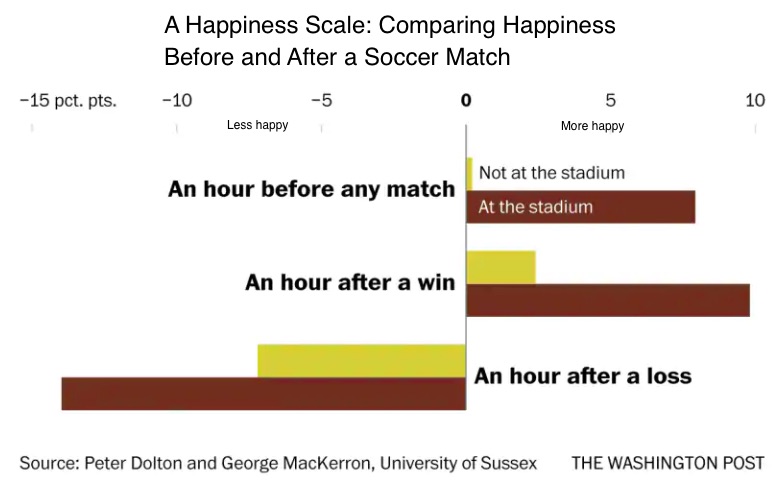
In a 2018 study, economists monitored the happiness of 32,000 fans during 3 years of British soccer matches. Controlling for variables like the time of day and location, they observed happiness fluctuations before, after, and during the games through a smartphone app. On their scale, fans were 3.9 points “happier than usual” with a win for their team and 7.8 points sadder if their team lost.

And it gets worse. Because the losers’ sadness lasts longer than winners’ happiness, those down feelings are close to four times any upside that winning created.

Furthermore, attending the game intensifies how you feel. In Madison Square Garden, the happiness surge could have been three-to-four times higher than those of us watching from home. Even before the game began, in-stadium fans experienced a burst of pleasure.

Similarly, the night before when the Knicks lost, the fans in MSG, would have experienced a drop of 14 happiness points rather than the 7.8 point average. Also, they suffered more than the home audience.

Below, you can see that people felt the pain of loss more acutely than the joy of winning:
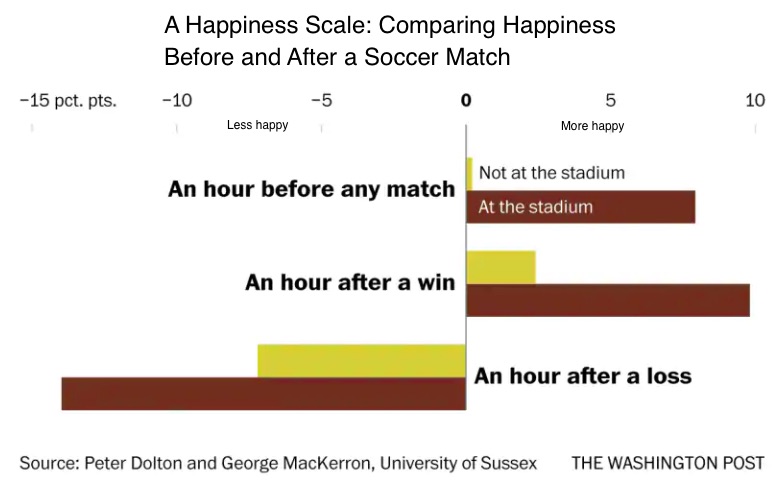
measuring happiness at the World Cup


Investing

University of Chicago economist John List suggests that investors ignore stock market fluctuations because they too feel loss more intensely than winning. People who are down $1000 experience the drop more so than if they had been up by the same amount. The result? Most of us sell when stock prices plummet…precisely when we should be patient. Or, we hold on too long because we want to avoid the reality of a loss. Either way, the pain of loss makes us sell at the wrong time.

Our Bottom Line: Loss Aversion

Called loss aversion by behavioral economists like Nobel economics laureate Daniel Kahneman, our desire to avoid a loss affects how we feel and act. For many of us, the dismay over losing a $10 bill exceeds the happiness we feel when we find one:


loss aversion


Hard to believe, but based on the Sussex study, there was more sadness in the world after the Knicks won.

My sources and more: Seeing so many happy Knicks fans reminded me of this Washington Post article.  A perfect summary, the Post article then linked to more detail from the University of Sussex. I also referred to ESPN for game four details.

Please note that several of today’s sentences were in a past econlife post.

The post How Happy Were the Knicks’ Fans? appeared first on Econlife.


Source link

Leave a Reply

Subscribe to Our Newsletter

Get our latest articles delivered straight to your inbox. No spam, we promise.

Recent Reviews


Google is experimenting with a new policy restricting the amount of free storage provided to some accounts. New Google accounts (including new Gmail accounts) created in certain regions will be limited to 5GB of free storage when they’re first set up. That’s only one-third of the amount of storage that has been typically offered. There is a way of increasing the amount of free storage you get when setting up a new account, though: you can unlock it by linking your phone number.

When approached for comment by Android Authority, a Google spokesperson confirmed that the new policy was being tested to “help us continue to provide a high-quality storage service to our users, while encouraging users to improve their account security and data recovery.” The statement didn’t clarify which regions the policy is being tested in, nor for how long the testing period will last.

Notably, a Google One Help support page about account storage has been updated to state that each Google account contains “up to 15 GB of storage”, as noted by 9to5Google. Previously, the page didn’t say “up to”; it simply stated that accounts come with 15 GB of storage. So far, the experiment doesn’t appear to stretch to pre-existing accounts.

Per a screenshot shared by Reddit user Sungusungu on R/DeGoogle (a subreddit dedicated to finding alternatives to Google services and products) Google is collecting phone numbers to make sure that the full 15 GB of storage is only redeemed once per person. Of course, that’s easily evaded by using a burner phone to set up multiple accounts, should you want to. The pop-up directs users to a webpage to learn more about storage management. However, at the time of writing, the link redirects to the help center landing page instead.

How to link your Google account with a phone number

If you’re in the process of setting up a new Google account in an impacted region, then you might be prompted with the option of unlocking an extra 10 GB of storage using your phone number via a simple pop-up menu. If so, you can go ahead and follow those steps. However, if you want to link your phone number with a pre-existing Google account, then here’s what you need to do. Using your computer, you need to:

  1. Open your browser and head to myaccount.google.com, then navigate to “Security and sign in” on the left-hand toolbar. This should open a list of security options.

  2. Select “Use your phone to sign in” and then “Set it up”. 

  3. Add a phone number using the “Recovery phone” option.

  4. Follow the on-screen steps to verify your number and finish linking it to your account.

Your options might look a little different if you already have a recovery number set up with your account.

Alternatively, you can connect a phone number to your Google account from your Android device, iPhone, or iPad. Much like on a computer, you connect your number by adding it as a recovery phone. First, head over to myaccount.google.com. Then select “Personal info”, followed by “Phone”. From there, you should be able to add or edit your phone number by navigating to the “Recovery phone” section.


Source link