What Popular Baby Names Can Signal


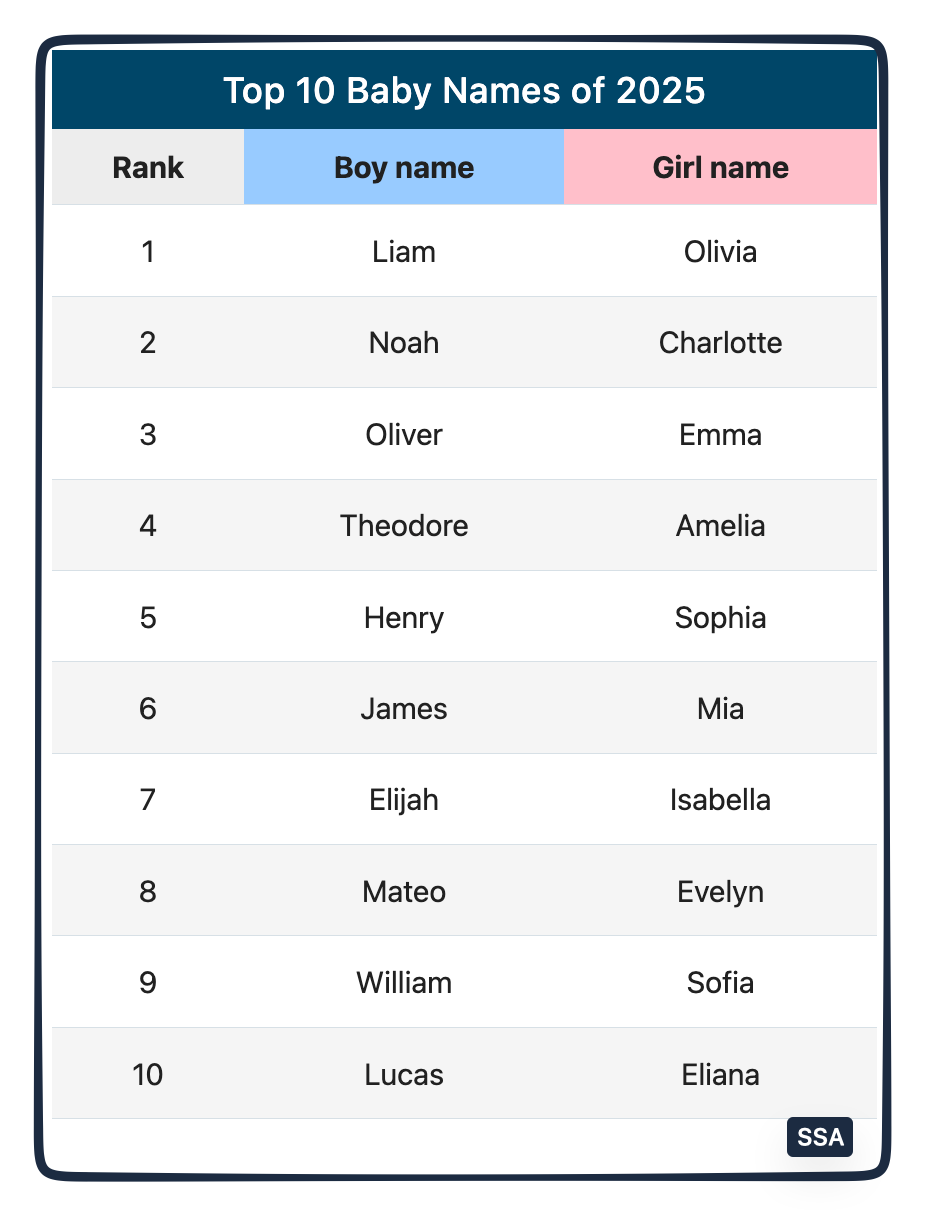
For Liam it was the ninth straight year and Olivia’s seventh as the most popular baby names in the United States:
most popular baby names 2026

When parents apply for their baby’s new Social Security card, the Social Security Administration (SSA) records the names. During 2025, 20,818 selected Liam and 13,544, Olivia. Meanwhile, among the girls, popularity surged for Ailany (from #101 to #14) and Sienna (#139 to #94). With boys, it was Eithan (#227 to #97) and Atlas (#101 to #75) that grabbed more parents.

Our question though is why, why do parents select certain names?

The Message From a Name

Referring to Washington D.C.’s new parents’ baby names, a consultant said they were “résumé-ready.” Classic, the names in the boys’ top 10 included Charles and John while conservative names like Francis, Helen, Ann, and Rose were more popular in D.C. than elsewhere.

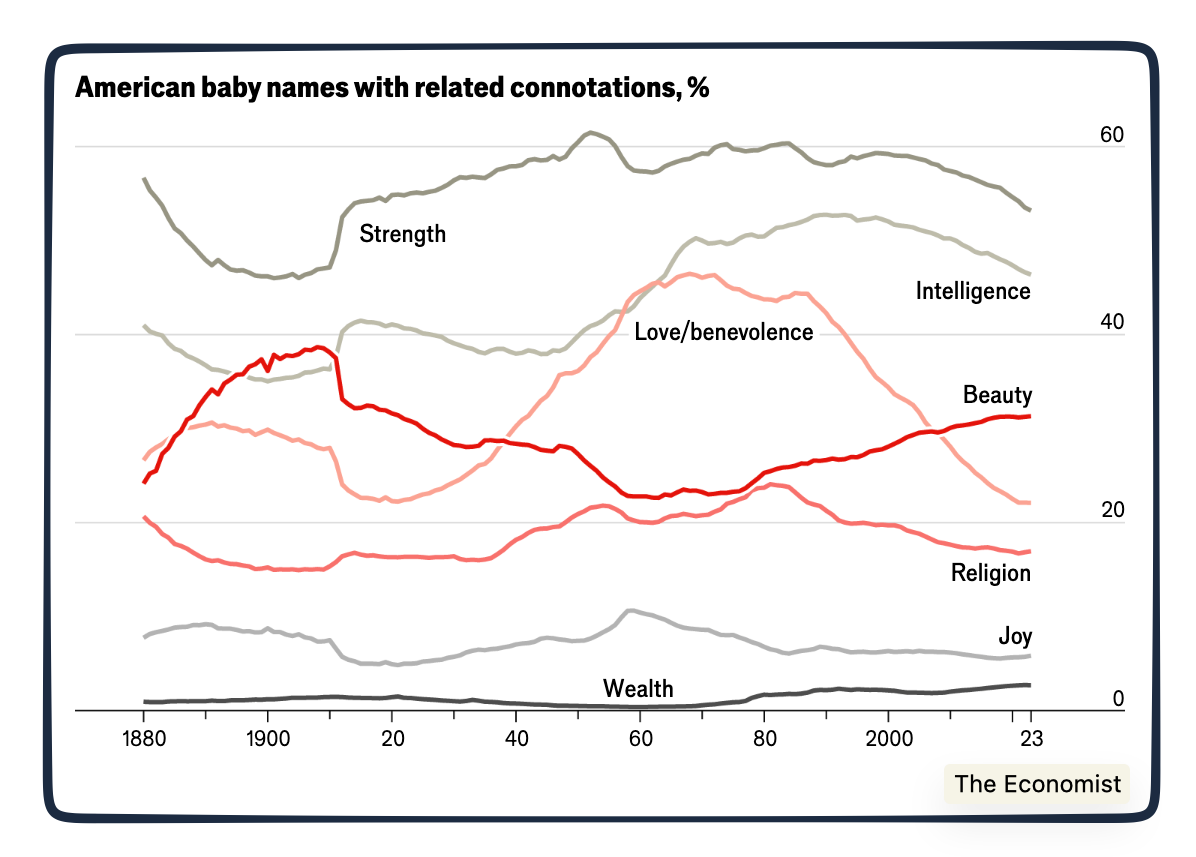
Curious about what names tell us, The Economist used AI to analyze 143 years of nearly 400 million baby names in the U.S. and Great Britain. To see the connotations, they used word clusters. The results indicated that Olivia, Emma, and Charlotte evoke elegant associations while boys’ names like Liam and Noah tilt to power and strength. And a few parents (thinking of luxury?) selected Aston (#3723 in U.S. births) for their boy or girl.

You can see below that beauty and money are on the upswing. By contrast, names that connect to religion, love, and joy plunged in popularity:
popular baby names


Our Bottom Line: Signaling

While I am not sure about the academic rigor for some of the baby naming research, I do believe that many parents say something through their children’s names. A behavioral economist would say that they send a signal.

By signaling, we are using a very specific act to convey a much broader message. Politicians vote for the death penalty to show they are tough on crime. Someone shops at Annye’s Organics to demonstrate concern about the environment. And you name your little boy Stirling to display his monetary future.

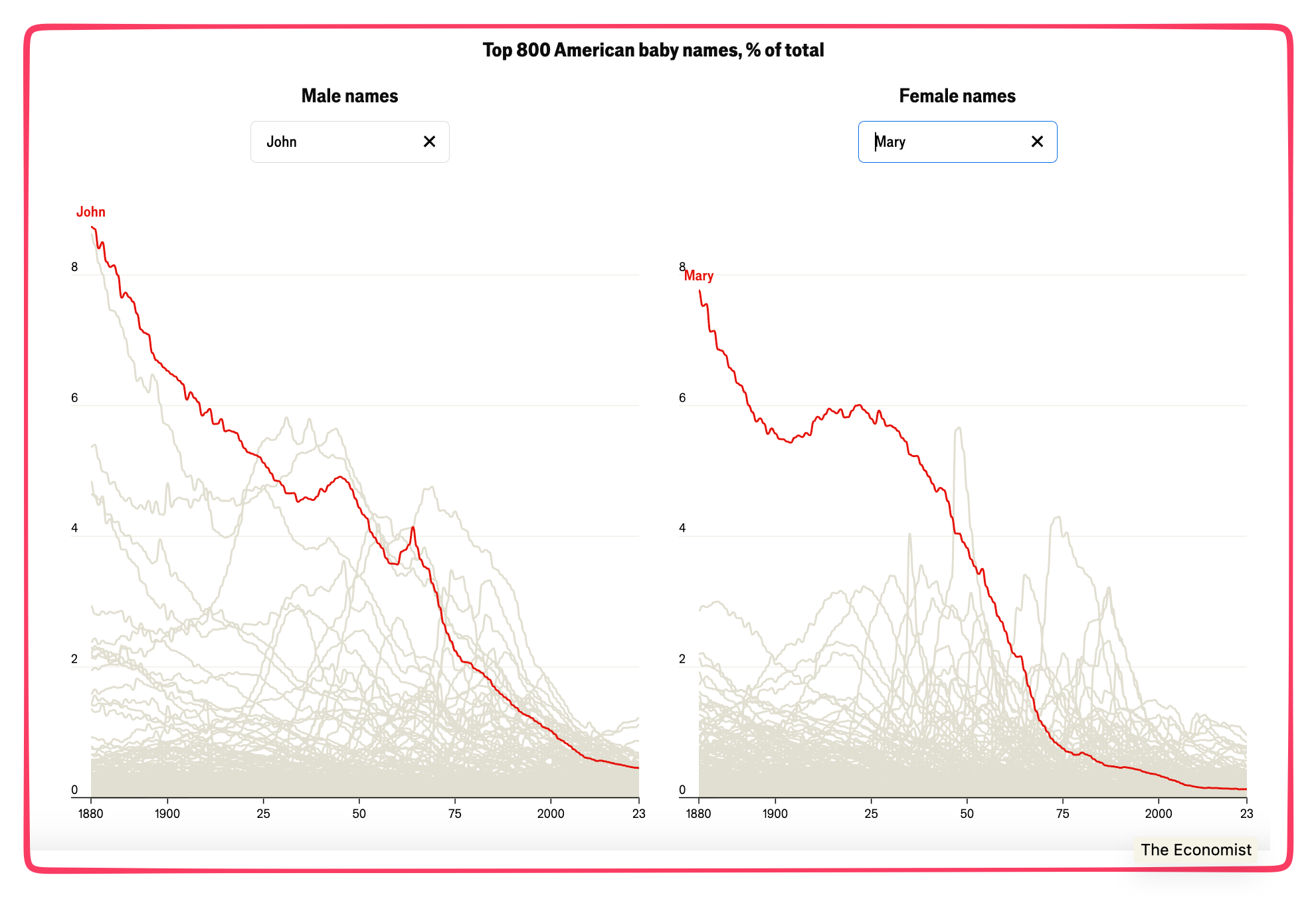
Perhaps not what the parents of future entrepreneurs want to signal, John and Mary will always convey a classic conservatism:
popular baby names


My sources and more: While SSA was the logical starting place for today’s post, there is so much more. After the basic baby name list, we went to The Hill, The Economist, The Washington Post, and Yahoo. But best of all, I recommend returning to the Freakonomics podcast, “How Much Does Your Name Matter?”

I did want to add (and am not sure of the significance) that, with Texas, NJ, and NY selecting Emma as #1, sometimes red and blue states do agree.


Source link

Leave a Reply

Subscribe to Our Newsletter

Get our latest articles delivered straight to your inbox. No spam, we promise.

Recent Reviews


Researchers in South Korea developed a wearable system that uses seven smart rings to read finger and hand motions to translate American Sign Language and International Sign Language into text. The purpose is to make communicating easier between those who sign and nonsigners without needing a separate human interpreter. 

AI Atlas

According to the study, published Friday in the journal Science Advances, the system reliably recognized 100 ASL and ISL words during testing. It also performed well with users the system had not seen before, and it didn’t require recalibration for each person. Because the system detects words in sequence, it can produce sentence-level translations without extra training on grammar. 

ASL and ISL are the everyday languages of more than 72 million deaf and hard-of-hearing people. However, most hearing people do not know any words in these languages or have a very basic understanding. That gap makes certain tasks, like ordering at a restaurant or asking for help, much more difficult. 

A graphic shows two illustrated people talking in sign language, ASL and ISL. The graphic also shows the different components of the ring as well as pictures of hands modeling the rings.

A concept of how the rings work in the real world. 

American Association for the Advancement of Science (AAAS)

Existing sign language translator prototypes often rely on bulky gloves that can distract from or block natural hand movement or feel uncomfortable for the wearer, which limits real word adaption. Camera-based technologies can work well in controlled environments but are often limited to those places where a camera can be set up with a clear line of sight, the researchers wrote. 

To solve these problems, the researchers designed sensing rings for each finger that can capture precise motion and finger position while letting the hands move naturally. The rings can detect both signs that involve movement, like the words for “dance,” “fly” and “sun,” and signs that are held still, like “I” and “you.”

“These advances suggest that [the device could enable] barrier-free public translation systems for unseen users and unrestricted daily assistive interfaces,” the authors wrote in the study. 

The authors are affiliated with Yonsei University, Hankuk University of Foreign Studies and the Korea Institute of Science and Technology, among others. While the technology is still experimental, the authors wrote that the technology has the potential to ease communication difficulties. The underlying idea could also help improve controls for other systems, like virtual or augmented reality.

“Beyond sign language translation, the ring-type, wireless, and modular architecture of (wirelessly connected, ring-type sign language translators) may also be extended to other gesture-driven applications such as virtual or augmented reality control, touchless device interfaces, or rehabilitation monitoring systems where fine-grained hand movement tracking is essential,” they wrote.


Source link