
Why Do Some Speed Limit Signs Have Such Odd Numbers?


Drivers in the U.S. are very familiar with typical speed limits, from 25 mph in neighborhoods to 65 mph and above for interstates. While there are different sign types, including maximum and minimum speed limit signs, these numbers are often measured in increments of five. However, that’s not always the case, and the reason for that has to do with guidelines set by the Federal Highway Administration (FHWA).

Speed limits are the direct result of engineering speed studies conducted by State Departments of Transportation. These studies evaluate various factors, including road design, traffic volume, and crash history, as well as the speeds that drivers just naturally use. However, federal rules require these study results to be rounded to the nearest multiple of five on public roads. This means that when you see an odd number like 19 on a speed limit sign, it’s usually on private property, placed there as a psychological trick to catch your attention rather than as the unrounded result of a roadway study.

But there are times when odd speed limits, including those signs with a decimal point, are used for reasons outside of standard roadway engineering studies. For example, the Outagamie County Recycling & Solid Waste complex in Appleton, Wisconsin, posted a limit of 17.3 mph. This was done to draw attention to the speed limit and slow drivers down in a high-activity area that requires increased awareness.

The FHWA’s role in speed limits and road signs

The FHWA, as a government organization, does not set or enforce speed limits. This responsibility lies with state and local agencies that have jurisdiction over public roads. Instead, the FHWA provides guidance, standards, and tools to support those agencies in making decisions about speed limits. As a result, the federal government is not responsible for evaluating road conditions across the country.

Much of the FHWA’s work involves the Manual on Uniform Traffic Control Devices (MUTCD). The MUTCD sets national standards for how traffic signs, signals, and road markings are designed and used across the U.S. As a result, states must follow these guidelines to ensure consistency and safety in how speed limits are displayed to drivers. So, in cases where a state wants to use a traffic sign that falls outside MUTCD standards, it may need to obtain FHWA approval before the sign can be installed.

This means that when you see speed limit signs that are different than what is usually posted, the FHWA may still be involved in some way. For example, the red-bordered speed limit signs in Texas were put there by the state to notify drivers of speed changes on certain roads. While the FHWA did not set those limits, it granted experimental authorization for the state’s request to use the new signs, which are non-standard in design.


Source link

Leave a Reply

Subscribe to Our Newsletter

Get our latest articles delivered straight to your inbox. No spam, we promise.

Recent Reviews


1,000W, 10-port charger for $45... predictably disappointing.

1,000W, 10-port charger for $45… predictably disappointing. 

Adrian Kingsley-Hughes/ZDNET

Follow ZDNET: Add us as a preferred source on Google.


ZDNET’s key takeaways

  • Things that look “too good to be true” invariable are just that.
  • This example got dangerously hot in a short period of time before dying. 
  • There’s no legitimate charger that comes close to delivering on the 1,000W promise.

Being a tech reviewer for a living means that I get offered some very interesting things. Not interesting as in Bugatti supercars or jewel-encrusted Fabergé eggs, but interesting as in “this thing could easily be a fire hazard — want to take a look?”

Also: The best GaN chargers of 2026: Expert tested

Submissively, I often say yes. And I’m glad I did with the most recent pitch, because it was very interesting indeed.

Meet the “interesting” charger

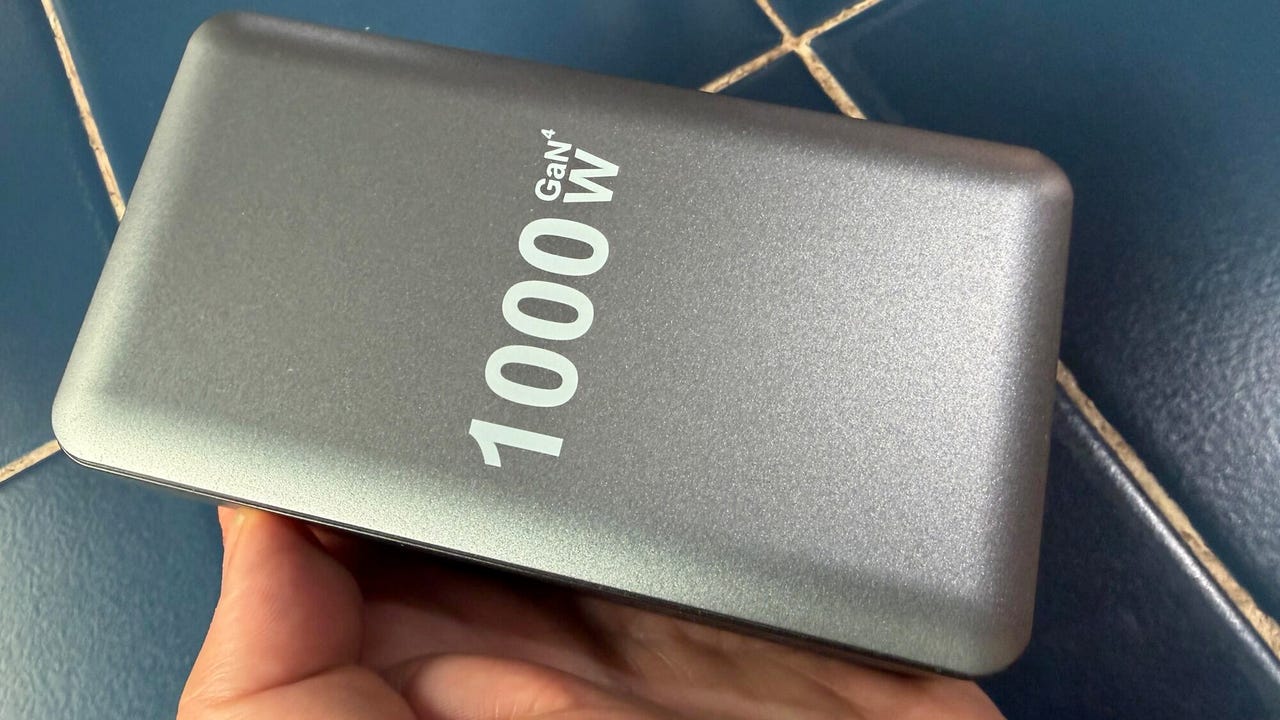
This time around, the thing of interest was a charger that claimed to deliver an incredible 1,000W through its ten ports — four 140W USB-C ports, four 100W USB-C ports, and two 20W USB-A ports. 

The person who bought this charger told me that they’d plugged it in, used it to charge their phone for “a few minutes,” got worried when it became “a little hot,” and unplugged it.

That's a lot of promise... but (spoilers), they don't deliver!

That’s a lot of promise… but (spoilers), they don’t deliver!

Adrian Kingsley-Hughes/ZDNET

The unit was suspiciously light and plasticky, especially given its built-in power supply. Compare this to Ugreen’s Nexode 500W charger, which weighs a hair under 5 lb.

There was also a slight whiff of melty plastic, which made me think that this had been a bit more than a little hot. 

Also: This $4 router reboot timer is the cheap internet fix I didn’t know I needed – and it works reliably

Color me suspicious, but I had a gut feeling that the only way this charger would be able to push out 1,000W would be if it caught fire. 

Turns out I wasn’t far wrong.

How long would it last? Answer: Minutes

Talk is cheap. It was time to test the charger. 

So I plugged it in, turned it on, and started using it. Within a couple of minutes of starting to use it, I noticed a few things:

  • No matter what I tried, I couldn’t persuade the charger to deliver more than about 60W from any of the ports. 
  • As for peak output, I managed to get close to 250W.
  • The power output was very uneven and noisy, fluctuating wildly. The more ports I used, the worse it got.
  • The unit got very hot to the touch very quickly, even under light loads. 
  • But… before I could get the thermal camera out to check how hot it got, there was a pop and the unmistakable smell of “Magic Smoke.” The charger had been sent to Silicon Heaven within minutes.

Annnnd… POP! This is the moment the charger gave up the ghost.

Adrian Kingsley-Hughes/ZDNET

Diagnosis time

Time to take it apart and have a look inside. For an item that plugged into the mains power, this unit was shockingly easy to take apart. 

A thin sheet of easily removable plastic is a that separates curious hands from live AC power.

A thin sheet of easily removable plastic is a that separates curious hands from live AC power.

Adrian Kingsley-Hughes/ZDNET

And even unplugged and broken, it was capable of delivering zaps! If the case came off while this was plugged into an outlet, it could very easily be deadly.

There’s charge still in some of the capacitors, and these could deliver quite a zap despite the unit being broken and unplugged!

Adrian Kingsley-Hughes/ZDNET

After getting inside, the unit was filled with a grey goo that I’d seen in a previous disappointing charger I’d taken apart. This is a thermal paste that’s used to try to dissipate the heat generated by the components. 

It’s not really going to work because it’s sealed in a plastic box with no effective heatsink. It’s a token gesture at best. At worst, it creates a mass that’ll slowly heat up and hold temperature because it’s got no way to get rid of it.

Behold the grey goo!

Adrian Kingsley-Hughes/ZDNET

Next to this goo was a bank of capacitors — the black cylinders in the photo — which were the cause of the failure. They’d clearly overheated, with three of them showing signs of bulging.

The problem!

Adrian Kingsley-Hughes/ZDNET

Well there’s the problem!

I also noticed that two of the components — bridge rectifiers that are used to turn AC mains into DC — have been fixed on an angle to make the touch a metal heatsink. It’s not really an effective way to cool down components.

The bottom line

Another “too good to be true” device bites the dust. It’s not the first one I’ve come across, and it won’t be the last.

Moral of the story here is that manufactures are using big number marketing — in this case 1,000W and masses of ports — to scalewash poor quality products. 

This might be a half-decent product if it was built to deliver 100W, but there’s no end of competition at that end of the market. Silkscreen “1,000W” on the outside, sprinkle in a few reviews that feel scripted and fake, and all of a sudden it’s interesting and exciting… right up until it blows up. 

Also: My top 7 laptop-bag essentials now, after decades of remote work

I know of no 1,000W charger. In fact, the 500W Ugreen Nexode is the highest-power charger that I’ve tested that’s legit. And the price is also legit — $250. 

But it’s built to deliver on what it promises and is packed with safety features, including “tip-over protection,” which cuts the output when the unit tips over and prevents it from falling on its side, where it can’t dissipate heat effectively. Now that’s an attention to safety that I like to see in a product that handles that much power. 

But if you want 1,000W of output, you’ll have to buy two and duct tape them together.


Source link