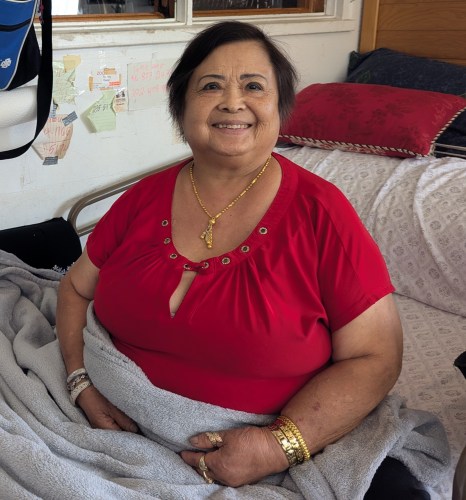
Sitting inside her cozily decorated house in St. Paul’s North End, 69-year-old Kamee Yang began to list some of her favorite foods, like milk, leafy greens and squash.
While seemingly simple, Yang, speaking Hmong, told MinnPost through a translator that these foods get her to “a place where I feel comfortable with myself.”
Compared to a few years ago, comfort is a big leap. At a routine doctor’s appointment, Yang, who manages health conditions like diabetes and high blood pressure, screened positive for food insecurity. It triggered her eligibility for Fair Table, providing free boxes of fresh food, prepared meals, food vouchers and ready-to-use food bags to patients in need.
The initiative, designed by Fairview Health Services, is part of the organization’s expanding efforts to center healthy food access in overall patient care, said Terese Hill, the manager of Fairview’s “Food is Medicine” approach.
“How are we as a healthcare system shifting the understanding of medicine and health care and the care that we offer, and making and embedding healthy food access as a component of the care you receive at your doctor’s office?” Hill said.
Putting down roots in North End
Decades ago, Yang immigrated from Laos to Thailand before settling in the United States in 1980. Over the years, she has faced many challenges to accessing healthy foods, including a limited income and transportation and language barriers.

She is one of the many Minnesotans who has faced hunger. Today, nearly 600,000 people in the state – about 1 in 10 – are considered food insecure, according to the nonprofit Feeding America. Since opting into Fair Table programs, Yang said she eats and feels healthier.
In 2025, more than 31,000 Fairview patients screened positive for food insecurity at routine checkups. More than 6,700 of them were able to participate in Fair Table, whose programs receive funding from Fairview as well as outside sources like the state’s Department of Human Services.
This summer, Fairview is aiming to expand food accessibility by way of a community garden outside of its Rice Street clinic through a partnership with Urban Roots, a St. Paul nonprofit that works with young people to address the causes of food insecurity.
Hayley Ball, the executive director of Urban Roots, told MinnPost that Fairview approached the organization over a year ago hoping to create more opportunities for area residents to access healthy food. Urban Roots already operates five community gardens primarily serving St. Paul’s North End and East Side, so Ball said the partnership came naturally.
On top of the garden providing more healthy food options to patients at the clinic and residents in the area, Ball hopes the new garden will create a new, third space for community members.
“I think that when we are bringing together people to grow their own food and connect within nature, we’re providing opportunity for safe spaces for community as well, and just encouraging general positive community building,” she said.
‘Food that’s coming back to their roots’
Mang Vang, who works for Fairview as a food resource navigator, explained that once a patient receives a referral to Fair Table, she helps connect them to programs and community resources to meet their needs.
Yang, for example, receives her summer vegetables through Fairview’s Veggie Rx program and has prepared meals delivered to her through a partnership with Open Arms, a Minnesota nonprofit that delivers dietitian-tailored meals to critically-ill individuals. She also participates in the MarketRx program, which provides $80-a-month food vouchers for eligible patients.
Vang added that Fair Table also works to provide culturally-relevant foods, like traditional Hmong meals in Yang’s case. When talking with food-insecure patients, Vang said they often note the importance of accessing foods they would normally eat.
“They’re getting food that’s coming back to their roots and they’re able to feed themselves on it, thrive and just start to feel and heal better,” Vang said.
So far, the results have been encouraging. Patients in Fair Table’s prepared meals program have reported an 80% increase in eating a more balanced diet. Those in the food voucher program have experienced a 14% decrease in emergency department visits and an 11% decrease in inpatient stays, according to figures provided to MinnPost. Yang has noticed more specific improvements, like better managing her blood sugar levels.
“If I was still back in my homeland and I was going through food insecurity such as this, I feel that maybe I would have just been dead out of starvation,” Yang said. “But because I’m here and I find that these resources are able to help me with my ongoing symptoms and my health problems, it has revived me quite a bit.”
Related