
The 1970s was an era when a certain frenzy had gripped automakers, and we’re all the worse off for that frenzy’s passing. It was truly the “no replacement for displacement” era, and, leading up to the worst horsepower-killing gas crisis America had ever seen, it was a time that many consider the golden age of motoring. This was a decade when you could walk into a showroom and buy a car that was almost 20 feet long as a two-door coupe. Alternatively, you could get one with a wing taller than the vehicle itself and a horn that went “beep-beep” like a certain cartoon roadrunner.
It was glorious, excessive, and the industry was having fun. That’s what made its end all the worse. Somewhere betwixt the oil crises and the beige tsunami onslaught of sensible saloons, executives across the U.S. decided that cars need to be practical. The wings came off, the colors were muted, and the big, throbbing V8 motor was strangled — first in horsepower, then in size, and eventually, in cylinders. These cars should never have died, and every single example on this list is an automotive tragedy.
Plymouth Superbird
The Superbird was based on the Plymouth Road Runner, with an estimated 1,920 units built. Unfortunately, there is no data on how many survive. Just like the Road Runner that inspired it, the Superbird got the iconic “beep-beep” horn, though the Superbird was a homologation car that was sold to the public just to meet Nascar requirements. Plymouth actually licensed the rights from the “Looney Tunes Road Runner” cartoon from Warner Brothers to use as the car’s mascot. Plymouth purportedly paid $50,000 for the mascot license, and spent a further $10,000 to develop a custom horn that imitated perfectly the cartoon bird’s catchphrase.
There were also decals inside and outside the Superbird of the cartoon Road Runner — but while the regular Plymouth Road Runner had standard decals, the mascot on the Superbird was depicted holding a racing driver’s helmet. Of the three engines available on the car, the biggest was the 426 Hemi V8 (which only about 135 out of the 1,920 units produced got) that displaced 426 ci (6,981 cc), and pushed out 425 hp, along with 490 lb-ft of torque. The Superbird and other “aero-cars” ended up being so dominant — race versions hit 240 mph on the Superspeedway — that Nascar officials imposed restrictions to make them much less efficient after just one year. In that year, the Superbird had gotten back a star driver (Richard Petty) to race for Chrysler and took Plymouth to 18 Nascar victories.
Chevrolet K5 Blazer
If you sit down with a driver who was around in the 1970s, ask their opinion on the K5 Blazer. It’s an incredibly divisive topic — but General Motors was cooking up a storm back then, with its trucks and SUVs. The K5 Blazer was launched at the end of the 1960s — in 1969, to be precise — because Ford and International Harvester had been gobbling up market share at the time. You could have your K5 Blazer with a huge V8 engine, displacing up to 350 ci (5,735 cc), and making 255 hp, along with 355 lb-ft of torque.
The design is also a key point on the K5 Blazer, as it was remarkably close to the International Harvester Scout II SUV. Looking at some pictures, you might think that the Blazer looks awfully like the small Chevy pickups on sale at the time — and you’d be right, because that’s what the K5 Blazer was based on, given a wheelbase chop and an (optional) plastic back roof.
Across the varying setups that could be had on the K5, you could also get the car in either 4WD or RWD. Enthusiasts will delight in knowing that all 4WD K5 Blazers had a solid front axle unit. The K5 Blazer would be phased out in the middle of the 1990s. It would be replaced (in spirit) by the Chevrolet Tahoe, and the rest is history.
International Harvester Scout II
While the IH Scout II, Jeep Wrangler, Ford Bronco, and Chevrolet K5 Blazer were all vying for the wallet of the same customer, the Scout II was undoubtedly what inspired the movement. You see, the original International Harvester Scout 80 roared onto the scene in 1961 and told the Jeep CJ SUV that not all SUVs have to be barebones workhorses.
The Scout II built on that legacy in 1971, when it tried to steal back the market share that had since gone over to the Bronco and K5 Blazer. The best and biggest engine was arguably the 345 ci (5,654 cc) V8 unit that made 160 hp, along with about 300 lb-ft of torque — not bad for a vehicle that weighed in at 3,500 pounds in the base unit. Like John Deere, International Harvester was a company that predated the age of the automobile, and the design of both the Scout I (also known as the Scout 80) and the Scout II clearly shows that.
We simply cannot think of another vehicle that is as fitting of the “square body” moniker than the Scout II, with its almost 90-degree front end grill, equally vertical windshield, and the straight-back, drop-down profile of the tailgate and rear windscreen. Today, used units sell for about $50,000. Pristine models would be even more pricey, because the Scout II was particularly prone to rust, like all trucks from that generation.
Pontiac Firebird Trans Am
Many car companies were coming out with amazing vehicles in the 1970s, but a few really stood out. The 1970s European supercars that spring to mind are the Lamborghini Countach, Detomaso Pantera, Lancia Stratos, BMW M1. On the American side, we had the Mustangs and Corvettes of the era, and of course, the Pontiac Firebird Trans Am. The popularity of the model meant that there would have been a number of engine and transmission options, but in that decade, the Firebird engine that had the most oomph would have been the high-output version of the 455 ci V8 — pushing out 335 hp, along with 480 lb-ft of torque.
Additionally, less than 1,000 models were said to have been equipped with the combination of the 455 V8 and the four-speed manual gearbox, but that car, in our eyes, was the epitome of the American muscle car era. The front looked oddly reminiscent of the Dodge Super Bee styling, and the long, sloping curves evoked a mental image of speed even when the beautiful machine was standing stock still. The original Firebird was actually loosely based on the Chevrolet Camaros of the time, going so far as to share the platform, and was ostensibly the main competitor to the Ford Mustang, which was the dominant muscle car of the time. The “Trans Am” suffix at the end was not a model, as many people think, but a performance trim level.
Chevrolet El Camino SS
The El Camino could be compared to a mullet, in that it is all businesslike in the front, but there’s a party in the back. The El Camino SS of the 1970s is what you get when a muscle car and a pickup truck have a lovechild. Initially released in 1958, the El Camino would remain in production for about 30 years, being discontinued in 1987 because of changing regulations and lower demand. Because the car was a variant of the Chevrolet Chevelle, owners could have the El Camino SS with several of the legendary Chevrolet “Big Block” engines, making the El Camino undoubtedly a muscle car.
The biggest engine would have been the 454 ci (7,440 cc) V8 monster that would end up making about 450 hp and 500 lb-ft of torque, and giving the El Camino an estimated top speed of about 130 mph on the freeway. For reference, a 1971 Ford Mustang Boss 351 would make 330 hp from its 351 ci (5,750 cc) V8 engine, and had a top speed of approximately 117 mph. There was also a less powerful engine that was quite popular on the El Camino, making 360 hp and 500 lb-ft from the same 454 cubic inches. Depending on the state of the car you’re looking at, buyers in 2026 can expect to pay anywhere from $50,000 to $80,000.
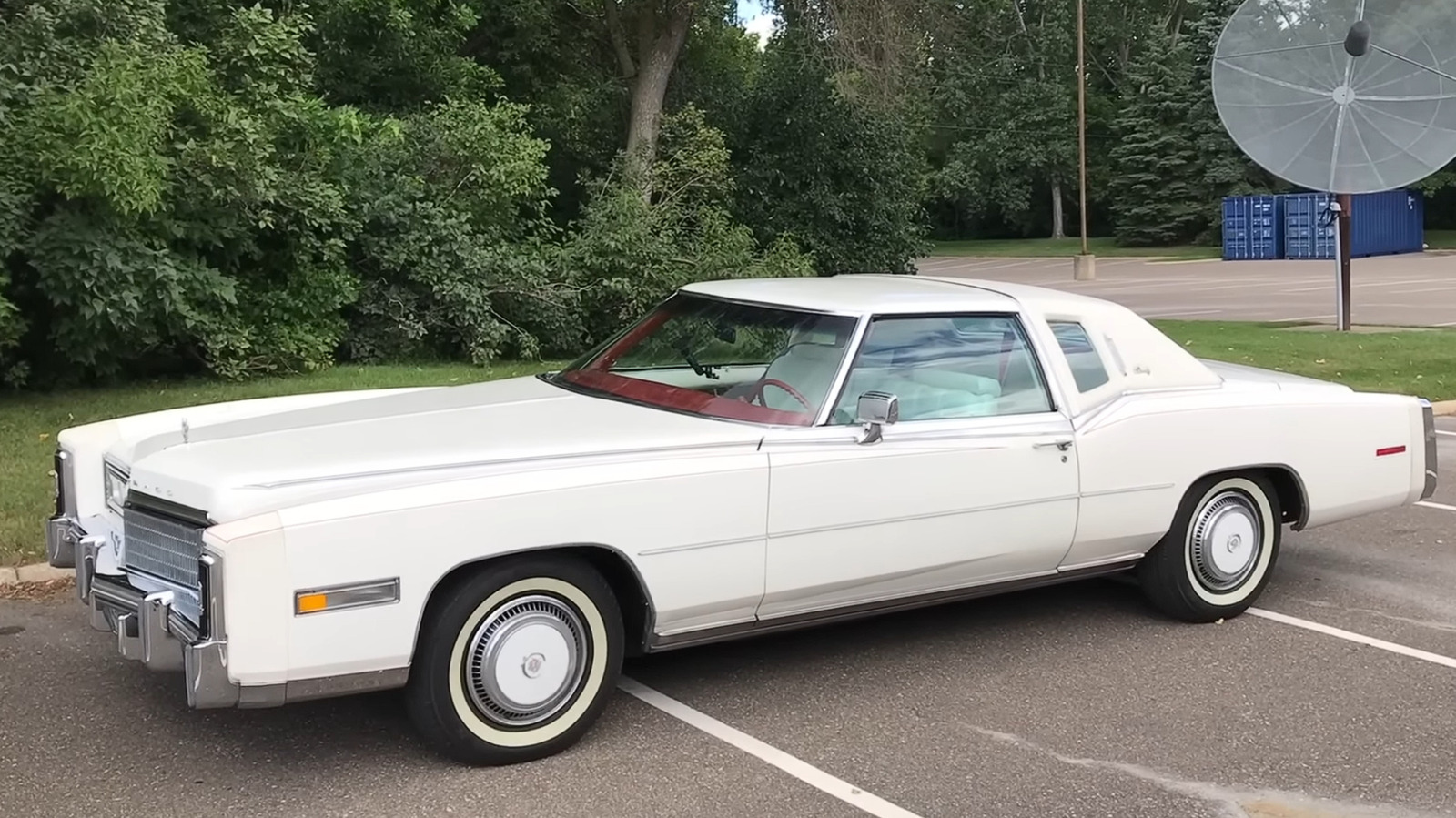
Cadillac Eldorado
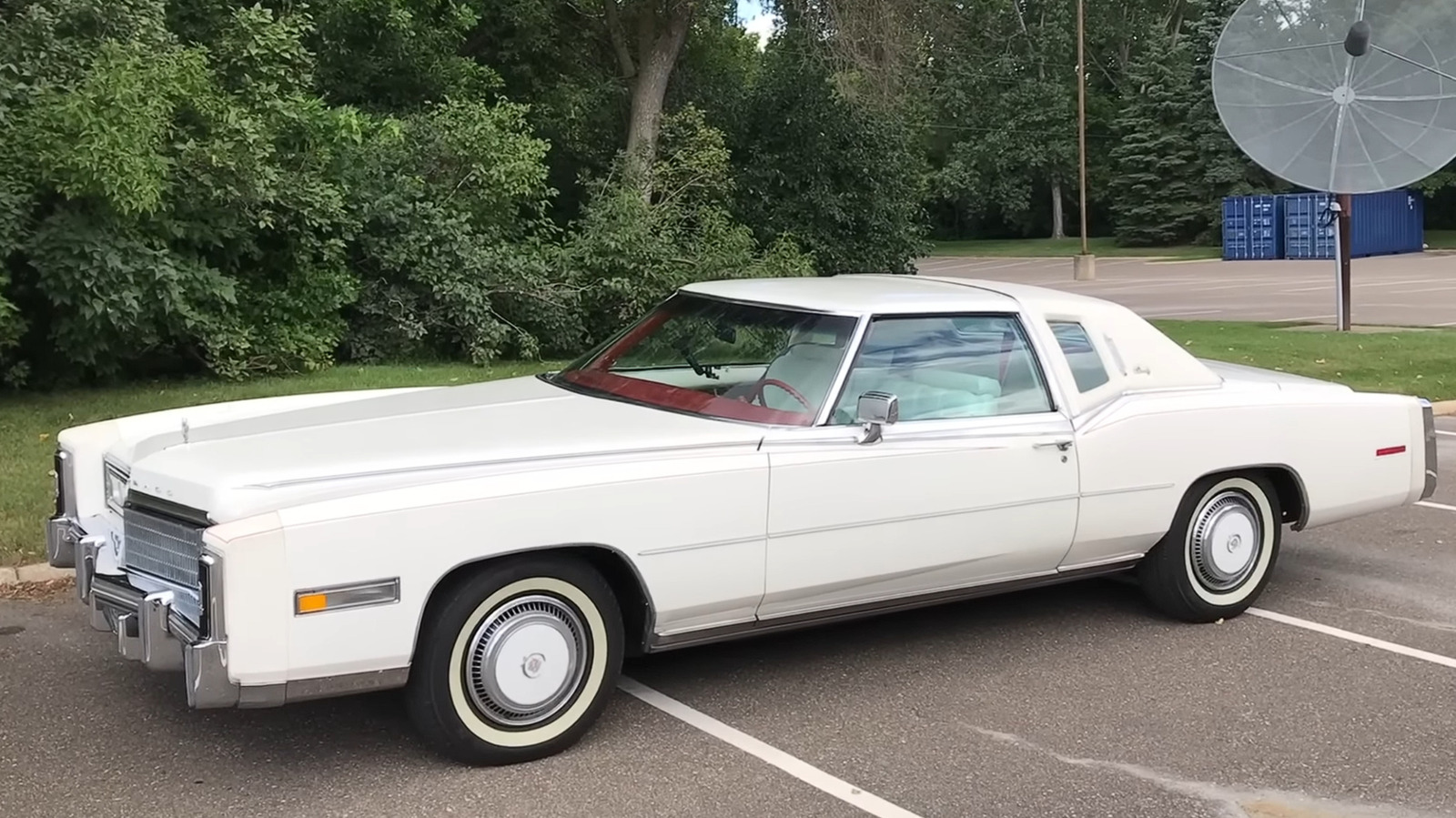
Perhaps the vehicle that most accurately described the excesses of the sinful ’70s was the Cadillac Eldorad. Clearly, General Motors was following the “bigger is better” mandate that had gripped the world at the time. Like so many other vehicles on this list, the Eldorado was released in the 1950s, but really gained steam in the 1970s.
The most collectible and desirable engine in the Eldorado is undoubtedly the 500 ci V8 motor that made 400 hp and 550 lb-ft of torque; even better when paired with a manual transmission. Today, Eldorado units in good nick routinely sell for about $30,000 on the used market or auction houses, and as the years tick by and more Eldorados meet the junkyard, prices will only creep up. Despite its sheer size — a 1971 Eldorado came in at 222 inches, or 18.4 feet in length — the car could run the standing quarter-mile in about 16.4 seconds, and at the end of that run, the speedometer would show about 85 mph.
Clearly positioned as a competitor to the Mark III Lincoln Continental from the Ford Motor Company’s posse, the Eldorado achieved reasonable success in its lifetime. However, it is a car so iconic that you’ll be forgiven for thinking that tens of millions were sold.

Stephan is the sports journalist for the Maple Grove Report.