
Is The ‘Righty Tighty, Lefty Loosey’ Rule Universal?


Depending on how often you handle a screwdriver, a major brand power drill, or wrench, it’s a safe bet that you count “lefty-loosey, righty-tighty” among the universal truths in your life. Odds are that you’ve believed that from an early age too, as the phrase is one of those that has been passed down through the generations as an irrefutable fact.

As often as you’ve likely heard the phrase uttered over the years, you may be surprised to learn that it is not, in fact, a universal truth. There are exceptions to that rule though they are typically few and far between outside of certain industries. 

The reason for the “righty-tighty” dominant world should be pretty obvious, as the setup generally makes it easier for right-handed people to tighten screws and nuts and all manner of fasteners. According to some estimates, these days the population is as right-handed as ever, with some 85-percent to 90-percent of the world’s occupants claiming right-handed dominance. Even still, the rule will only be true if the fastener you’re working with has not been reverse threaded.     

Here’s why a fastener might be threaded in reverse
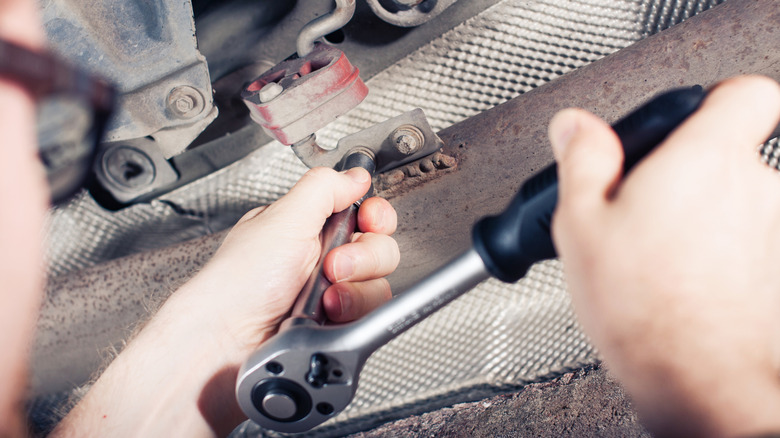
If you are working with a fastener that has been reverse threaded, the tightening and loosening procedures will, obviously, work exactly the opposite. If that entire concept bothers you, you can take heart in knowing that reverse threaded fasteners aren’t particularly prominent and largely used with engines and machines that feature moving parts. 

That means you may more frequently encounter reverse threaded fasteners when you are working with an automobile and sometimes even lawn mower blades. These reverse threaded items may sometimes be referred to as “left-handed” screws, nuts, or bolts. If you’re wondering why they exist, it’s largely due to potential safety concerns. The science behind the concept is pretty sound too, as engine and machine parts that turn tend to more easily loosen with standard fasteners, as the normal torquing motions force them away from the fastening point.

As you’ve likely surmised, reverse threaded fasteners are designed to produce the exact opposite effect, with torquing motions instead ensuring the nut, bolt or screw stays tight to the fastening point. There’s also an easy way to determine if the fastener is normal or reverse threaded, as the former’s threads will appear to run up to the right on inspection, and the latter will run up to the left. It will, of course, also be most obvious when you try to loosen or tighten them.


Source link

Leave a Reply

Subscribe to Our Newsletter

Get our latest articles delivered straight to your inbox. No spam, we promise.

Recent Reviews


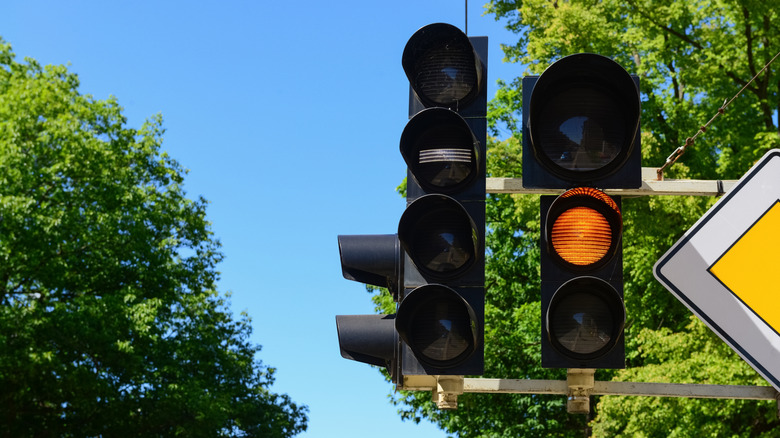
Traffic lights are one of those pieces of street furniture you probably don’t think about all that much until you’re stuck waiting at them. They all serve the same core purpose of letting vehicles know when it’s safe to move ahead or not, but there’s more variation among them than you might expect. Some traffic lights have two red arrows, others have a blinking green light, and one traffic light in New York even has upside down green and red lights thanks to protests by resident Irish immigrants.

You might also notice that some traffic lights are surrounded by yellow borders that usually stretch between 1-3 inches around the edge of the signal. These reflective yellow borders are installed to boost their visibility at night, making them more instantly recognizable by tired or distracted drivers. They also help drivers with color vision deficiencies spot them quicker. As a bonus, a reflective border will remain visible even when the lights are inoperative due to a power outage, which helps warn all drivers that there’s an intersection ahead.

Installing a reflective border is one of the cheapest ways to boost the visibility of a traffic light, but research has shown that it makes a notable difference to road safety. In fact, one 2005 study found that intersections where traffic lights had reflective borders installed saw a 15% decrease in crashes.

Other subtle safety-centric traffic light differences

Even a traffic light that doesn’t have a noticeable visual difference like a reflective yellow border might still be different to a light that’s just down the road. Another tactic employed by transport agencies to boost road safety is adjusting the amount of time each traffic light’s yellow light phase lasts.

The goal is to give drivers enough time to recognize the yellow light and slow down without making it last so long that drivers start to treat it as an extension of the green light. Too long or too short and the risk of drivers running red lights increases, which can lead to a higher rate of crashes. There’s no one set ideal period of time for a yellow light to last, since it depends on a range of factors like the overall layout of the intersection, the speed of the surrounding roads, and the speed that drivers will need to slow down to in order to make their turn safely.

The latest traffic lights can use automated systems to monitor and adjust the yellow light phase in real time. It’s a far cry from the early, simplistic traffic lights that were used before modern computers were invented.


Source link