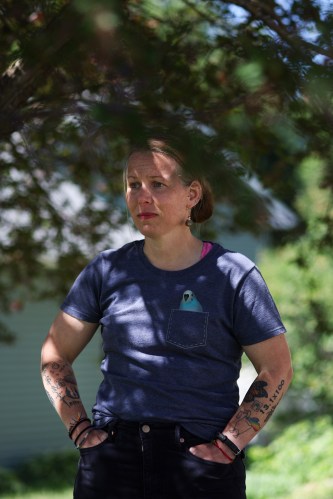
Driving down a dirt road that runs along a sprawling farm field, Aubree Derksen described feeling like David against Goliath.
Her Goliath is Google, the tech behemoth working with a developer to transform that rural field into a hyperscale data center. From Derksen’s nearby home in Pine Island, conspicuous for its anti-data center signage, she mounts local opposition to the plans.
She has allies around town and across the state. Together, they make up a grassroots coalition of Minnesotans working to stop projects in Pine Island, Farmington, Hermantown, Monticello and other cities.
They say local governments are too charmed by the promises of economic development to heed resident concerns about the health, environmental and resource-management risks posed by data centers.
Despite their vocal protests, proposed developments hummed through local regulatory processes over the past two years — unless court orders forced them to pause, as they did in Pine Island and Faribault. Higher up the elected office chain, a host of bills seeking to rein in data center proposals failed at the Legislature last session.
“That was incredibly disappointing,” Derksen said.
Related: Minnesota residents opposed to data centers look to legislators for moratoriums and transparency
But campaign season presents another opportunity. With city, county and state offices in the balance across Minnesota this fall, Derksen said data centers should be seen as a key election issue.
“This is the new single-issue voter,” she said. “It’s not going to be abortion or LGBTQ or immigration issues. I think it’s going to be data centers, and I think that’s something both parties are going to have to reckon with.”
The politics of data centers
Spurred by a groundswell of fired up residents, the reckoning started at the DFL and GOP state conventions last month.
Two data center resolutions garnered broad support from DFL delegates. A moratorium drew 64% of the votes, while a more conciliatory (and palatable to labor unions) resolution focused on tighter regulations came in at 76%. The latter was second only to Boundary Waters’ protections in its popularity among DFLers.
By no means a local government gadfly before she caught wind of data centers, Derksen was a first-time delegate. So, too, was Cathy Johnson, a retired teacher turned activist against a project in Farmington.

“I was really enjoying my retirement,” Johnson said. “I just felt like these are such egregious projects that I could not just sit by. I needed to be involved.”
Johnson leads a group known as the Coalition for Responsible Data Center Development. She came to the cause from an environmentalist angle, seeing data centers as an unnecessary risk to local energy and water resources.
A place under the DFL’s tent is the natural fit for her, although party lawmakers are far from unified on data centers. Pro-business moderates, labor groups and environmentalists differ in what, if any, solutions are needed.
The issue simply doesn’t fit within an easily definable, partisan box, according to recent polling.
Although it’s Democrats who are most concerned about the environmental impacts of data centers, most Republicans also share that sentiment, an Ipsos poll found. Republicans oppose government restrictions on data centers more than Democrats do, but conservatives are quite split on the question.
Overall, the pollster concluded that:
“Partisan rifts on data centers come from unsurprising areas. Republicans have a stronger inclination for a more free-market approach, while Democrats are more cautious about environmental impacts. And while Republicans are slightly more optimistic about data centers, overall support for their construction remains low.”
-

Children bike in Pine Island on Friday, June 12, 2026, in Pine Island, Minn. A proposed 482-acre data center, “Project Skyway,” is receiving backlash from residents of the town which houses almost 4,000 people, which is just outside of Rochester. Credit: Ellen Schmidt/MinnPost/CatchLight Local/Report for America -
The Zumbro River runs through Pine Island on Friday, June 12, 2026. Credit: Ellen Schmidt/MinnPost/CatchLight Local/Report for America -
A “No Data Centers” sign is vandalized in a resident’s yard on Friday, June 12, 2026, in Pine Island, Minn. Credit: Ellen Schmidt/MinnPost/CatchLight Local/Report for America -
A new mural is placed in downtown Pine Island on Friday, June 12, 2026. Credit: Ellen Schmidt/MinnPost/CatchLight Local/Report for America -
Signs denouncing a proposed 482-acre data center, “Project Skyway,” are placed in local resident and activist Aubree Derksen’s lawn on Friday, June 12, 2026, in Pine Island, Minn. Construction for the project has been halted after a Minnesota judge issued a temporary restraining order until a lawsuit regarding the project’s environmental impact is heard. Credit: Ellen Schmidt/MinnPost/CatchLight Local/Report for America -
Rodney Lanners wears a “No Data Centers” hat on Friday, June 12, 2026, in Pine Island, Minn. Lanners vocally opposes “Project Skyway,” which he says would be seen and heard from his home. Credit: Ellen Schmidt/MinnPost/CatchLight Local/Report for America


Minnesota’s Republican convention wasn’t as focused on data centers as the DFL gathering. That said, platform committee members adopted a resolution calling for a data center pause.
Whether parties and candidates like it or not, they can’t ignore that data centers are an energizing topic this year, said Sarah Mooradian, government relations and policy director at CURE. The nonprofit, based in Montevideo, follows data center issues around the state.
“(The DFL platform votes) were a pretty good indicator of what’s happening statewide,” she said. “We know how bipartisan it is.”
Why elections matter
Pragmatically, Pine Island residents who oppose the data center proposal, codenamed Project Skyway, need three of the five City Council members to agree with them. How many local races will be on the ballot this fall? Three, including a mayoral race.
Former Mayor David Friese resigned last week, citing changes at work as the reason for leaving office early and not seeking reelection. Recognizing how impactful local races will be, Derksen said residents are working to identify candidates for all races.
Activists in other Minnesota cities are closely watching local candidates and races, as well. Rebecca Gilbertson said her group in Hermantown, where Google is pursuing a development known as Project Loon, is exploring its options on how to get involved at the local government level.
“We’re doing everything we can to make it an election issue,” she said.
For examples of what can be done when elected officials slow down data center developments, activists can look to a growing number of local governments. Perhaps the most notable of the bunch is Rosemount. Meta is actively building a data center in the southeast Twin Cities suburb, but the city imposed a moratorium on any new projects beyond it.
Lonsdale, about 40 miles south of Minneapolis, imposed a one-year moratorium in May. Tom Berg, mayor of the Rice County city, said Lonsdale saw other cities entering into conversations with developers before regulations were in place and didn’t want to follow suit.
“It was easy for us to take that pause and enact it now, and then start really pushing forward with regulations with community feedback,” he said.
Earlier this year, Berg testified at the Capitol in favor of a bill banning local officials from signing non-disclosure agreements. NDAs, common tools used by data center developers to keep projects out of the public eye, are eroding public trust in institutions, he said.
He’s skeptical of developer claims about how much property tax revenue and jobs data center developments will bring to Greater Minnesota cities. Most of the jobs would be for construction, providing only a temporary benefit to the local economy, he said.
Property tax revenue, while always attractive, might dry up in the long-term, leaving cities overextended with an empty industrial building.
“Praying for a boom is just not good fiscal responsibility,” Berg said.

Outside of local council and board races, the campaigns with the biggest implications for data centers are at state House and Senate levels. Shifts in party control at the Legislature could revive proposals next session.
That’s why data center opponents will also be closely watching legislative races. Every district with communities where data centers are being proposed will have candidates on the ballot this year.
Related: Why local officials in Minnesota are signing nondisclosure agreements
Berg and Johnson live in a battleground Senate district south of the Twin Cities metro held by Bill Lieske, a Republican. Johnson supports Lieske’s DFL challenger, Mark Legvold, because she feels he’ll be more in alignment with her on data centers.
In northern Minnesota, Gilbertson resides in another high-stakes swing district. Sen. Grant Hauschild, DFL-Hermantown, and Rep. Natalie Zeleznikar, R-Fredenberg Township, are defending the seats.
Positive changes, at least the kinds that data-center opponents want, may not be achievable in every district. Incumbents who don’t support moratoriums could face challengers even less supportive of moratoriums.
But where there are opportunities to find candidates willing to slow down data center development, Derksen, Johnson and Gilbertson said they’ll target them.
What’s at stake
Nothing in Pine Island is too far away. Derksen likes that about it, having moved to the city with about 3,800 residents six years ago.
Rochester, the region’s fast-developing population center, is a mere 20-minute drive away. Yet Pine Island, in comparison, retains a rural, small-town feel.
Derksen lives in a neighborhood where many houses match hers in displaying “no data centers” signs. As consuming as her fight with Google can feel, she said she tries to bring it back to what she’s trying to protect.
It’s the little things about her community as it currently exists: the native plants, birds and pollinators she monitors in her backyard, the Northern Lights she can see from her patio, the bald eagle’s nest high up in a treetop towering over a cemetery.
“If this were to get built, with the noise, with the light, are we still going to be able to hear the birds?” Derksen said. “We can’t afford to move, so we don’t have an escape plan.”
The fight often feels daunting. Attending public meetings, testifying at the Capitol and interviewing with news outlets are time consuming.
It’s not her job, nor does she have anywhere near the resources of Google, Meta or any other big tech company wanting to expand in Minnesota. In a relatively modest display of the war chest backing the data center, Google, project developer Ryan Companies, and Xcel Energy were platinum sponsors at Pine Island’s annual Cheese Festival.
Going from her yard to the proposed site within minutes, Derksen then drives up a hill to visit Rodney Lanners. The 74-year-old man is decked out in an anti-data center hat and shirt, having just returned from a public meeting.
The two first met over their shared opposition to the project. It hits close to home for everyone in Pine Island, but Lanners is truly one of the closest to it.
Sitting in his backyard on a sunny, breezy summer day, he sees raptors soar over a field below. Songbirds make pit stops on feeders in the yard.
In between talk of the data center, he shares how he puts out jelly for orioles, how lucky he got in acquiring a Lady Slipper and how the upstairs in his garage remains a work in progress.
He’s a man who’d clearly prefer to be at home tending to projects than be at public meetings. “I’m a little bit in heaven here,” he said of the home he’s lived in for 26 years.

Data centers are such an energizing topic for Lanners and others because, to them, the projects represent a fundamental change to a community’s character and landscape. People who might not agree on much else find themselves up in arms on the same team when they sense a risk to what makes home feel like home.
Lanners sees the risk down a ways and to the left from his yard. Through trees he can see the site where the data center could be constructed.
Not wanting to live by it, he wants a City Council that better represents him.
“This is supposed to be our final home, and hopefully it is,” he said.
Related