The AOC Agon Pro AG276QSG2 is a very capable 1440p gaming screen with the clever benefit of G-Sync Pulsar to take motion clarity to the next level. It’s also bright and sharp, plus it has an adjustable stand and a feature-rich OSD. It is quite expensive for an IPS screen, though, and the ports are just okay with that in mind.
The key benefit of this AOC screen is the addition of Nvidia’s new G-Sync Pulsar module for immense gains to motion clarity.
27-inch 1440p 360Hz screen
It hits the sweet spot for resolution and screen size, and has a fast refresh rate to boot.
Highly adjustable stand
This AOC screen has a very adjustable stand, with everything from tilt and swivel to portrait orientation available.
Introduction
The AOC Agon Pro AG276QSG2 might look like quite an unassuming 27-inch gaming screen, but what lies within is one of the most exciting leaps forward in display tech.
The spec sheet wouldn’t give you much of an indication either, as this is a 27-inch 1440p Fast IPS screen, admittedly with a high 360Hz refresh rate, that makes this ideal for FPS and more competitive gameplay. The key thing, though, is that this is the first monitor I’ve tested with Nvidia’s clever G-Sync Pulsar module, which it says can provide motion clarity equivalent to that of a 1000Hz-refresh-rate screen – mighty clever.
All of this, and more besides, comes at a hefty cost, though, with a £558.95 price tag that puts it up there with some of the best gaming monitors we’ve tested. There aren’t many equivalent rivals, although this premium end of the 1440p market is usually reserved for 1440p 240Hz OLEDs such as the AOC Agon Pro AG276QZD – spend a little more, and you can even get a 27-inch 1440p 500Hz OLED screen with the Samsung Odyssey OLED G6 G60SF.
Advertisement
To see if G-Sync Pulsar is all it’s cracked up to be with the Agon Pro AG276QSG2, I’ve been putting it through its paces for the last week or so.
Design
Angular design
Convenient construction and stand adjustment
Port selection is okay
AOC hasn’t moved the needle much with the Agon Pro AG276QSG2’s looks and design against the Agon Pro AG276QZD. It’s a striking finish, that’s for sure, with an angular, flat stand that can be quite polarising, plus slim bezels around the 27-inch screen for a more modern touch.
This screen fits together without any need for tools, with the stand clipping into the rear of the screen, and the base screwing in from the underside. It’s easy to get this high-refresh-rate behemoth set up in a matter of minutes.
Image Credit (Trusted Reviews)
Advertisement
Stand adjustment is decent, too, with good scope for tilt, swivel and height adjustment. This AOC screen can also move into a portrait orientation with little effort if you need it to.
There are some pleasant extras with the Agon Pro AG276QSG2, such as a pop-out headphone holder on the right hand side and what looks like a webcam on the top – it isn’t a webcam, and is actually an ambient light sensor that works in conjunction with Nvidia’s new Pulsar Ambient Brightness tech that can adjust brightness and colour temperature is real time to ensure optimal visuals without needing to go into the OSD – that’s a nice touch.
Image Credit (Trusted Reviews)
When it comes to ports, this AOC is well-endowed in some ways, but not others. You get a pair of HDMI 2.1 and DP 1.4 ports for display connectivity, and a solid USB hub, with a USB-B upstream port that breaks into three USB-As.
This is fine, although it’d have been a nice touch to see a USB-C in any guise, especially with power delivery and display powers for use with a laptop or to help with a KVM switch. Lots of other high-end screens at this price come with a USB-C port in some guise, so it’s a bit of a sore miss here.
Image Quality
G-Sync Pulsar pays dividends for motion clarity
Solid detail and punchy peak brightness
Middling black level and contrast ratio
Advertisement
Of course, the key thing with the Agon Pro AG276QSG2 is how it looks – it is a monitor after all. Usually, I’d break into a few paragraphs about panel type and such, but that’s almost secondary to the USP of this monitor – G-Sync Pulsar.
Admittedly, it is a little technical, but I’ll try my best to explain how it works. Nvidia first announced G-Sync Pulsar at CES 2024, which is a module inside the display that fuses the powers of variable refresh rate (designed to stop screen tear and judder) and backlight strobing (designed to reduce motion blur through the rapid turning on and off of a monitor’s backlight) with a clever algorithm to allow pixels to transition from one colour to another at a rate that manages to reduce both motion blur and pixel ghosting.
Image Credit (Trusted Reviews)
Previously, you couldn’t use the two together without causing immense flicker from the backlight strobing, and it’s also quite difficult to time the strobes to the monitor’s refresh rate, which is itself linked to the output of the GPU you’re using.
With G-Sync Pulsar, though, Nvidia has made it possible, resulting in immense gains in motion clarity and fidelity, yielding even smoother and more responsive gaming than on a standard G-Sync screen. We’d seen tech such as VRR, motion-blur reduction and overdrive implemented separately on screens in the past, but not working together to such an extent.
Image Credit (Trusted Reviews)
Advertisement
The end result for the Agon Pro AG276QSG2 is some of the clearest and sharpest motion at high refresh rates I’ve ever experienced. It’s possible to notice the frequency of the backlight strobing if you hold a camera up to the screen running a game – you can see the camera try and focus as the backlight strobes to such an extent.
Being a 360Hz screen in the first place helps, especially for zippy motion in competitive gaming, such as fast-paced titles like Counter-Strike 2 and Dirt Rally 2.0, where this monitor is designed to feel at home. However, the addition of G-Sync Pulsar makes a surprising difference in how that 360Hz feels, if that makes sense.
Image Credit (Trusted Reviews)
Otherwise, being a 27-inch 1440p screen means it hits the sweet spot for resolution and screen size, and with high-end hardware in the right games, it’s pleasant to get close to the top end of the refresh rate.
My colorimeter tests were conducted in Nvidia’s preset eSports mode with Pulsar enabled, as I think that’s where folks are most likely to spend the most amount of time with this screen, and admittedly, the results were a little surprising.
Image Credit (Trusted Reviews)
Advertisement
At 50% brightness (300 nits according to the OSD), I measured 335.5 nits, though with middling black level and contrast ratio results of 0.39 and 860:1, respectively. Going up to peak brightness pushed the black level to 0.61, giving it more of a grey tinge than I’d anticipated, though it still delivers a punchy 521.5 nits of peak brightness.
Colour accuracy, as expected for an IPS screen, is pretty good, with perfect 100% coverage of the sRGB colour space, meaning this screen displays all the mainstream colours needed for gaming and productivity workloads perfectly. For more colour-sensitive workloads, this panel is surprisingly good, with 89% DCI-P3 and 82% Adobe RGB coverage.
With this in mind, the black level and contrast ratio results mean I wouldn’t necessarily use the Agon Pro AG276QSG2 for any more colour-sensitive tasks.
Software and Features
Feature-rich OSD
Meagre speakers
The Agon Pro AG276QSG2 has a feature-rich OSD that’s easy to navigate and control with the joystick on the rear of the screen. Here you can fiddle with everything from the ambient RGB lighting on the rear of the panel to brightness, contrast, input selection and more.
There is also a hot menu for the G-Sync Pulsar settings where you can set things such as game colour, overdrive settings and dial in Nvidia’s Pulsar settings as you wish. For set-and-forget use for competitive gaming, there’s even an Nvidia eSports mode.
Advertisement
Image Credit (Trusted Reviews)
AOC bundles speakers with the Agon Pro AG276QSG2, although they are standard fare for a monitor, carrying mostly mids at a fair old volume. For the competitive gaming use that this screen is designed for, you’re certainly better off with one of the best gaming headsets.
Should you buy it?
You want the best motion clarity
Nvidia’s G-Sync Pulsar impresses on this AOC screen for immense motion clarity that’s unlike any other IPS screen I’ve ever tested.
For the premium price tag, you can get better definition and depth with an equivalent-priced OLED panel than this Fast IPS choice can provide.
Final Thoughts
The AOC Agon Pro AG276QSG2 is a very capable 1440p gaming screen with the clever benefit of G-Sync Pulsar to take motion clarity to the next level. It’s also bright and sharp, with an adjustable stand and a feature-rich OSD. It is quite expensive for an IPS screen, though, and the ports are just okay given that.
The thing is, you’re not going to find an IPS screen that provides as strong motion clarity as this choice, and you will need to look up the price ladder a bit at the Samsung Odyssey OLED G6 G60SF to get close, as it’s a 500Hz OLED. It also provides deeper blacks and much better contrast than this AOC choice, along with a stronger port selection, although it is more expensive.
Likewise, you can pick up the AOC Agon Pro AG276QZD for slightly less, which provides the same screen size and resolution, plus OLED quality with a 240Hz refresh rate. It has a similar look and stand to this other AOC choice, although it forgoes the same modern accoutrements in its port selection.
It’s swings and roundabouts in any guise, but if you want some of the best motion clarity you’ll find on any monitor today, along with a capable Fast IPS screen, interesting looks and more, the Agon Pro AG276QSG2 is a great monitor. For more options, check out our list of the best gaming monitors we’ve tested.
How We Test
We use every monitor we test for at least a week. During that time, we’ll check it for ease of use and put it through its paces by using it for both everyday tasks and more specialist, colour-sensitive work.
We also check its colours and image quality with a colorimeter to test its coverage and the display’s quality.
We used a colorimeter to get benchmark results.
We used our own expert judgement for image quality.
Advertisement
FAQs
What is Nvidia G-Sync Pulsar?
Nvidia G-Sync Pulsar is the brand’s latest leap forward in VRR tech, and combines variable refresh rate with backlight strobing and motion blur reduction tech with a new algorithm to allow for class-leading motion clarity.
There’s a popular argument that AI will do to human workers what tractors did to horses. Tractors could do what horses did. Horses became obsolete. AI can do what humans do. Therefore…
Plenty of major AI figures seem to agree. Elon Musk says AI will “replace all jobs.” Anthropic CEO Dario Amodei regularly warns about mass job loss, framing AI as “a general labor substitute.” OpenAI investors talk openly about AI replacing “80% of all jobs by 2030.” These are influential people, not random bloggers. Still, they are not necessarily a representative sample of the world’s most careful economists.
And the fear itself is hardly new. Economist Wassily Leontief—best known for developing input-output analysis, a way of mapping how industries depend on one another—raised similar concerns in the early 1980s. If AI really were a perfect substitute for human labor, the logic would be straightforward. Any cost advantage would eventually drive firms toward 100% AI labor. You do not need a long essay to prove that result.
The problem is that the phrase “AI will eventually be a perfect substitute” does almost all the analytical work. That assumption hides a great deal: differences across tasks, industries, and workers; the many margins along which firms adjust; and the messy heterogeneity that makes the real economy more than a toy model.
How substitutable is AI today? What would need to happen for that substitutability to rise meaningfully? What other conditions would also need to hold? Even the historical analogy—“tractors could do what horses did, therefore horses became obsolete”—compresses several distinct steps into one neat sentence. “AI can do what humans do, therefore humans become obsolete” hides even more.
So let’s unpack those steps.
(This post draws on a new working paper that walks through the math and economics in detail. Really, though, it is mostly basic accounting.)
Before We All Become Horses
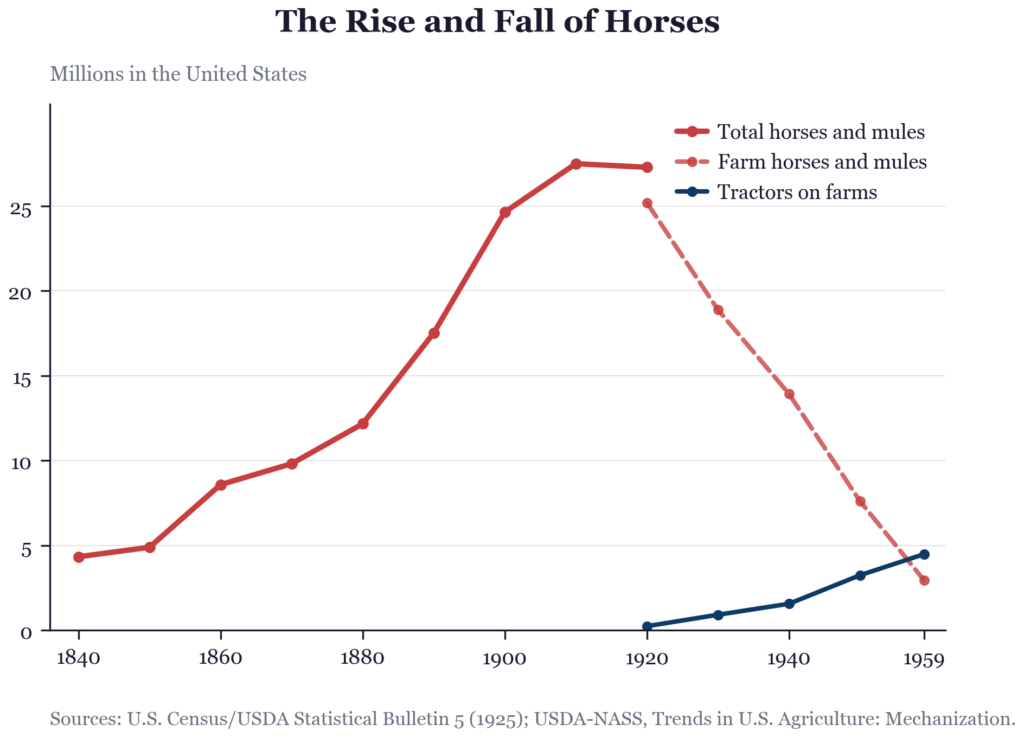
For those unfamiliar with the history of horses in the United States, the horse population actually rose for decades alongside industrialization. It increased from 4.3 million in 1840 to 27.3 million in 1920. The collapse came later, as tractors and motor vehicles displaced horses in agriculture and transportation. The number of farm horses and mules then fell to roughly 3 million by 1960.
Horses, in effect, had one main economic role, and that role disappeared. Humans are different. So before jumping from “AI can do tasks” to “humans become obsolete,” we should define carefully what that outcome would actually mean.
To keep things simple, suppose demand for human labor falls to zero. Not “low.” Zero. What would that require?
It would mean that no dollar spent anywhere in the economy passes through human labor at any point in the supply chain. Not the person who made the product. Not the person who shipped it. Not the person who designed it, marketed it, maintained it, or cleaned the building where it was assembled. Zero human labor embodied in final expenditure. That is the benchmark. That is what “humans become horses” would mean, stated precisely.
This is the input-output framework the aforementioned Wassily Leontief built his career on. The idea is straightforward: trace any final purchase backward through its supply chain and add up all the labor that contributed to it, both directly and indirectly. A cup of coffee includes the labor of the barista, but also the roaster, the truck driver, the coffee farmer, and the workers who built the truck. “Embodied labor” means all of it.
For labor demand truly to collapse, every one of those links would need to disappear across every good and service consumers buy. That is a much stronger claim than “AI can do some jobs.” The economy is not a single production function. It is a sprawling network of activities. When AI makes one activity cheaper, consumers do not simply buy more of the same thing forever. They redirect spending elsewhere.
Every dollar lands somewhere. Some spending flows into highly labor-intensive activities, such as restaurants, therapy, or home repair. Other spending flows into activities that require very little labor, such as cloud storage, automated checkout systems, or streaming subscriptions. So the relevant question is not merely: “Can AI do my job?” It is: “When AI makes some things cheaper, where does the saved money go next?”
Aggregate labor demand depends on at least three things: total spending in the economy, the share of spending that goes toward labor-intensive activities, and the amount of labor embodied in each activity. For labor demand to fall to zero, AI cannot merely displace workers in a few sectors. Every dollar of spending, wherever it ultimately lands, must shed all embodied human labor. The “humans become horses” story therefore requires three separate margins to collapse simultaneously.
A useful starting point is the simple observation that firms do not want labor per se. A restaurant does not want waiters because it enjoys employing waiters. It wants orders taken, customers reassured, mistakes fixed, and meals delivered. Labor demand is therefore “derived demand”—firms demand workers because workers help produce something else consumers value.
When AI can perform those underlying tasks more cheaply, two things happen at once. First, firms substitute AI for workers, reducing labor demand per unit of output. Second, lower production costs reduce prices, output expands, and that expansion tends to pull labor demand back upward. Whether total labor demand rises or falls depends on which force dominates.
Economists call this the Hicks-Marshall decomposition of derived demand into substitution effects and scale effects. The terminology sounds forbidding, but the intuition is simple: cheaper production reduces the need for workers in one sense, while expanding the market for output in another. That tension will organize the rest of the discussion.
When a dollar gets saved, where does it go? Into new tasks? New jobs? New industries? The money has to end up somewhere.
Your Job Is Not a Checklist
The case that AI can automate many tasks is not speculative anymore. This is obviously true to some extent, and it has been true for years.
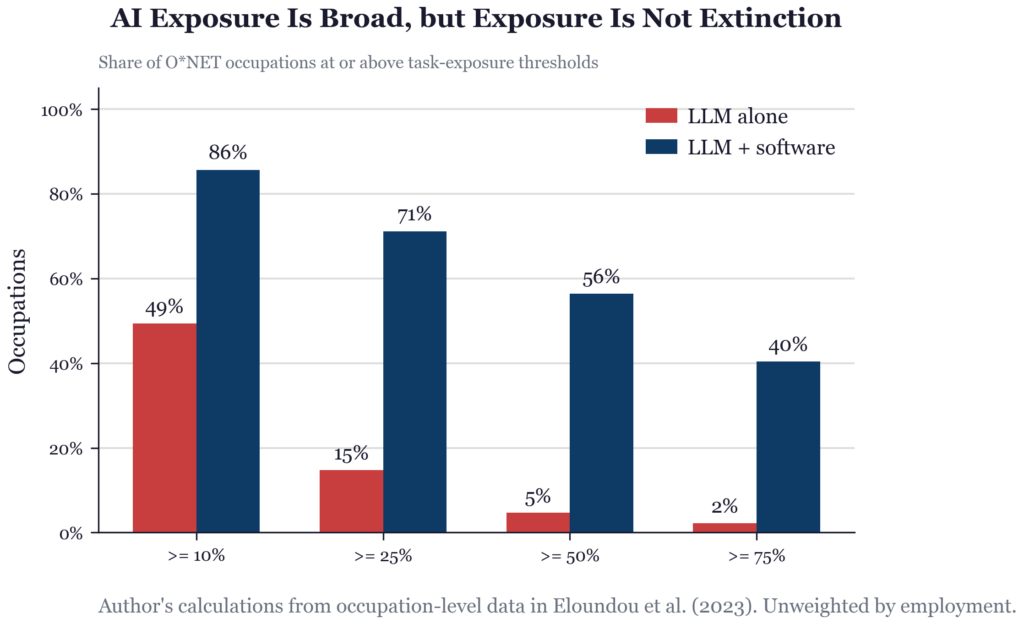
Even early large language models (LLMs) showed substantial potential to affect workplace tasks. One widely cited paper by Tyna Eloundou, Sam Manning, Pamela Mishkin, and Daniel Rock estimated that roughly 80% of the U.S. workforce could see at least 10% of their job tasks affected by LLMs. When paired with complementary software tools, 86% of occupations crossed that 10% exposure threshold.
Since then, the empirical literature has grown rapidly, and the task-level evidence is hard to dismiss. In a large customer-support study, access to generative AI increased the number of issues resolved per hour by roughly 15%. In an experiment involving professional writing tasks, ChatGPT reduced average completion time by 40% while increasing measured output quality by 18%. In a controlled GitHub Copilot study, software developers completed coding tasks 55.8% faster. Those are not rounding errors.
But they are effects on tasks, not necessarily on jobs. That distinction matters. When a task gets automated, the saved dollar does not disappear into the void. Firms and workers often redirect it toward new activities within the same occupation: more client management, more review and verification, more coordination, more judgment calls, more customization.
Just as there is no fixed amount of demand in the economy, there is no fixed bundle of tasks that permanently defines a job. Jobs evolve. They absorb new responsibilities, shed old ones, and reorganize around whatever remains scarce and valuable.
The O-Ring Problem
There is a familiar ritual in AI discourse. Someone posts a demo. The demo performs a task associated with a particular job. People immediately conclude that the job is doomed.
Sometimes they are right. But that inference skips about 15 intermediate steps.
What does it actually cost to deploy the system once error rates are included? Do customers trust it? Can firms reorganize workflows around it? Does management even know how to integrate it effectively? A chatbot demo can appear overnight. A hospital cannot reorganize clinical liability around AI overnight.
That distinction matters because firms are not simply collections of isolated tasks. They are organizations. In many cases, the result will not be pure replacement, but rather a human-AI team producing output together. Economists call this complementarity: two inputs become more valuable when used jointly than separately.
But complementarity is not free. A human-AI pair that produces only marginally more value than the AI alone will not justify paying a full human wage. The human worker must contribute something the AI cannot reproduce cheaply or reliably.
That matters especially in high-stakes settings where errors are extraordinarily costly. Surgery, aviation, structural engineering, fiduciary advice, and many legal services all fall into this category. In these fields, the cost of failure can easily dwarf the savings from cheaper production.
That could eventually change. It probably will change in some areas over time. But it is not likely to change quickly.
This is essentially the “O-ring” logic from economics, named after the tiny rubber seal whose failure destroyed the Space Shuttle Challenger. When the value of the entire system collapses because one component fails, buyers do not focus primarily on sticker price. They focus on the expected cost of a system that actually works.
In those environments, human-supervised production can remain economically efficient even if AI itself becomes extremely cheap.
Horses Had Nowhere Else to Go
Suppose substitution effects really do dominate within most jobs. The saved dollar then escapes the workplace entirely. Where does it go next?
Most standard economic models collapse the economy into a single “final good,” which makes that question disappear by assumption. Real economies do not work that way. They contain many sectors, and every dollar eventually lands somewhere.
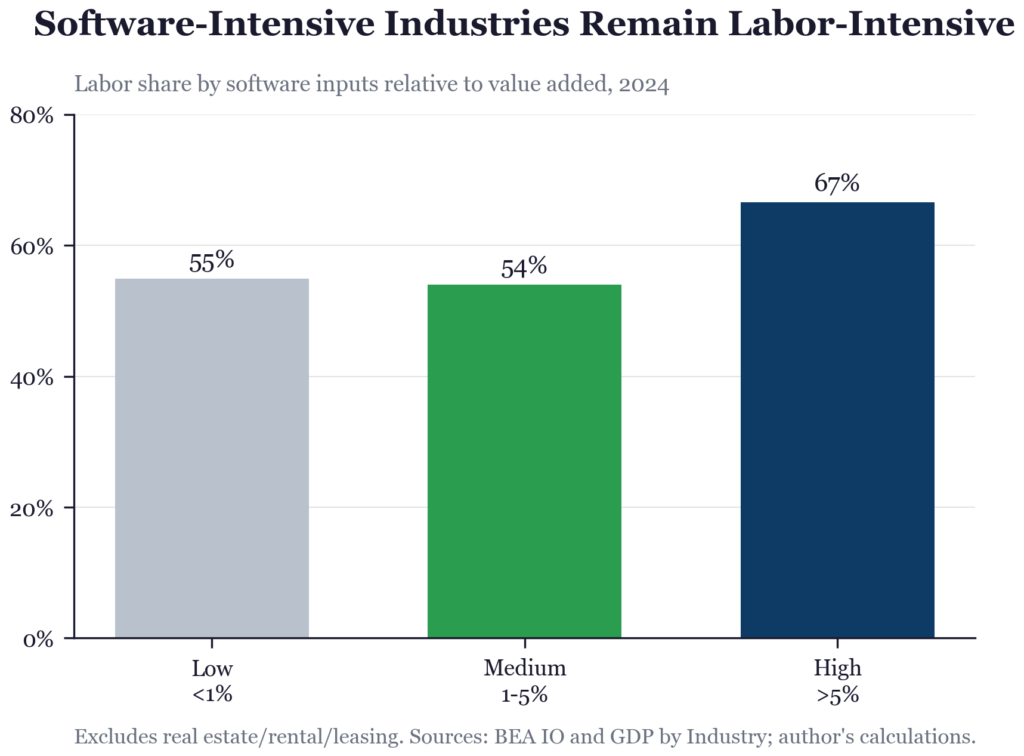
Start with software, which serves as a useful microcosm. Software-intensive industries have already undergone decades of automation through digital tools. If automation were going to drive human labor out of a sector entirely, this is where you would expect to see it first. The chart below groups industries according to how much software they purchase relative to value added: low, medium, and high software intensity. The result is striking.
The most software-intensive industries do not merely retain human labor. They actually devote a larger share of income to labor compensation—about 67%—than the least software-intensive industries, which devote roughly 55%. In other words, the industries that automated the most heavily also remained highly labor-intensive.
The same pattern appears in employment projections. The Bureau of Labor Statistics (BLS) projects total U.S. employment to increase by 5.2 million jobs between 2024 and 2034. Employment for software developers—a profession directly exposed to AI tools—is projected to grow 17.9%. BLS could ultimately prove wrong. Forecasting always carries uncertainty. Still, the evidence so far points strongly toward scale effects dominating in software-intensive industries. Automation reduced costs, output expanded, and labor demand remained robust.
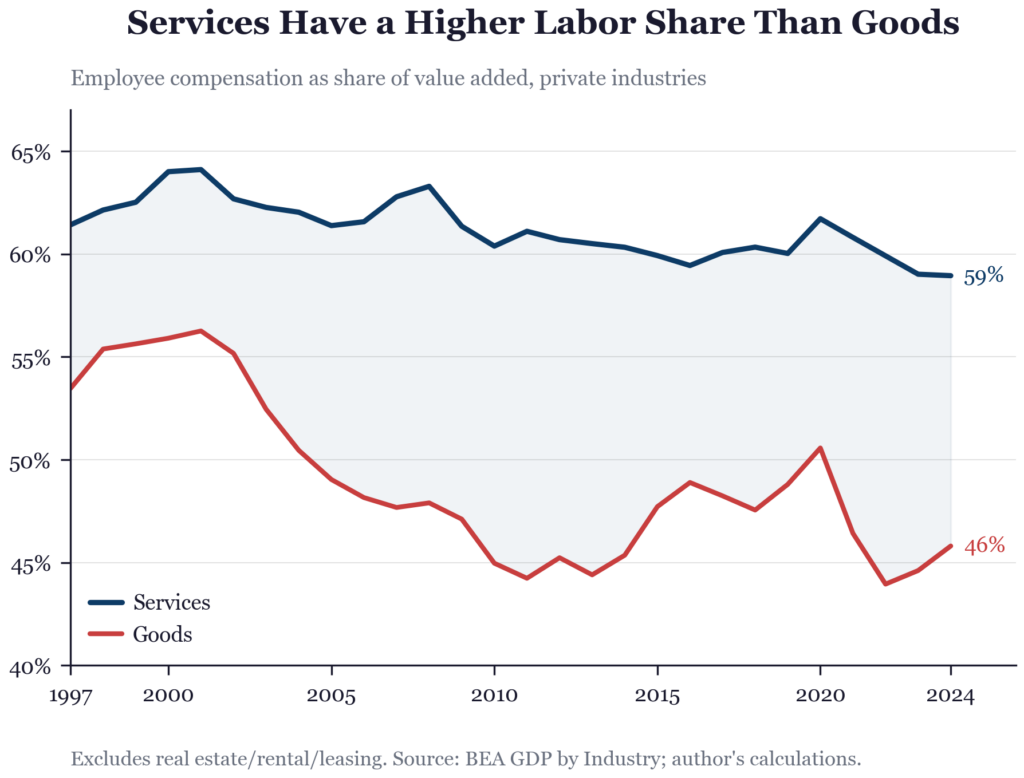
Software may be an extreme case, but versions of this pattern appear across the broader economy and over much longer periods. Take the shift from goods to services. In 1929, most consumer spending went toward physical goods. Today, roughly two-thirds of consumer spending flows toward services. As manufacturing became dramatically more efficient, consumers did not respond by purchasing infinite refrigerators and toasters. Instead, spending shifted toward health care, education, restaurants, entertainment, travel, and personal services.
That is the “saved dollar” in action at the economy-wide level. Goods became cheaper. The substitution effect largely won within goods-producing industries. Employment growth in manufacturing did not continue indefinitely. But the freed-up purchasing power migrated elsewhere, and the scale effect emerged across sectors instead.
From a macroeconomic perspective, output expanded overall. Consumers simply redirected spending toward new categories of consumption. But migration alone does not help workers unless the destination sectors still contain substantial human labor. Did they?
Again, the answer appears to be yes.
Services consistently devote a larger share of value added to employee compensation than goods-producing industries do. Spending did not merely migrate. It migrated toward sectors where more of each dollar ends up in someone’s paycheck.
So yes, one could argue that this still resembles the horse story in one respect. The relative importance of goods production declined as productivity increased. The point, though, is that large, diverse economies contain adjustment margins that horses never had. There are escape valves.
Comparative advantage keeps reappearing. When automation makes some activities extremely cheap, spending tends to shift toward the activities that remain relatively expensive. And the activities that remain expensive are often the ones that are hardest to automate. Those are precisely the areas where humans continue to hold a comparative advantage—that is, where human labor remains relatively more productive or valuable than machine substitutes. The saved dollar therefore tends to drift toward areas where humans are still worth paying.
That is not technological optimism. It is simply the logic of comparative advantage.
James Bessen documents this dynamic sector by sector. In early textile manufacturing, power looms sharply reduced labor required per yard of cloth. But cloth became so much cheaper that demand exploded, and total textile employment increased for decades. Similar patterns appeared in steel and automobile production. Eventually, demand saturated. Prices stopped falling rapidly enough to offset labor-saving automation, and employment in those sectors declined.
The key question for AI, then, is not whether automation can destroy jobs. Of course it can. The real question is: Which sectors are in which phase? Where might AI-generated savings flow today?
Health care already accounts for roughly 18% of U.S. GDP, and that share continues to rise. Elder care will likely expand further as populations age. Personalized services, human-intensive care work, and new categories of consumption may absorb growing shares of spending.
Joel Mokyr, Chris Vickers, and Nicolas Ziebarth make this historical argument well in a Journal of Economic Perspectivesarticle. Across prior waves of technological change, new tasks emerged, comparative advantage persisted, and entirely new categories of work appeared that earlier generations could not have anticipated.
Horses had no equivalent adjustment path. They did not move into elder care.
Will Humans Become a Luxury Good?
The saved dollar migrated toward human-intensive sectors last time. The strongest argument for why this time could be different comes from economist Philip Trammell’s paper, “Is Labor a Luxury in the Long Run?”
His answer is: probably not. Even if richer consumers initially spend more on human-intensive goods and services—live music, handmade products, personal care, bespoke experiences—four long-run forces may steadily erode that demand.
AI-generated variety keeps expanding. New AI-produced goods compete for every dollar that might otherwise land on a human-made product or service.
Human experiences carry opportunity costs. Time spent at a live concert is time not spent consuming some potentially superior AI-generated alternative.
Labor competes with other scarce goods for consumers’ willingness-to-pay premiums. Beachfront property, status goods, intellectual property, and research-intensive products may all absorb spending that might otherwise flow toward human labor.
Capital goods become cheaper over time. If investment opportunities continue expanding, the share of economic activity devoted to capital accumulation could grow indefinitely.
Trammell’s Coca-Cola analogy captures the intuition cleanly. Original Coke once held roughly 50% of the soda market. Then came Diet Coke, Cherry Coke, Pepsi Max, energy drinks, flavored sparkling water, and endless other varieties. Even with enormous brand loyalty and supply constraints, Coke’s market share fell below 20%.
The implication for AI is straightforward. Even if consumers initially prefer human-made goods, that preference may weaken as AI continuously generates new substitutes and varieties. Human labor does not need to become worthless. Its share can erode through dilution.
That is a serious argument, and I take it seriously. Still, notice what the argument requires. It is not enough for AI-generated variety merely to expand. That will almost certainly happen. The stronger claim is that AI-generated substitutes must expand broadly and rapidly enough to pull spending away from every human-intensive category simultaneously.
The real question is not whether AI competes with some human-produced goods. Of course it will. The question is whether any human-intensive islands survive. Does anyone still spend money on something with a person inside it?
The arithmetic quickly becomes more demanding than many “humans become horses” narratives imply. Suppose AI eventually captures 85% of economic activity. Software, accounting, logistics, medicine, law, management, and much of media production become almost fully automated. Human labor largely disappears from those sectors.
Now suppose the remaining 15% of spending flows toward activities that still contain at least 30% human labor: elder care, live entertainment, skilled trades, therapy, surgery, in-person education, luxury craftsmanship, status goods, and other relational or trust-intensive services.
The aggregate labor share would still equal at least:
S ? 0.15 × 0.30 = 0.045
That leaves labor with at least a 4.5% share of economic output. That may not sound comforting, but remember what this calculation is doing. It is merely establishing a lower bound under extremely aggressive automation assumptions. It is not utopia. It is not full employment. But it is also not zero. And a falling labor share does not necessarily imply falling labor demand if total output grows rapidly enough.
Alex Imas offers another reason to doubt the “humans disappear” story. As AI drives down the cost of commodities, real incomes rise. Historically, richer consumers tend to shift spending toward what Imas calls “relational goods”—goods and services whose value depends partly on human connection, scarcity, or social meaning.
That idea connects to a large economics literature on structural change. Over time, economies tend to shift from agriculture to manufacturing to services as incomes rise. The key debate is why. Do consumers simply buy more of whatever becomes cheaper? Or do rising incomes fundamentally change what people want?
Diego Comin, Danial Lashkari, and Marti Mestieri decompose those effects and conclude that income effects account for more than 75% of the long-run shift toward services. That distinction matters enormously here. If structural change were driven mainly by falling prices, then AI-generated abundance might pull spending overwhelmingly toward AI-produced goods. But if structural change is driven mainly by rising incomes and evolving preferences, then richer consumers may continue demanding more human-intensive experiences and services. Historically, that is exactly what has happened.
Experimental evidence points the same way. In one set of experiments, subjects learned that other people would be excluded from purchasing an otherwise identical product. Willingness to pay roughly doubled. The exclusivity itself created value.
Importantly, the exclusivity premium was stronger for human-made goods than AI-generated ones. Human-created artwork gained roughly 44% in value from exclusivity, compared with about 21% for AI-generated artwork. AI-made goods feel infinitely replicable. Human-made goods feel scarce, even when they technically are not. People value what other people cannot easily obtain. That impulse does not disappear as societies grow wealthier. If anything, it intensifies.
Perhaps AI-generated variety eventually overwhelms even those preferences. Maybe. Still, the structural-change evidence consistently suggests that income effects dominate price effects by roughly three to one. When basic goods become cheaper, humans do not announce that they are finally satisfied and stop developing new wants. They invent new forms of distinction, identity, taste, and status competition. The open question is where those new desires land. So far, the evidence points toward humans retaining an important role.
One final clarification matters here, because popular AI discussions often conflate two distinct claims. A falling labor share is not the same thing as falling labor demand. Labor’s share of national income can decline even while total employment and total wages continue rising, provided the overall economy grows fast enough. In that world, AI appears to “take over” a larger share of production while human workers still earn more in absolute terms because the economic pie itself expands dramatically.
That may well describe the phase we are currently entering. We already observe the basic pattern. Higher-income households consume more services, and service sectors remain relatively labor-intensive. Could that eventually reverse? Of course. But at the moment, this is the evidence we actually have.
The Horse Story Ends Here
Walking through all these layers—from tasks, where we are only beginning to see meaningful substitution, up through firms, sectors, and the macroeconomy—leaves me fairly skeptical of the “humans become horses” outcome. I know I have concealed that conclusion masterfully until now.
AI will absolutely perform many tasks. It will reorganize jobs, sometimes painfully. Some sectors may lose most of their human labor. Spending will often chase automation and lower prices. All of that can happen without driving human labor demand to zero. Because at every stage of the process, there is still a saved dollar looking for somewhere to land. And the same question keeps reappearing: Where does it go next?
For the horse outcome to occur, that saved dollar must eventually fail to find any activity with meaningful human labor embodied in it. Not some activities. All activities.
That is a very specific future. It is logically possible. But it requires substitution to dominate simultaneously across tasks, firms, sectors, and final consumption patterns, with no surviving human-intensive islands anywhere in the economy. The evidence we currently have—structural change, revealed preferences, comparative advantage, and experimental results—keeps pointing the other way.
Horses lost because the economy stopped needing horsepower. Humans are not just horsepower.
To provide the best experiences, we use technologies like cookies to store and/or access device information. Consenting to these technologies will allow us to process data such as browsing behavior or unique IDs on this site. Not consenting or withdrawing consent, may adversely affect certain features and functions.
Functional
Always active
The technical storage or access is strictly necessary for the legitimate purpose of enabling the use of a specific service explicitly requested by the subscriber or user, or for the sole purpose of carrying out the transmission of a communication over an electronic communications network.
Preferences
The technical storage or access is necessary for the legitimate purpose of storing preferences that are not requested by the subscriber or user.
Statistics
The technical storage or access that is used exclusively for statistical purposes.The technical storage or access that is used exclusively for anonymous statistical purposes. Without a subpoena, voluntary compliance on the part of your Internet Service Provider, or additional records from a third party, information stored or retrieved for this purpose alone cannot usually be used to identify you.
Marketing
The technical storage or access is required to create user profiles to send advertising, or to track the user on a website or across several websites for similar marketing purposes.