European North/South stereotypes have been predictable. The North is dour but hardworking while Southerners are “drinkers and dreamers.” In the European Union, the Germans and Dutch have complained about southern “Club Med” countries. The German media even condescendingly said, “Greece, but also Spain and Portugal have to understand that hard work—meaning ironfisted money-saving—comes before the siesta…”

Now though, Spain is surprising everyone.

Spain’s Surprising Success

With 27% unemployment and banks needing bailouts, Spain especially suffered from the 2008 financial crisis. Then, before they had entirely recovered, Covid hit. But soon after, with their welfare state extending its safety net and tourism growing, the economy had more demand than its labor force and aging population could satisfy.

They needed immigrants.

Offering incentives, especially to attract Latin Americans that knew the language and were culturally similar, Spain welcomed three million immigrants between 2021 and 2023. As workers, the newcomers filled the empty job positions. As consumers they spent money. And, as a group, they stimulated the economy.

At the same time, Spain had hiked the minimum wage, initiated energy price controls, and offered a guaranteed income for the least affluent. They also wound up creating one third of the EU’s new jobs. Most notably, though, their disposable income grew three times as much as France’s and exceeded Germany’s by a whopping multiple of eight. Unemployment, poverty, and inequality were all down. In 2024, the Economist said Spain had the world’s best economy.

It was win/win until the housing shortage developed.

Our Bottom Line: Human Capital

Migrants brought their human capital to Spain. They brought the education, informal knowhow, and psychological equipment that compose our human capital.

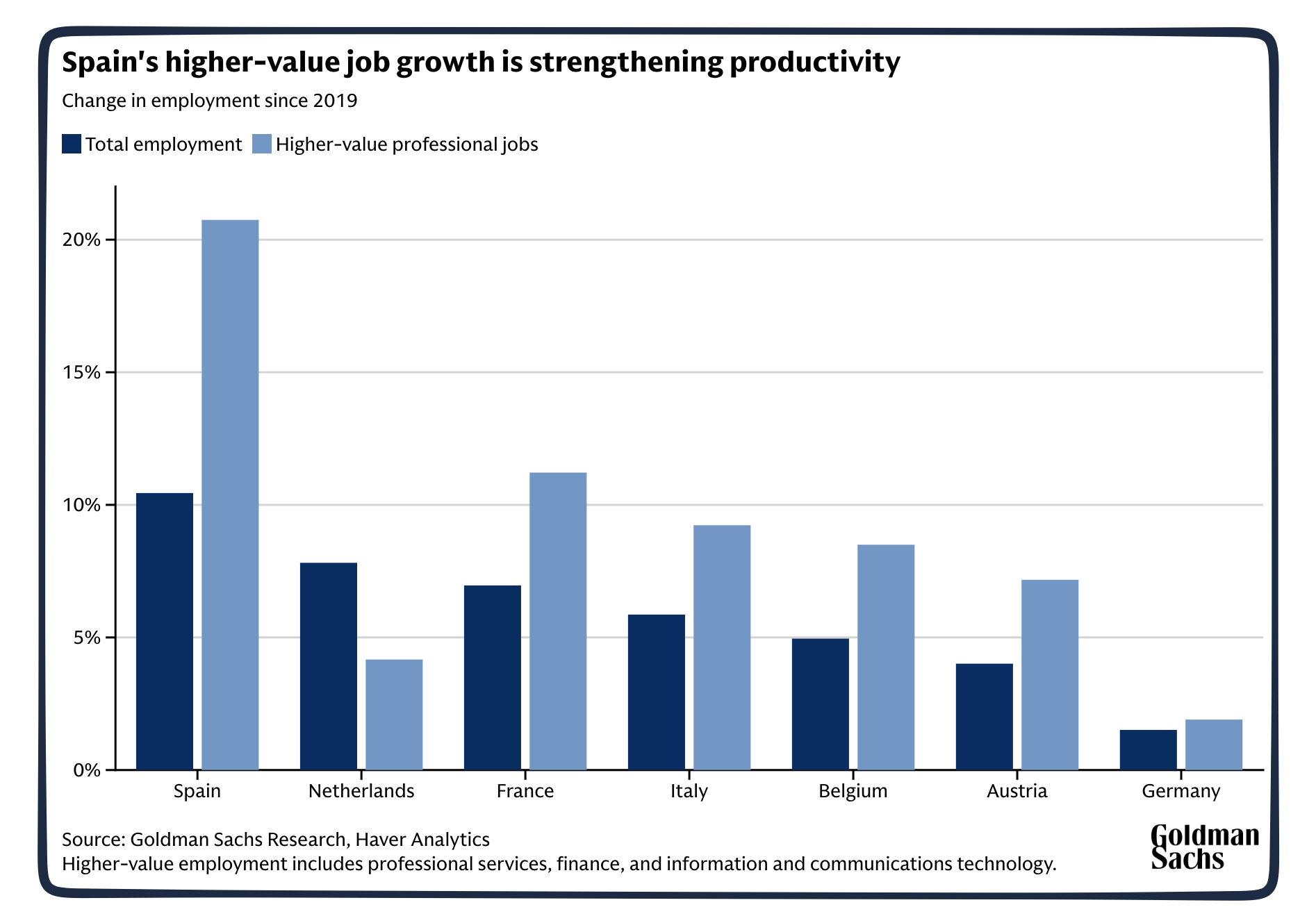
Reflecting human capital, Spain has demonstrated higher value job growth in sectors Including information technology and finance:
High value jobs and Spanish immigration

According to an IMF economist, a 1% increase in migrants’ share of the adult population in a rich country propels the GDP to an extra 2% of growth. At three million, migrants’ share of Spain’s population could have been close to 6%. Consequently, we can hypothesize that immigration did indeed invigorate Spain’s economy.

My sources and more: Thanks to Slate Money for alerting me to The Atlantic’s “The Spanish Exception”. Because of its focus on immigration, from there we returned to this econlife. Then, we discovered this Goldman Sachs commentary that confirmed all we concluded about Spain. Related, an Economist spotlight on Portugal also displayed the rising importance of the European South. It returns us to a contradiction of the stereotypes we initially cited.

Please note that several of today’s sentences were in a past econlife post.


The post How Immigrants Saved Spain appeared first on Econlife.


Source link

Leave a Reply

Subscribe to Our Newsletter

Get our latest articles delivered straight to your inbox. No spam, we promise.

Recent Reviews


Google is experimenting with a new policy restricting the amount of free storage provided to some accounts. New Google accounts (including new Gmail accounts) created in certain regions will be limited to 5GB of free storage when they’re first set up. That’s only one-third of the amount of storage that has been typically offered. There is a way of increasing the amount of free storage you get when setting up a new account, though: you can unlock it by linking your phone number.

When approached for comment by Android Authority, a Google spokesperson confirmed that the new policy was being tested to “help us continue to provide a high-quality storage service to our users, while encouraging users to improve their account security and data recovery.” The statement didn’t clarify which regions the policy is being tested in, nor for how long the testing period will last.

Notably, a Google One Help support page about account storage has been updated to state that each Google account contains “up to 15 GB of storage”, as noted by 9to5Google. Previously, the page didn’t say “up to”; it simply stated that accounts come with 15 GB of storage. So far, the experiment doesn’t appear to stretch to pre-existing accounts.

Per a screenshot shared by Reddit user Sungusungu on R/DeGoogle (a subreddit dedicated to finding alternatives to Google services and products) Google is collecting phone numbers to make sure that the full 15 GB of storage is only redeemed once per person. Of course, that’s easily evaded by using a burner phone to set up multiple accounts, should you want to. The pop-up directs users to a webpage to learn more about storage management. However, at the time of writing, the link redirects to the help center landing page instead.

How to link your Google account with a phone number

If you’re in the process of setting up a new Google account in an impacted region, then you might be prompted with the option of unlocking an extra 10 GB of storage using your phone number via a simple pop-up menu. If so, you can go ahead and follow those steps. However, if you want to link your phone number with a pre-existing Google account, then here’s what you need to do. Using your computer, you need to:

  1. Open your browser and head to myaccount.google.com, then navigate to “Security and sign in” on the left-hand toolbar. This should open a list of security options.

  2. Select “Use your phone to sign in” and then “Set it up”. 

  3. Add a phone number using the “Recovery phone” option.

  4. Follow the on-screen steps to verify your number and finish linking it to your account.

Your options might look a little different if you already have a recovery number set up with your account.

Alternatively, you can connect a phone number to your Google account from your Android device, iPhone, or iPad. Much like on a computer, you connect your number by adding it as a recovery phone. First, head over to myaccount.google.com. Then select “Personal info”, followed by “Phone”. From there, you should be able to add or edit your phone number by navigating to the “Recovery phone” section.


Source link