How the Strait of Hormuz’s Data Cables Could Be Compromised


Control of the Strait of Hormuz involves more than potato chips, tomatoes, Diet Coke, and condoms.

It is about data.

Strait of Hormuz Data Cables

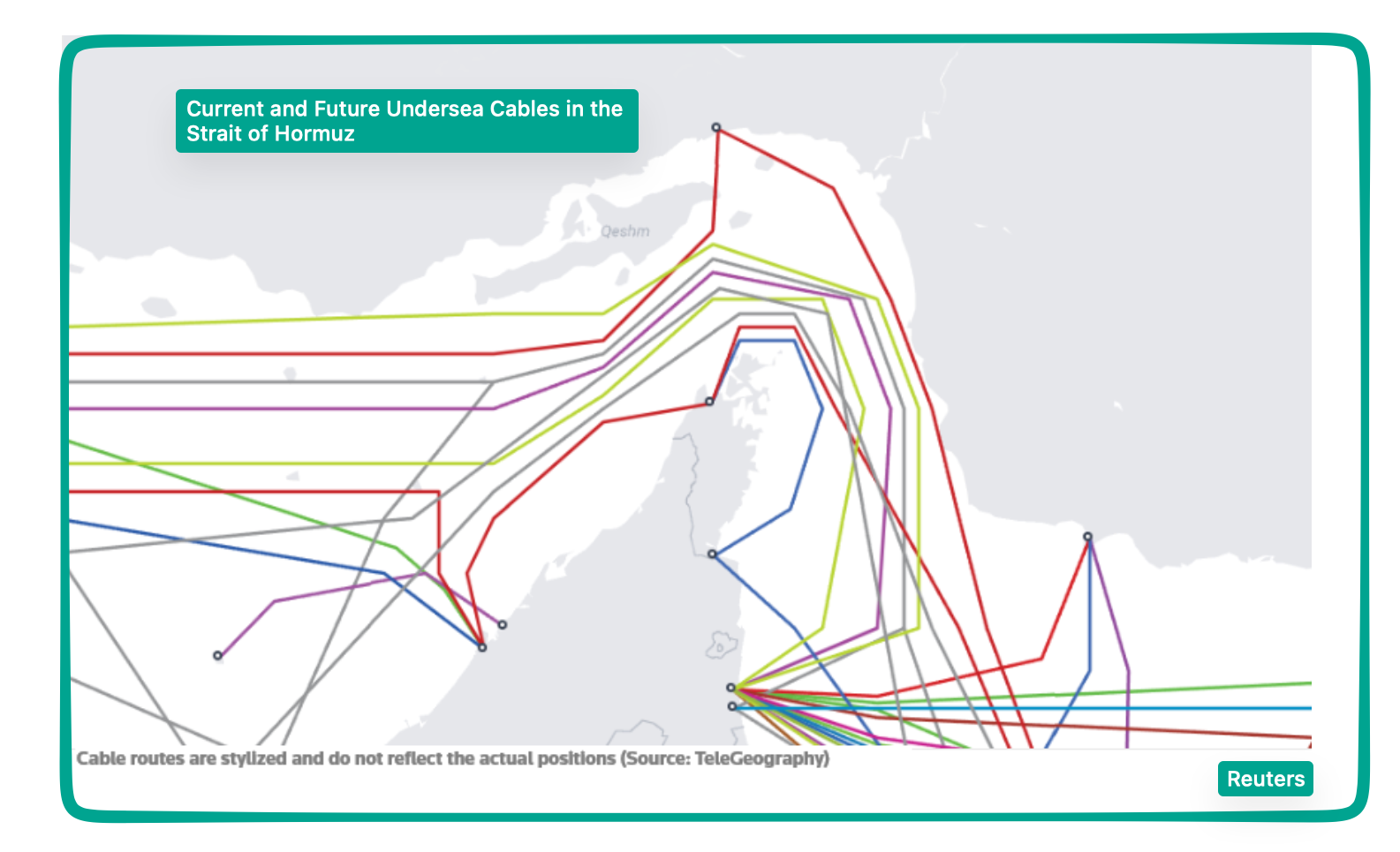
The undersea fiber-optic cables that bring internet data to the Middle East, Europe, and Asia snake through the Strait of Hormuz. So, when a spokesperson for the Iranian government said they would “…impose fees on internet cables,” it jolted big and little tech. We were already worried that military maneuvers would accidentally (or intentionally) jostle the cables. But it is also possible that damaged vessels will disrupt a cable with a dragging anchor. Now, in addition, a tax could upset the free flow of data.

As much as 20% of the world’s internet and financial data flows through the Strait of Hormuz. With their cheap energy, Saudi Arabia, and the UAE hope to lure the AI investment that needs those undersea cables. In addition, the Strait of Hormuz is home to some of the cables that service our data dependencies like cloud storage, e-commerce, and streaming services.

These cables are a part of larger networks:
Strait of Hormuz undersea cables

Our Bottom Line: Information Infrastructure

Thinking of an infrastructure, we could imagine transportation and our network of roads, airports, bridges, and all that we use for travel. We could picture the financial infrastructure that, starting with banks, moves our money from one place to another.

Somewhat similarly, our data travels through our information infrastructure. In a past post, we said the US Postal Service was a part of our information infrastructure. So too was the printing press, our stock tickers, and countless other devices and structures.

As for the internet, it has become an increasingly massive part of our information infrastructure: Moving from chips, to devices, to services, the structure grew:

future of AI

Already dated, this 2021 graphic shows some of the components of our information infrastructure:

future of AI

Returning to where we began, we can add invisible data to the impact of the Iran War.

My sources and more: Thanks to economist Ed Yardeni for alerting me to the data that travels through the Strait of Hormuz. From there, I discovered much more detail in this Reuters article. Then, looking for internet history, we can always go to this past econlife post.

Please note that several of today’s sentences are elsewhere in econlife.


Source link

Leave a Reply

Subscribe to Our Newsletter

Get our latest articles delivered straight to your inbox. No spam, we promise.

Recent Reviews


Google is experimenting with a new policy restricting the amount of free storage provided to some accounts. New Google accounts (including new Gmail accounts) created in certain regions will be limited to 5GB of free storage when they’re first set up. That’s only one-third of the amount of storage that has been typically offered. There is a way of increasing the amount of free storage you get when setting up a new account, though: you can unlock it by linking your phone number.

When approached for comment by Android Authority, a Google spokesperson confirmed that the new policy was being tested to “help us continue to provide a high-quality storage service to our users, while encouraging users to improve their account security and data recovery.” The statement didn’t clarify which regions the policy is being tested in, nor for how long the testing period will last.

Notably, a Google One Help support page about account storage has been updated to state that each Google account contains “up to 15 GB of storage”, as noted by 9to5Google. Previously, the page didn’t say “up to”; it simply stated that accounts come with 15 GB of storage. So far, the experiment doesn’t appear to stretch to pre-existing accounts.

Per a screenshot shared by Reddit user Sungusungu on R/DeGoogle (a subreddit dedicated to finding alternatives to Google services and products) Google is collecting phone numbers to make sure that the full 15 GB of storage is only redeemed once per person. Of course, that’s easily evaded by using a burner phone to set up multiple accounts, should you want to. The pop-up directs users to a webpage to learn more about storage management. However, at the time of writing, the link redirects to the help center landing page instead.

How to link your Google account with a phone number

If you’re in the process of setting up a new Google account in an impacted region, then you might be prompted with the option of unlocking an extra 10 GB of storage using your phone number via a simple pop-up menu. If so, you can go ahead and follow those steps. However, if you want to link your phone number with a pre-existing Google account, then here’s what you need to do. Using your computer, you need to:

  1. Open your browser and head to myaccount.google.com, then navigate to “Security and sign in” on the left-hand toolbar. This should open a list of security options.

  2. Select “Use your phone to sign in” and then “Set it up”. 

  3. Add a phone number using the “Recovery phone” option.

  4. Follow the on-screen steps to verify your number and finish linking it to your account.

Your options might look a little different if you already have a recovery number set up with your account.

Alternatively, you can connect a phone number to your Google account from your Android device, iPhone, or iPad. Much like on a computer, you connect your number by adding it as a recovery phone. First, head over to myaccount.google.com. Then select “Personal info”, followed by “Phone”. From there, you should be able to add or edit your phone number by navigating to the “Recovery phone” section.


Source link