I found an AirTag alternative that’s twice as durable and works with Android phones


img-3352.jpg

pros and cons

Pros

  • These touch tags can withstand life on key chains and being dropped.
  • They feature a USB-C rechargeable battery, so there are no button cells to mess with.
  • They work with both iPhone and Android devices.
Cons

  • The little cover for the USB-C port isn’t attached, so it could become lost.

Follow ZDNET: Add us as a preferred source on Google.


Yes, once again, I declare my undying love for the Apple AirTag. Overnight, that little plastic disc has pretty much eliminated the stress of losing things like keys and bags. But if you’re an Android user, you’re not invited to the AirTag party. 

Thankfully, a host of third-party makers have stepped in to fill the void. And while no tag is quite as good as the AirTag — precision finding that takes you directly to the tag feels like magic — there are still some great alternatives out there.

But there’s one big problem: durability.

Also: This $5 magnetic USB-C connector can save your laptop’s charging port

Life on a keychain is tough. Keys are hard, sharp, and they get dropped, stepped on, and banged around. While AirTags are relatively robust — partly because they require an additional holder to attach them to keys — a lot of third-party tags aren’t as durable. Sure, they’re probably good enough for the average person, but I’ve had tags crack, break, and even burst apart (a common issue with replaceable-battery tags that snap together).

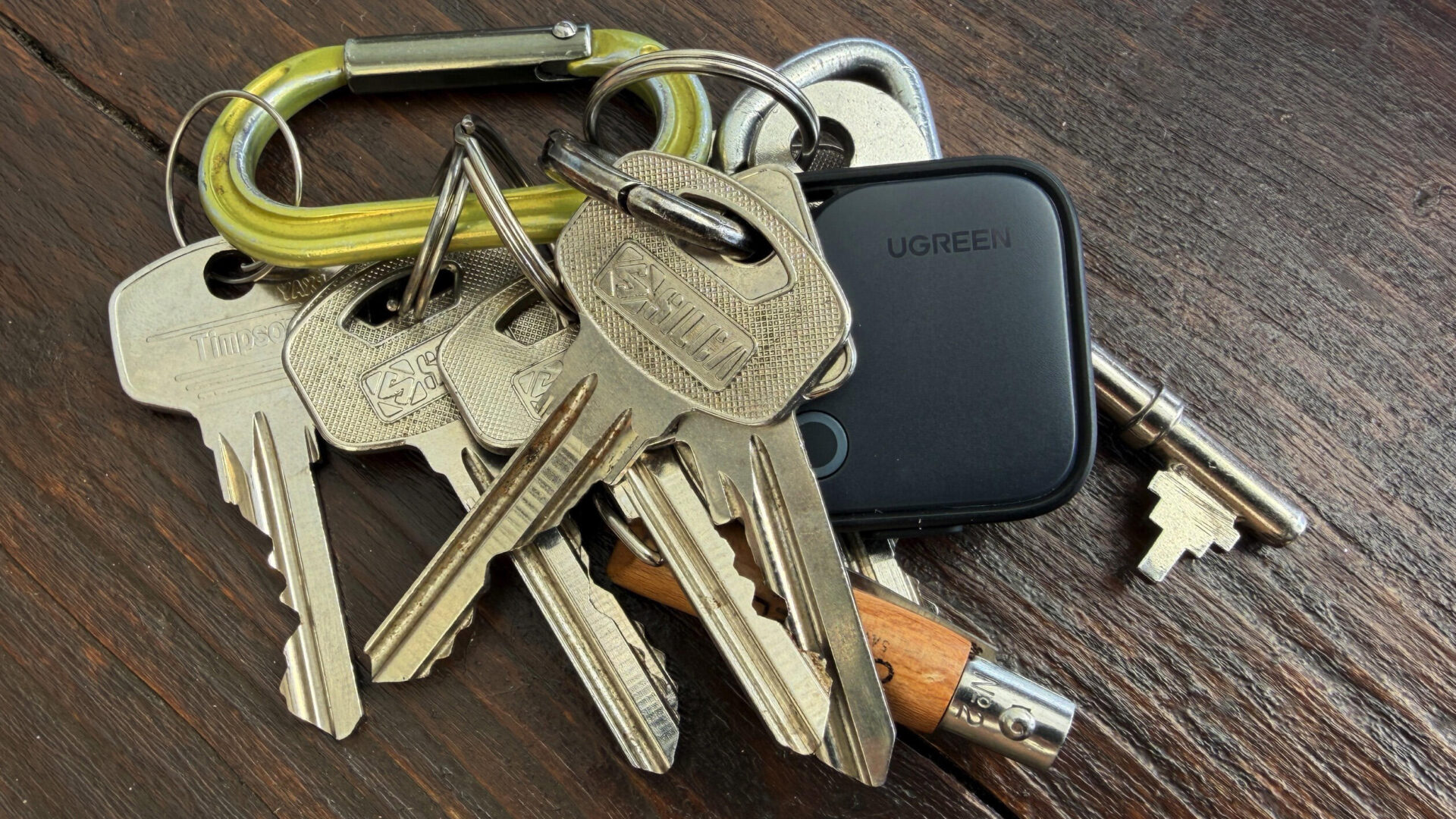
That’s why I found the new Finder Pro tags from Ugreen so impressive. These tags have earned the title of “toughest tags I’ve tested.”

Features and design

Before diving into their durability, let’s take a look at the tags themselves. The Finder Pro tags are standard keychain-style tags, but instead of the circular shape most manufacturers use, these are square, measuring 1.25 x 1.25 x 0.6 inches. They’re made of a tough polymer, and there’s a hole in one corner to make attaching them to keys and luggage easy.

Also: This single power station is keeping my off-grid cabin running – here’s why I picked it

The tags feature a built-in 90 mAh polymer lithium-ion battery that’s rechargeable via a USB-C port on the bottom. The battery has an estimated runtime of a year, so you won’t be using the USB-C port very often.

The USB-C port has a little cover -- it can be lost but is not really necessary.

The USB-C port has a little cover — it can be lost but is not really necessary.

Adrian Kingsley-Hughes/ZDNET

To keep dirt, moisture, and other pocket grime out of the port, Ugreen has included a small rubber cover. This cover is detachable, so there’s a chance it could get lost, but all of mine have stayed in place. Even if you lose it, it’s not the end of the world — after all, your smartphone’s USB-C port doesn’t come with a cover, and it lives in your pocket or bag just fine.

Sound comparison

The Finder Pro is also louder than an AirTag. Ugreen claims the speaker outputs a sound in the range of 80 to 100 dB, and when I tested it (using a smartphone app for this, which, while not perfectly accurate, is good enough for this kind of test), I got readings around the 90 dB mark. For reference, that’s on par with a power tool or a nearby motorcycle. By comparison, Apple AirTags are around 80 dB, equivalent to the noise level of a vacuum cleaner, heavy traffic, or a busy restaurant.

I ran my usual test of hiding the tag under some sofa cushions, and the Finder Pro was noticeably louder than the AirTag.

A quick note on decibels

It’s worth noting that the decibel (dB) scale is logarithmic, not linear. This means that every 10 dB increase represents a tenfold increase in sound intensity. However, the human ear perceives a 90 dB sound as being about twice as loud as an 80 dB sound. So while the Finder Pro’s 90 dB output may not seem like a huge jump on paper, it’s significantly louder in practice.

Compatibility and range

Like many third-party tags, the Finder Pro works with both the Apple Find My and Google Find My Device networks. However, keep in mind that you can’t connect it to both simultaneously — you have to choose one when setting up the tag.

I tested the range of the tags, and the quoted Bluetooth range of 30 to 65 feet checks out for line of sight and when there’s not much between the tag and the searching smartphone, which is pretty typical for Bluetooth-based finder tags.

Durability testing

Now, let’s talk about durability. To put these tags through their paces, I subjected them to a series of grueling tests. I attached them to a bunch of old keys and tumbled them in the dryer (on cold) for a couple of hours. I tossed them around.

I even drove over them.

Drove over your tag? No problem!

Adrian Kingsley-Hughes/ZDNET

No problem.

These tags are tough. Sure, they pick up some scratches and scrapes along the way, but nothing that affected the performance of the tag.

I subsequently took the tag that was driven over apart (the tag was driven over several times to get the shot I wanted), and there was no real damage to the case, seams, or interior.

Curious about what's inside a finder tag? Here you go!

Curious about what’s inside a finder tag? Here you go!

Adrian Kingsley-Hughes/ZDNET

ZDNET’s buying advice

The Ugreen Finder Pro tags are durable, loud, and feature-packed, making them some of the best third-party alternatives to the Apple AirTag that I’ve tested. While they may not have the precision finding magic of AirTags, their rugged build and long-lasting rechargeable battery make them a fantastic choice for anyone prone to losing things and looking for a reliable, hard-wearing tracker.

These tags — which are called Finder Duo over on Amazon, but Finder Pro on the box (confusing) — normally retail for $50 for a four-pack, but they are currently only $30, making them an unmissable deal!




Source link

Leave a Reply

Subscribe to Our Newsletter

Get our latest articles delivered straight to your inbox. No spam, we promise.

Recent Reviews


The Windows Insider Program is about to get much easier

Ed Bott / Elyse Betters Picaro / ZDNET

Follow ZDNET: Add us as a preferred source on Google.


ZDNET’s key takeaways

  • Microsoft is making the Insider Program less complicated.
  • Beta channel will be a more reliable preview of the next retail release.
  • Other changes will allow testers to quickly enable/disable new features.

Last month, Microsoft took official notice of its customers’ many complaints about Windows 11. Pavan Davaluri, the executive vice president who runs the Windows and Devices group, promised sweeping changes to Windows 11. Today, the company announced the first of those changes in a post authored by Alec Oot, who’s been the principal group product manager for the Windows Insider Program since January 2024.

Those changes will streamline the Insider program, which has lost sight of its original goals in the past few years. (For a brief history of the program and what had gone wrong, see my post from last November: “The Windows Insider Program is a confusing mess.”)

Also: If Microsoft really wants to fix Windows 11, it should do these four things ASAP

If you’re currently participating in the Windows Insider Program, these are meaningful changes. Here’s what you can expect.

Simplifying the Insider channel lineup

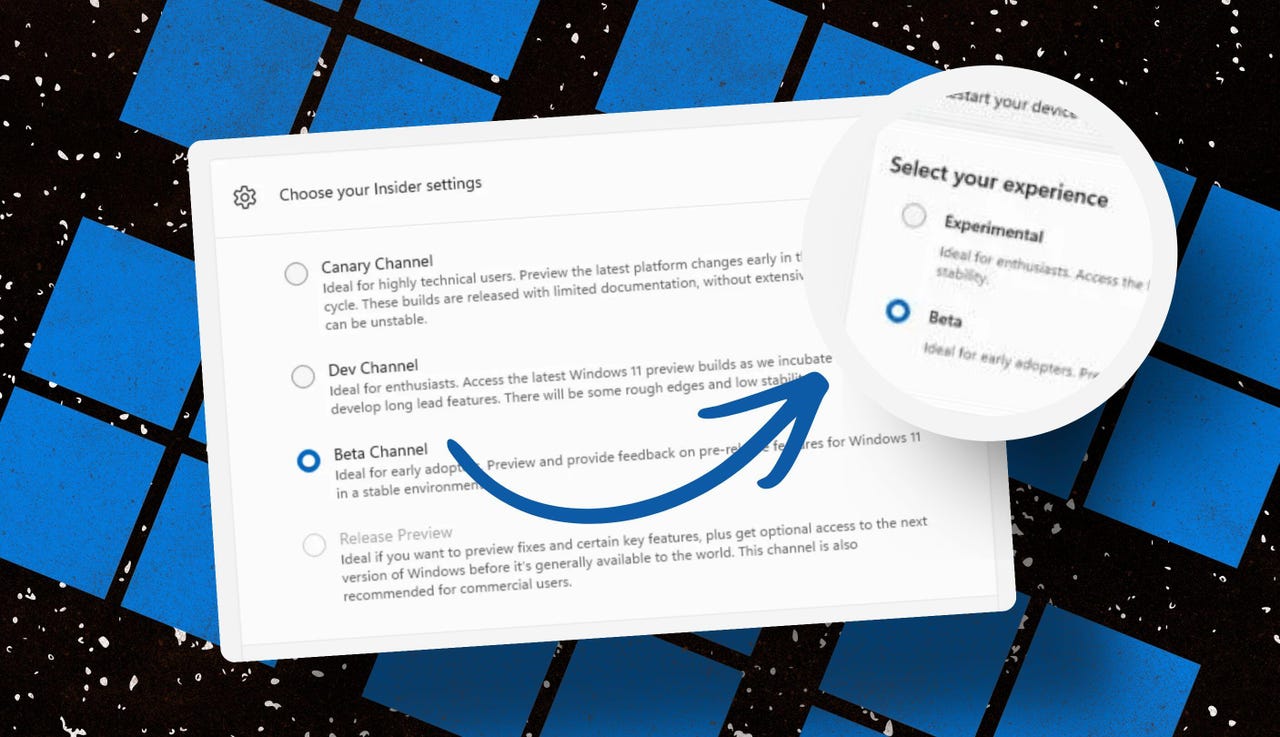
Throughout the Windows 11 era, signing up for the Insider program has required choosing one of four channels using a dialog in Windows Settings. Here’s what those options look like today on one of my test PCs.

insider-program-channels-lineup-old

The current Insider channel lineup is confusing, to say the least.

Screenshot by Ed Bott/ZDNET

Which channel should you choose? As the company admitted in today’s post, “the channel structure became confusing. It was not clear what channel to pick based on what you wanted to get out of the program.”

The new lineup consists of two primary channels: Experimental and Beta. The Release Preview channel will still be available, primarily for the benefit of corporate customers who want early access to production builds a few days before their official release. That option will be available under the Advanced Options section.

windows-insider-channel-lineup-new

This simplified lineup is easier to follow. Beta is the upcoming retail release, Experimental is for the adventurous.

Screenshot courtesy of Microsoft

Here’s Microsoft’s official description of what’s in each channel now, with the company’s emphasis retained:

  • Experimental replaces what were previously the Dev and Canary channels. The name is deliberate: you’re getting early access to features under active development, with the understanding that what you see may change, get delayed, or not ship at all. We’ve heard your feedback that you want to access and contribute to features early in development and this is the channel to do that.
  • Beta is a refresh of the previous Beta Channel and previews what we plan to ship in the coming weeks. The big change: we’re ending gradual feature rollouts in Beta. When we announce a feature in a Beta update and you take that update, you will have that feature. You may occasionally see small differences within a feature as we test variations, but the feature itself will always be on your device.

These changes will apply to the Windows Insider Program for Business as well.

Offering a choice of platforms

For those testers who want to tinker with the bleeding edge of Windows development, a few additional options will be available in the Experimental channel. These advanced options will allow you to choose from a platform that’s aligned to a currently supported retail build. Currently, that’s Windows 11 version 25H2 or 26H1, with the latter being exclusively for new hardware arriving soon with Snapdragon X2 Arm chips.

Also: Microsoft account vs. local account: How to choose

There will also be a Future Platforms option, which represents a preview build that is not aligned to a retail version of Windows. According to today’s announcement, this option is “aimed at users who are looking to be at the forefront of platform development. Insiders looking for the earliest access to features should remain on a version aligned to a retail build.”

windows-insider-advanced-options-new

The Future Platforms option is the equivalent of the current Canary channel

Screenshot courtesy of Microsoft

Minimizing the chaos of Controlled Feature Rollout

Last month, I urged Microsoft to stop using its Controlled Feature Rollout technology, especially for builds in the Beta channel. Apparently, someone in Redmond was listening.

One of the most common questions we receive from Insiders is “why don’t I have access to a feature that’s been announced in a WIP blog?” This is usually due to a technology called Controlled Feature Rollout (CFR), a gradual process of rolling out new features to ensure quality before releasing to wider audiences. These gradual rollouts are an industry standard that help us measure impact before releasing more broadly. But they also make your experience unpredictable and often mean you don’t get the new features that motivated many of you to join the Insider program to begin with.

Moving forward, Insider builds in the Beta channel will no longer suffer from this gradual rollout of features. Meanwhile, the company says, “Insiders in the Experimental channel will have a new ability to enable or disable specific features via the new Feature Flags page on the Windows Insider Program settings page.”

windows-insider-feature-flags

Builds in the Experimental channel will include the option to turn new features on or off.

Screenshot courtesy of Microsoft

Not every feature will be available from this list, but the intent is to add those flags for “visible new features” that are announced as part of a new Insider build.

Making it easier to change channels

The final change announced today is one I didn’t see coming. Historically, leaving the Windows Insider Program or downgrading a channel (from Dev to Beta, for example) has required a full wipe and reinstall. That’s a major hurdle and a big impediment to anyone who doesn’t have the time or technical skills to do that sort of migration.

Also: Why Microsoft is forcing Windows 11 25H2 update on all eligible PCs

Beginning with the new channel lineup, it should be easier to change channels or leave the program without jumping through a bunch of hoops.

To make this a more streamlined and consistent experience, we’re making some behind the scenes changes to enable Insider builds to use an in-place upgrade (IPU) to hop between versions. This will allow in most cases Insiders to move between Experimental, Beta, and Release Preview on the same Windows core version, or leave the program without a clean install. An IPU takes a bit more time than your normal update but migrates your apps, settings, and data in-place.

If you’ve chosen one of the future platforms from the Experimental channel, those options don’t apply. To move back to a supported retail platform, you’ll need to do a clean install.

Also: Apple, Google, and Microsoft join Anthropic’s Project Glasswing to defend world’s most critical software

The upshot of all these changes should make things a lot clearer for anyone trying to figure out what’s coming in the next big feature update. Beta channel updates, for example, should offer a more accurate preview of what’s coming in the next big feature update, so over the next month or two we should get a better picture of what’s coming in the 26H2 release, due in October.

When can we start to see those changes rolling out to the general public? Stay tuned.


Source link