
Follow ZDNET: Add us as a preferred source on Google.
ZDNET’s key takeaways
- ChatGPT’s Live model aims to enhance voice-based conversations with AI.
- With Live, ChatGPT can speak and listen to you at the same time.
- ChatGPT can now speak with you almost as if it were a real person.
I like having voice conversations with my favorite AIs. Chatting by voice feels more convenient and more engaging than interacting via regular text prompts. But depending on the model, the conversation can still feel stilted.
In voice mode, most AIs can tackle only one task at a time — either speaking to you or listening to you. Try to pause or interrupt, and the conversation can go off the rails. Now, OpenAI has unveiled new voice models for ChatGPT that promise to turn the AI into a more natural and accomplished conversationalist.
Also: AI Model Release Tracker: OpenAI’s new GPT-Live-1 voice model won’t interrupt you
Added on Wednesday to the ChatGPT website, the Windows app, and the mobile apps, the new GPT-Live uses a “full-duplex architecture.” That simply means it can both speak to you and listen to you at the same time. While you’re talking, the AI model shows that it’s paying attention by sneaking in phrases like “Yeah” or “Mhmm.” Depending on the flow of the conversation, GPT-Live can keep up with you in quick back-and-forth banter or stay silent while it gives you time to collect your thoughts.
(Disclosure: Ziff Davis, ZDNET’s parent company, filed an April 2025 lawsuit against OpenAI, alleging it infringed Ziff Davis copyrights in training and operating its AI systems.)
While the two of you are chatting away, you can ask ChatGPT to conduct research or carry out a request. The online search is handed off to another model behind the scenes, so the AI can focus on your conversation without interruption. That reminds me of myself when I’m speaking with a friend or relative on the phone who needs technical help, and I’m searching for the topic on the web, all at the same time.
The new full-duplex conversational model is available for all ChatGPT users. However, there are two different models depending on whether you’re a paid subscriber or a free user. GPT‑Live‑1 is the default model for ChatGPT Voice for Go, Plus, and Pro users. GPT‑Live‑1 mini is the default for free users. Between the two, GPT‑Live‑1 offers higher quality, while the mini model uses fewer resources.
Want to take it for a spin?
You can try Live Voice on the ChatGPT website, the ChatGPT Windows app, and the iOS and Android mobile apps. The ChatGPT Mac app no longer supports Voice mode, so Mac users will have to turn to the website.
The new Live model should automatically be accessible. To check at the site or one of the apps, go to Settings and select Voice. The model should show Live as the new default. Select the drop-down menu, and you can always go back to Advanced or Standard, but I recommend keeping it at Live.
Also: How to audit what ChatGPT knows about you – and reclaim your data privacy
Another option called Intelligence determines the level of reasoning ChatGPT uses in your voice chats. As the default, Instant is fine for general chats and quick replies. Medium digs deeper into your question or request and takes longer to respond. High is for more complex problem solving and takes the longest to finish. You’ll want to keep it set at Instant for the most part unless you’re conducting complex research.
You can also change the voice based on gender, accent, and other attributes. Since I love anything British, my favorite is Vale with her friendly yet bright British accent.
To kick off a voice conversation, select the voice icon to the right of the prompt. After you’re done, ChatGPT displays a transcription of your entire chat.
Though GPT-Live is technically a smaller upgrade than a brand-new general model, it still promises to enhance the experience of speaking with AI assistants. Does it live up to that promise? Here’s what I found.
Search the web during a conversation
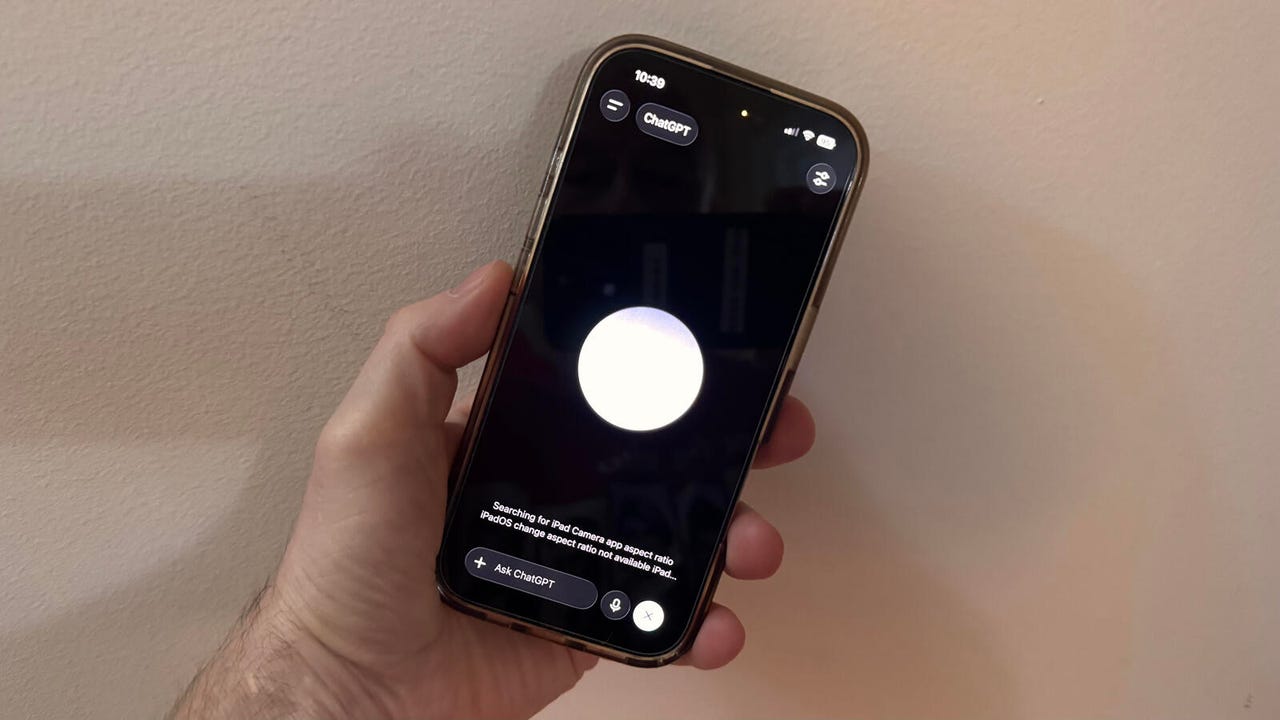
In one conversation, I told ChatGPT that I couldn’t find a way to change the aspect ratio in the Camera app on an iPad mini. At first, the AI gave me instructions that worked only on an iPhone. I interrupted it to explain that the suggested steps apply to an iPhone but don’t seem to work on an iPad mini. In response, ChatGPT searched the web during our conversation to confirm that the iPad mini doesn’t let you change the ratio in the camera app.
Also: I connected ChatGPT to my bank, and it’s my go-to finance app now – here’s how (and why)
The AI then gave me instructions for changing the ratio in the Photos app. Again, I interrupted and asked it to find third-party camera apps for the iPad that would let me change the ratio before taking a photo. ChatGPT searched the web while it resumed our conversation about changing this in the Photos app. I then asked it to tell me about the third-party apps it found. Throughout the conversation, ChatGPT handled all interruptions and requests while remaining focused on our chat.
Change up a story
In another conversation, I asked it to tell me a story about my cat, Mr. Giggles, traveling to the moon and landing there. During the chat, I interrupted it a few times, telling it to slow down, speed up, and even change the story so that Mr. Giggles lands on Mars instead. Each time, the AI easily let me interrupt it and adjusted the story based on my request.
Veer off in different directions
In another conversation, I told ChatGPT I wanted to discuss classic Hollywood films of the ’30s, ’40s, and ’50s. After the conversation kicked off, the AI mentioned screwball comedies of the ’30s, noir films of the ’40s, and Technicolor musicals of the ’50s and asked me which mood struck me. After I suggested screwball comedies, the conversation veered off in that direction. Along the way, ChatGPT suggested several films in that genre. We explored one particular film that I’ve seen but don’t enjoy as much as others. We explored why that could be, and the AI came up with a great explanation. Beyond just taking the chat in different directions, I thoroughly enjoyed the conversation — it felt like talking to a fellow film lover.
Translate a conversation
Finally, I asked ChatGPT to translate a live conversation, specifically one between me speaking English and someone else speaking French. The back-and-forth live translations were quick and fluid, fitting right into the conversation. The next time I need a translator when I’m in another country, I’ll definitely give ChatGPT the job.
Also: How to use ChatGPT: A beginner’s guide to mastering OpenAI’s chatbot
Any problems?
What happens if the TV is on in the background or other people are speaking near you? Could that interrupt your conversation? Two ZDNET editors who tried GPT Live said that their conversations were interrupted by background audio and by another person speaking, forcing them to tell the AI to continue the chat.
I tried to replicate that problem but I couldn’t. Even with loud TV dialogue playing and someone speaking in the background, none of my conversations were ever interrupted. If you do run into this dilemma, there’s not much you can do other than turn down the background audio or try to shush the other person speaking.
Final thoughts
Otherwise, I was quite impressed with ChatGPT’s new Live modes and enjoyed speaking with the AI without the usual impediments. The conversations certainly flowed and felt almost like speaking with a real person. From now on, I’ll choose ChatGPT when I want to strike up a conversation with an AI.