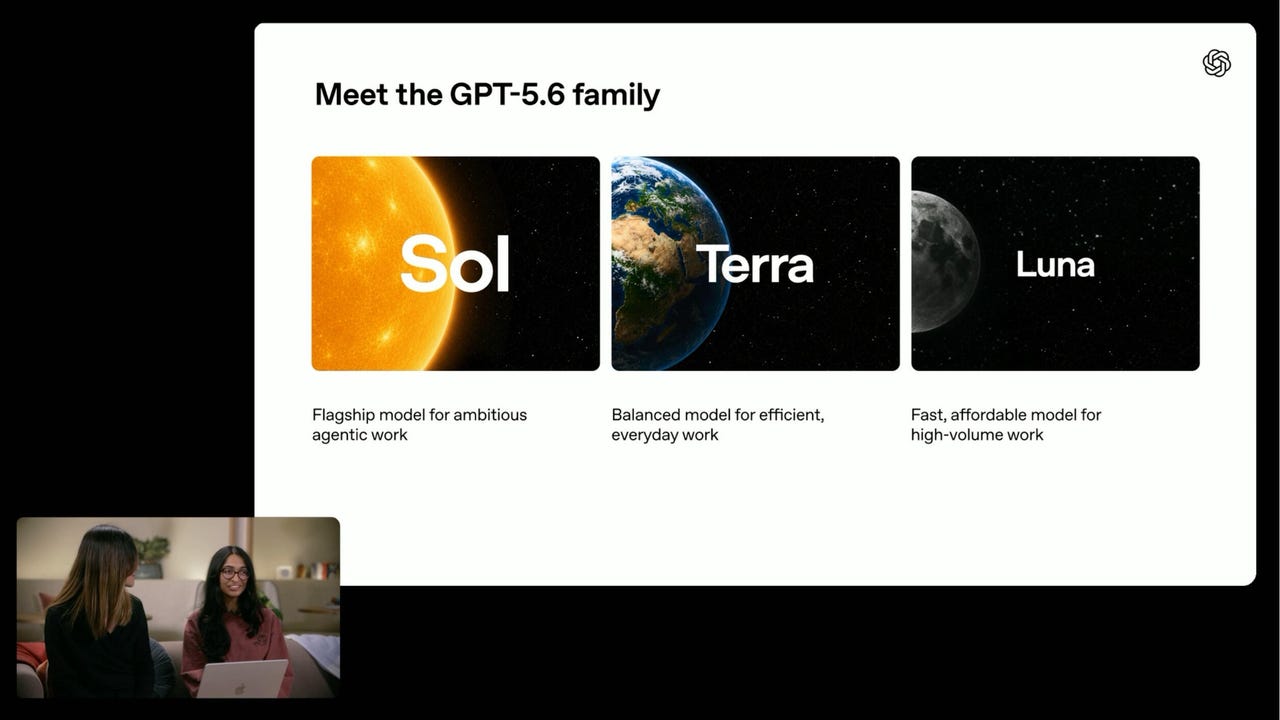

OpenAI’s briefing on the new models.
Screenshot by David Gewirtz/ZDNET
Follow ZDNET: Add us as a preferred source on Google.
ZDNET’s key takeaways
- OpenAI’s GPT-5.6 launch looks aimed directly at Anthropic.
- Sol, Terra, and Luna map closely to GPT-5.5’s tiers.
- ChatGPT Work brings OpenAI’s agent tools beyond coding.
OpenAI cranked out a series of big announcements today. They’re news-making in their own right, but I have to be honest with you. These announcements also feel like they’re OpenAI’s way of playing catch-up with all the buzz Anthropic has been generating.
Key among the announcements are three new models: GPT-5.6 Sol, Terra, and Luna. We knew that 5.6 was on the way because the government stepped in last month to delay its release. This, of course, follows hot on the heels of the big news-dominating Anthropic/White House kerfuffle about Fable 5 and Mythos 5.
Also: I tested ChatGPT’s Live Voice upgrade, and it almost felt human – how to try it
Also announced was ChatGPT Work, which is clearly OpenAI’s answer to Claude Cowork. ChatGPT Work allows the AI to access your desktop and browser and perform tasks for you.
This is not a new OpenAI feature. Previously, it was embedded in the Codex app, OpenAI’s agentic programming tool. Clearly, OpenAI took a branding page from Anthropic and separated the agentic work assistant from its agentic coding tool, which should make it more appealing to non-coders.
I have often criticized OpenAI for its startling absence of a good branding strategy, so this is actually a positive sign. Perhaps its programmers are no longer driving their product marketing strategy. Then again, perhaps ChatGPT 5.6 Sol is.
Benchmarks put Claude comparisons in the announcement
There’s no doubt OpenAI has Anthropic in its sights. The company’s announcement of the new models directly targets testing results and pricing levels of Anthropic’s offerings. But first, let’s do a quick rundown of those celestial model names.
- Sol: This is the flagship model, aimed straight at Fable 5. It is roughly equivalent to GPT-5.5’s thinking mode.
- Terra: As the Earth is smaller than the sun, Terra is less capable than Sol. Terra is the default, mainstream GPT-5.6 model, equivalent to GPT-5.5.
- Luna: As the moon is smaller than the Earth, Luna is less capable than Terra. Think of it as the equivalent of GPT-5.5’s instant model.
Agents’ Last Exam is a benchmark for testing how well AI models handle long-running, multi-step professional workflows across 55 fields. OpenAI says GPT-5.6 Sol scored 53.6 on Agents’ Last Exam, beating Claude Fable 5 by 13.1 points.
Artificial Analysis Intelligence Index is another benchmark. It attempts to quantify broad model intelligence across several categories. OpenAI says Sol came within one point of Fable 5 while completing tasks in 61% less time.
Also: Microsoft goes all in on new AI-powered Windows security strategy – what it means for you
In yet another benchmark, OpenAI says GPT-5.6 Sol reached 80 on the Artificial Analysis Coding Agent Index, 2.8 points above Fable 5. Are you seeing a theme here?
OpenAI also says that GPT-5.6, and especially Sol, is much more efficient and therefore less costly than Fable. At medium reasoning, OpenAI says Sol beat Fable 5 by 11.4 points at roughly one-quarter the estimated cost.
GPT-5.6 is also faster and more efficient than GPT-5.5. Qodo is an AI code review tool that gives teams deep codebase context to create faster and improve code quality.
Itamar Friedman, Qodo’s co-founder and CEO says, “GPT‑5.6 was the strongest model we evaluated on our agentic code-review tests. On our apples-to-apples internal and external PR benchmarks, it beat GPT‑5.5 on F1 while using roughly 3x fewer tokens per PR and delivering about 2x lower median latency.”
After all the government fuss about model safety and misuse, OpenAI says GPT-5.6 includes safeguards that combine model protections, real-time checks, monitoring, and access calibrated to trust and risk. According to the announcement, “GPT-5.6 launches with our most robust safeguards to date.”
ChatGPT Work
And then there’s ChatGPT Work, OpenAI’s agentic desktop productivity tool. Think Claude Cowork, but with OpenAI’s models. ChatGPT Work can create spreadsheets, PowerPoints, and full websites. It can work on complex projects for hours by breaking them into smaller tasks.
In one of the scariest demos I’ve seen in a long time, an OpenAIer let ChatGPT Work loose in his Apple Notes, allowing the tool to completely reorganize all his notes. Now, I gotta tell you. I heavily rely on the notes in my Apple Notes, and the idea that the AI would go in and move all that stuff around freaks me out.
OpenAI demonstrates Work reorganizing Apple Notes.
Screenshot by David Gewirtz/ZDNET
It’s a definitely powerful example of what ChatGPT Work can do, but I have trust issues at this level of delegation.
According to OpenAI, “The best way to learn how to use ChatGPT Work is to give it a task you already know well: analyze a month-end budget variance, turn source materials into a marketing campaign brief, or prepare for a sales meeting. You can follow its progress, answer questions, change direction, and approve important actions.”
Also: I gave Claude Cowork 7 non-coding jobs, and it earned a spot in my toolbox
I’ve been using Claude Cowork to do some of these larger, more complex agentic workflows, and it’s saved me a lot of time. While I haven’t yet tested ChatGPT Work, early users report similar benefits.
Angela Ferrante, head of enterprise marketing at Zapier, is quoted in the announcement as saying, “[We] used ChatGPT Work to build a repeatable system for reviewing thousands of leads each month. It traced customer touchpoints across Zapier’s CRM, email, and other tools, found where follow-ups broke down, and generated a weekly executive dashboard that highlighted missed pipeline and revealed seven figures in potential sales.”
In the same way that Claude Cowork connects to outside applications, ChatGPT Work has plugins and connectors that work with Slack, Microsoft Teams, Google Drive, SharePoint, email, calendars, CRMs, and project trackers, among other tools.
Availability
ChatGPT Work is rolling out on web and mobile for Pro, Enterprise, and Edu plans, with Plus and Business following over the next few days. I’m curious about how much you’ll be able to get done with Work on the $20/mo Plus plan. Since that’s the tier I’m spending on now, I’ll be testing it out, and I’ll report back to you.
Also: I connected ChatGPT to my bank, and it’s my go-to finance app now
Up until now, OpenAI had separate ChatGPT and Codex desktop apps. They’re combining the two into one app. Anthropic combines Claude chat, Claude Code, and Claude Cowork into one desktop app. From the announcement, it wasn’t clear whether ChatGPT Work will be folded into the newly combined ChatGPT/Codex app. This, too, I’ll tell you more about once I go hands-on.
Would GPT-5.6’s faster performance and lower cost make you more likely to choose OpenAI over Anthropic? Let us know in the comments below.
You can follow my day-to-day project updates on social media. Be sure to subscribe to my weekly update newsletter, and follow me on Twitter/X at @DavidGewirtz, on Facebook at Facebook.com/DavidGewirtz, on Instagram at Instagram.com/DavidGewirtz, on Bluesky at @DavidGewirtz.com, and on YouTube at YouTube.com/DavidGewirtzTV.