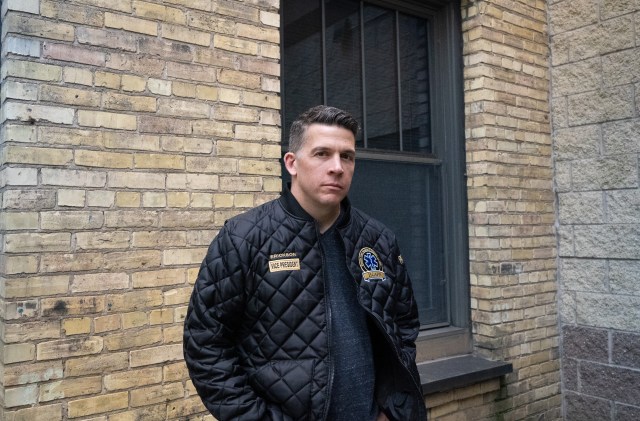
In 13 years as a paramedic, this past year has been especially trying for Sam Erickson. Beyond the predictable incidents – strokes, falls, painful accidents – he responded to an infant suffering cardiac arrest from co-sleeping with a parent; repeated overdoses; and residents “brutalized by federal agents” during Operation Metro Surge.
The personal toll added up, said Erickson, who’s also the vice president of the union representing paramedics and EMTs, and he decided to take an extended leave. While he was away, he took part in regular therapy sessions where he contemplated not returning to the work at all.
“I just needed to step away to maintain my ability to not only be a medical provider for my community, [but] because I live in the community,” Erickson told MinnPost. “I could tell that the stuff was affecting me outside of work as well.”
From 2022: How bad is the EMS staffing and diversity shortage, and how does Hennepin EMS want to solve it?
Erickson is not alone. In conversations with numerous emergency medical service providers in Hennepin County, they shared stories of a deeply distressing year for the Twin Cities, from the mass shooting at Annunciation Catholic Church and School to the widespread impact of Operation Metro Surge. In response, some say they feel pushed to the brink and are calling for new leadership, staffing ratios aligned with increasing demands and greater investment in mental health supports.
‘No confidence’ in EMS department chief
Union concerns came to a head this spring when 140 out of 147 members of Hennepin County Association of Paramedics and EMTs, or HCAPE, voted “no confidence” in Hennepin EMS Department Chief Martin Scheerer. The vote came amid ongoing contract negotiations between the union and Hennepin Healthcare, following the expiration of a three-year contract at the end of 2025.

A May letter from HCAPE to Hennepin Healthcare’s interim CEO, Dr. John Cumming, cited concerns like “irregular and, at times, inequitable disciplinary practices,” a lack of transparency around decision-making and “ongoing staffing challenges, increased workload, and persistent vacancies.”
“Members have also expressed serious concern regarding the increasing number of employees on mental health leave, driven by the cumulative stress of the job and workplace environment, often met with limited or insufficient organizational support,” said the letter, which was shared to HCAPE’s social media accounts.
In an email to MinnPost, a spokesperson for Hennepin Healthcare said that its leaders “recognize that our paramedics, EMTs, and dispatchers work in a high-stress environment every day, responding to difficult calls, managing demanding workloads, and navigating emotionally challenging situations.” The hospital system has “expanded the EMS team in recent weeks and [we] are actively recruiting for additional positions.”
A dwindling EMS workforce
Statewide, there are just under 31,000 certified and registered EMS personnel, according to figures from Minnesota’s Office of Emergency Medical Services. Providers are broken up into four types: emergency medical responders (EMRs), emergency medical technicians (EMTs), advanced emergency medical technicians (AEMTs) and paramedics.
EMRs, the lowest-tier EMS providers, are the first people on a scene and can treat immediate, life-threatening medical emergencies by doing things like performing CPR and controlling bleeding. EMTs are the next step up and can provide basic life support skills, like stabilizing and transporting patients to a hospital. AEMTs can start IVs and administer certain medications. And paramedics – the most highly-trained providers – can give advanced care under physician supervision.
During the COVID-19 pandemic, the EMS industry in Minnesota saw declining staffing numbers, according to data from the state’s EMS Workforce Dashboard. The number of EMS certifications that expired outpaced the number that were issued in 2020 and 2021. From 2022-24, the industry saw a small net gain in certifications. But in 2025, the most recent year with data, there was again a net loss.
Disguised in the overall numbers is a drop in the most highly trained providers – paramedics. In the Twin Cities metro area specifically, 2024 saw a net gain of 21 EMTs but a net loss of 67 paramedics, based on figures from the 2024 EMS System Report.
County weighing changes
In the midst of an overall decline in the number of EMS providers, Hennepin County is in the process of reevaluating how many providers should staff ambulances at a time. While county ordinance long required two paramedics to staff an ambulance for the highest risk calls, county commissioners now are considering changing the requirement to align with the state’s statute requiring only one paramedic and one EMT. While it may seem like a small change, some argue it can reduce health equity standards and puts more pressure on paramedics, like Erickson.

“To shoulder that burden functionally alone, as far as the highest-level provider, is exhausting,” Erickson said at a Hennepin County Board of Commissioners health committee public hearing in February.
The decision to adopt the proposed change was suspended until the end of 2027 and a task force was created to study the governance of Hennepin EMS at a health committee meeting in March.
‘Cumulative stress and wear-and-tear’
EMS workers have long experienced higher rates of mental health challenges compared to other professions, said Marcus Schmit, executive director of the National Alliance on Mental Illness (NAMI) Minnesota, which provides additional resources for the unique mental health needs of healthcare professionals.
“They’re exposed to trauma and death and human suffering, and just over time that really compounds,” Schmit said.
One study shows that more than 41% of EMS providers report mental health concerns, and almost 90% experience professional burnout. Other research shows suicide rates are more than twice as high among emergency medical technicians (EMTs) compared to the general population. And roughly 20% of paramedics have post-traumatic stress disorder, according to the National Center for PTSD.
But HCAPE maintains that Hennepin EMS has lagged in providing necessary mental health support. The recent hire of a staff psychologist to work with EMS providers on a part-time basis is a welcome addition, said Shane Hallow, a paramedic and the president of HCAPE. But it was a long time coming.
Paramedic Michelle Schneider added that Hennepin EMS offers peer support groups, but said there are currently not enough peer support workers to meet staff needs. She said part of the issue stems from EMS workers’ distinct mental health challenges and repeated exposure to trauma.
The tools that are offered EMS workers “are not the right tools for this job, because a lot of times they are systems that have been modeled after things that are in place for normal people – average citizens who don’t watch people die every day, who don’t have family members screaming at them to save their child, and you know you can’t do anything, you’ve done everything you can, and that’s day after day,” Schneider said.
Taylor Reece, a paramedic and union steward with HCAPE, said that while the most traumatic response calls have a negative impact on providers, the number of day-to-day calls has been rising, too, stretching an already strained workforce thinner.
“It’s the cumulative stress and wear-and-tear from just the sheer volume of the normal, regular calls,” Reece said.
Amid more emergencies, continued staffing struggles
Hennepin Healthcare responds to over 100,000 calls a year. But data collected by the regulatory board overseeing Minnesota Emergency Medical Services paints a clearer picture of the increases in call volume over time.
The data is broken down by specific incidents, like chest pain or pediatric encounters. In the Twin Cities metro area, the number of calls where an EMS personnel performed a stroke assessment rose to over 4,000 in 2025, up from about 1,500 in 2018. The number of cases with a documented respiratory assessment jumped to 13,000 cases, up from just under 6,000. And the number of calls identified as some sort of trauma, requiring a pain assessment, shot to 49,000, up from 19,000.
From 2025: EMS industry hopeful it’s a legislative priority, despite uncertainty
But even with many more 911 calls, Hallow said Hennepin EMS regularly operates below minimum staffing numbers, meaning fewer available ambulances and longer wait times. Hallow said that the department regularly has numerous people out at once for mental health-related reasons.
It’s a cyclical issue, he said. As staffing shortages persist and demands for EMS providers increase, employee mental health and burnout worsens. And as mental health and burnout worsens, staffing numbers decline as more employees take extended breaks or leave the field altogether.
Waiting on a resolution
Hennepin Healthcare did not grant MinnPost an interview about staffing and mental health concerns, or the “no confidence” vote on Scheerer’s leadership, citing the ongoing contract negotiations.
In lieu of an interview, Hennepin Healthcare said in a statement that they “are committed to listening to employee concerns and addressing them thoroughly and fairly to create an environment that builds trust and supports the excellent care they deliver to our community.”
In an interview with Fox9 News in April, Scheerer cited a 34% increase in staffing over the past five years and “a waiting list of people wanting to work as paramedics in Hennepin County.”
The next contract negotiation session between HCAPE and the hospital system is scheduled for late July, Hallow said. He’s hopeful that it will lead to “meaningful” mental health resources and solutions for ongoing staffing struggles.
“People are just being expected to function day in and day out after repeated incidents, and nobody would expect that in any other line of work,” he said. “Certainly not one where you’re responsible for people’s lives and well-being.”
Related