
US Navy Service Leader Sends Stern Message To America’s Military-Tech Strategists


The United States Navy’s issues with modernizing and replacing its fleet have been well publicized. On the production side, the gap between the Navy’s required fleet size and America’s shipbuilding capacity has prompted the Navy to consider building its upcoming ships in foreign shipyards. But the Navy isn’t only looking for solutions to improve its raw shipbuilding capacity; it also wants to develop and push new technologies into fleet service at a faster, more focused rate.

The military’s Office of Naval Research (ONR) is responsible for much of America’s maritime defense research and development. The ONR was established in 1946, tasked with turning scientific research into new technologies for the United States Navy and Marine Corps. The ONR’s experts work closely with the broader private defense industry to implement these new technologies. However, there’s been a sense among some that the ONR’s scientific culture has lost its edge, potentially putting the Navy’s long-term tech supremacy at risk.

Now, ONR leadership is sending a message to its workforce to trim down the bureaucracy and focus on science. The ONR has an annual budget of about $3 billion, and the department recently announced a new strategy aimed at accelerating the development of naval technology. Specifically, the ONR intends to focus its research efforts on military technology that private-sector companies would not otherwise pursue.

Doing what the private sector won’t do
As with so many government and military efforts, defense technology projects tend to get caught up in bureaucracy. The Office of Naval Research’s new strategy, as reported by Defense One and outlined at the 2026 Defense One Tech Summit by ONR Chief Rachel Riley, aims to reduce these bureaucratic and policy hurdles so that only science itself is the limiting factor in the Navy’s research projects.

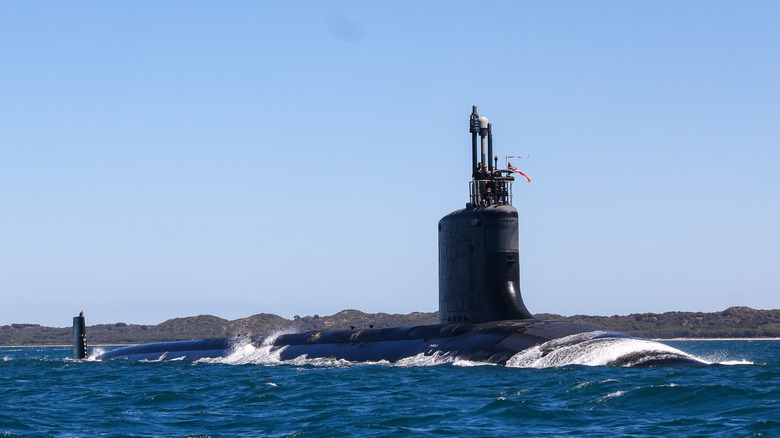
The updated ONR strategy also calls for an increased focus on research projects that are not being duplicated elsewhere in the commercial industry — or, in other words, projects that don’t have a profit motive in the private sector. The ONR will now focus on more distant technologies that are specific to the military’s needs. As seen with the Navy’s massive new ballistic missile submarine that’s set to join the fleet in 2029, stealthy operation is of vast importance for subs, and Riley uses submarines as a perfect example of technology that’s very important to the Navy but doesn’t have a larger market elsewhere.

The ability to move underwater quietly is vital for a Navy submarine that needs to avoid enemy surveillance, but is of little benefit for non-military use. Under the new strategy, the ONR wants to focus its sizeable budget on technologies like this, which would otherwise go undeveloped or overlooked by the private sector.

The naval drone technology of the future

Along with traditional submarines, underwater and surface drones are another area where the ONR will be focusing its efforts. More specifically, on how those vessels are controlled and coordinated as part of a swarm or formation. When it comes to these expensive and time-consuming military research projects, one might wonder how often this technology is actually used in real combat situations, but there have been some high-profile demonstrations.

At the same Defense One Tech Summit, Jarred Conley of the Defense Innovation Unit (DIU), which works alongside the ONR but operates across the entire United States military, touted the life-saving success of the military’s maritime drone tech during the war in Iran. In June 2026, in what would have been a difficult and dangerous mission for human sailors, an unmanned Navy boat successfully rescued two downed Apache helicopter crew members at sea, safely extracting them from the water in just two hours.

The Saronic Corsair autonomous surface vessel (ASV) used in the rescue mission had entered service just months earlier, quickly demonstrating its effectiveness at fast rescue operations in contested waters. Moving forward, both the ONR and DIU hope this sort of accelerated timeline will become commonplace across the United States Navy and the rest of the military.


Source link

Leave a Reply

Subscribe to Our Newsletter

Get our latest articles delivered straight to your inbox. No spam, we promise.

Recent Reviews


Google Pixel 10a

Kerry Wan/ZDNET

Follow ZDNET: Add us as a preferred source on Google.


ZDNET’s key takeaways

  • Android 17 is here, along with the June Pixel Drop.
  • The OS is rolling out to Pixel devices first.
  • Users are getting upgraded productivity, security, and more.

Android 17 is officially here, and it’s a doubly good day for Pixel users, as it’s bringing the June Pixel Drop with it.

Google has rolled out its annual OS update and its latest collection of Pixel-exclusive features at the same time, and the updates pack not only some practical features that will make an impact on how you use your phone daily, but also security protections, some new translation tricks, and more. Pixel Watches — the 2 and later — are included, too, with a potentially life-saving feature addition.

Also: I’m a devoted iPhone user but Android 17 is tempting me with its new video and social features

Here’s a look at what’s new in Android 17, which starts rolling out today to Pixel phones first and then to other devices “throughout 2026,” along with what’s new in the June 2026 Pixel Drop.

What’s new in Android 17?

Since many manufacturers now offer longer update windows, usually 4 to 7 years, a wide range of devices are eligible. The updated OS starts rolling out today to Pixel 6 phones and newer. Samsung’s Galaxy S23 series and newer will get it as One UI 9, along with the Flip 5 and newer, Galaxy A24 and newer, and Tab S9 series. OnePlus will bring Android 17 to the OnePlus 11 and newer.

1. App Bubbles

Perhaps the most useful feature is Bubbles, which lets you turn any app into a floating bubble on your main screen. All you have to do is long-press an app, and it becomes an easy-to-access bubble. If you consistently switch back and forth between apps or need to access a certain app often, like a map or airline app while you’re on a trip, you can now find what you need more quickly.

Pixel Folds are getting a special Bubble Bar at the bottom of the screen that lets you organize, move, and access your recent bubbles from one dedicated space.

2. Additional security

Android 17 is also bringing boosted security. 

To start, you can now grant an app temporary access to your exact location and share only specific contacts. 

Additionally, an enhanced “Mark as lost” feature, located in Find Hub, lets you lock a missing phone with your biometrics, so even if a thief has your passcode, they can’t access anything on your device or turn off tracking. 

Improvements to Live Threat Detection block more suspicious apps and scams, Google explained, and enhanced Advanced Protection mode helps keep you safe from sophisticated threats. Lastly, Google is reducing the number of times someone can attempt to guess your PIN and adding longer wait times between failed attempts.

Also: How to clear your Android phone cache – the 30-second routine every user should be doing

3. Screen reactions and more

Also new is Screen Reactions, which lets you take a selfie video overlaid on a screen recording in lieu of a green screen; a 50/50 gaming mode with a dynamic pad for foldables; and built-in parental controls beyond Pixel devices, so you can set screen time limits and content filtering with a PIN, even if you don’t link your Google Account.

What’s in the June Pixel Drop?

Beyond Android 17, Pixel users are getting several Pixel-specific upgrades in the June Pixel Drop.

1. Custom greetings for Take a Message

Introduced in 2025, Take a Message expands on the Pixel call screening feature and gives you a real-time transcript of what the caller is saying, along with AI-generated follow-up steps. Now, Take a Message has custom greetings, letting you record a personalized outgoing message instead of the default voice.

2. New AI models

Two new AI models are making their way to Android phones. The first is Gemini Omni, a new way to create and edit videos. Gemini Omni lets you type in a prompt and get a custom, high-quality video. This is available on all devices with the Gemini app for Gemini Pro users only.

Also: Everything we saw at Google I/O: Gemini 3.5, Android XR glasses, Spark, and more

Also on the way is Lyria 3, which lets you create original tracks using text prompts or images as inspiration. You can prompt Gemini with the style, vocals, and tempo you want. This is coming to all Android 17 Pixel phones and Folds.

3. Voice Translate for the Pixel 10a

One of the Pixel 10 series’ exclusive features is Voice Translate, which provides a real-time translation on phone calls in the speaker’s voice. ZDNET’s Sabrina Ortiz tried the feature last fall, noting how quickly the feature worked and how well it copied her voice. Voice Translate is getting a small expansion, coming to the Pixel 10a.

Also: iOS 27 envy? 4 features you can already use on an Android phone (including Samsung models)

4. Android Quick Share expansion and more

Pixel users are also getting an expansion of Android Quick Share compatibility with AirDrop, coming to the Pixel 9a and Pixel 8a, and an expansion of Magic Cue to more apps, coming to the Pixel 10 series.

What’s new for Pixel Watches?

Pixel Watches are only getting one new feature, but it’s a potentially big one. Core detection features, including Car Crash Detection, Fall Detection, and Loss of Pulse Detection, are getting emergency sharing. If a severe event is detected, Google explains, your Pixel will call emergency services and notify your chosen contacts. You can toggle emergency contacts on or off for each type of event.

Also: This silent Android feature scans your photos for ‘sensitive content’ – how to uninstall it

Fall Detection is coming to the Pixel Watch, plus the 2, 3, and 4, while Car Crash Detection is coming to the Pixel Watch 2, 3, and 4. Loss of Pulse Detection is only coming to the last two generations, the Pixel Watch 3 and 4.


Source link