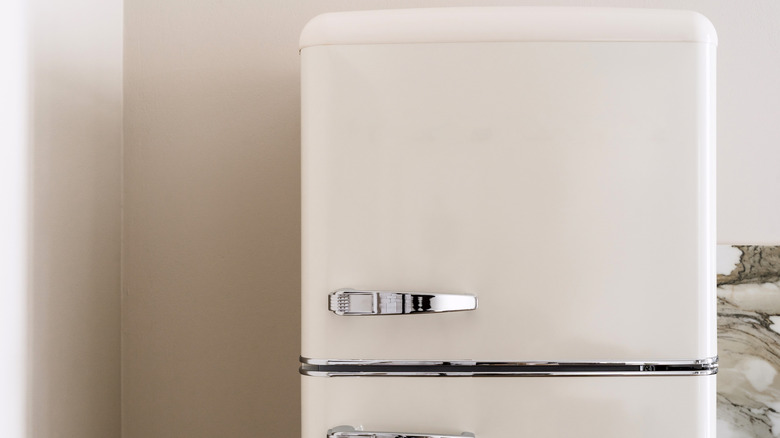

When choosing a refrigerator, it’s important to balance storage capacity with suitable dimensions. This is why manufacturers often offer a choice between full-depth and counter-depth models, with the latter typically shallower and easier to fit flush with your kitchen cabinets and surfaces. In either case, a suitable space for the model you’ve chosen is key, and that also means leaving some vital space between the refrigerator and the wall.
As for how much space to leave, manufacturers provide their own recommendations, and there can be considerable differences between them. For instance, LG recommends a clearance of 10 cm between the sides and back of the refrigerator and the wall, and a larger gap of 30 cm between the top of the refrigerator and the ceiling. KitchenAid, meanwhile, offers rather different guidance: “Allow for a 0.25 inch (6.35 mm) space on each side and at the top. When installing your refrigerator next to a fixed wall, leave 2.5 inches (6.35 cm) minimum clearance on each side.” Samsung suggests that consumers should ideally leave between 5 and 7 cm of space on every side of their appliance, but that they should stick to at least 2-3 cm if this isn’t possible in their setting.
In sum, it’s important to leave a certain amount of space between your model and the surrounding walls, but there’s some flexibility to adapt that space to your kitchen’s size. Failing to do so is one of the critical mistakes customers can make when buying and installing home appliances. What buyers need to understand is how refrigerators work and why they need this space, which allows the model to essentially breathe.
Why refrigerators need clearance

A refrigerator is always forced to deal with a lot of heat because of the way it works. These units typically boast a compressor and condenser, crucial parts of the refrigeration process that pressurize the refrigerant vapor and cool it into a liquid, respectively. The process by which a typical refrigerator cools its contents is evaporation, with the evaporator as the component that enables it and from which the cooling effect is produced.
What the refrigerator does is transfer heat from its interior to the surrounding air. To your kitchen. This is why it’s so important that there’s adequate clearance around the refrigerator, because that heated air needs sufficient space for ventilation. If the surrounding area remains too warm, the refrigerator will have to work that much harder to maintain optimal conditions for its contents. If you have particularly temperature-sensitive food inside, it can be negatively impacted. We all know how difficult it can be to keep certain foods at the peak of freshness.
There are more risks than just potentially reducing the quality of your food. If users don’t leave that space for their refrigerator when installing it, it can also be harmful for the appliance in various ways.
What can insufficient ventilation do to a refrigerator?

It’s true that, as Samsung notes, there’s some flexibility in the amount of space you need to provide, for example, when you have limited clearance at your proposed location. However, where strict minimum values are provided, they must be adhered to wherever possible. Though modern refrigerators can have very long lifespans if well maintained, there are many factors that can cause them to wear out or work less efficiently, and improper placement could be a leading one.
Without space for that hot air to disperse, it will remain in the refrigerator’s vicinity for longer. As such, it will need to run at higher power for longer. This means unnecessary strain on components, and by extension, a potentially shorter lifespan for your refrigerator. It can often be the case that the less ventilation space the system has around it, the faster these unfortunate symptoms can set in, and the more severe they may be.
As ZLINE Product Marketing Expert Nina McBeth put it to Home Living Handbook in April 2025, installing a refrigerator in a cramped space “could lead to overheating, higher energy bills and a shorter lifespan. This is especially true for premium appliances which are designed for optimal performance when installed with proper spacing.” As a warning sign, the outlet goes on, you might notice issues like louder operation. This is why those in the market for a new appliance should take careful measurements of the potential model and the space they’ve reserved for it: It can prove costly for several different reasons not to.

Stephan is the sports journalist for the Maple Grove Report.