
Where Tobacco Taxes Work Well


Urged to forbid smoking, Napoleon III said, “This vice brings in one hundred million francs in taxes every year. I will certainly forbid it at once–as soon as you can name a virtue that brings in as much revenue.”

Still today, Napoleon was right, but not entirely.

Tobacco Taxes

France, Greece, and Spain top a Western European list of tobacco users:
European tobacco usage

Consequently, it makes sense that the EU, and especially France (at €8.09/$9.51 per 20-cigarette pack), tax tobacco products. Meanwhile, Bulgaria’s €2.03 ($2.38) tax for a 20-cigarette pack is the EU’s lowest:

cigarette taxes

Cigarette Taxes

EU countries do not have a choice. Subject to a minimum, the required tax is €1.80 ($2.11) per 20-cigarette pack in addition to a percent of the average retail price (unless the price per pack is more than €2.30). Then, adding in the EU VAT, smokers typically pay more for the tax than for the cigarette.

Smuggling

The downside, however, is smuggling. In the EU, smuggled cigarettes from low-price Germany wind up in France. Similarly, because of smuggling, high cigarette tax states like New York lost out on an estimated $21.95 billion in revenue between 2007 and 2023. We could say, though, that New York’s loss was New Hampshire’s gain. The cigarettes from New Hampshire that were sold elsewhere generated more than $1 billion in extra revenue for them:

cigarette smuggling

Our Bottom Line: Elasticity

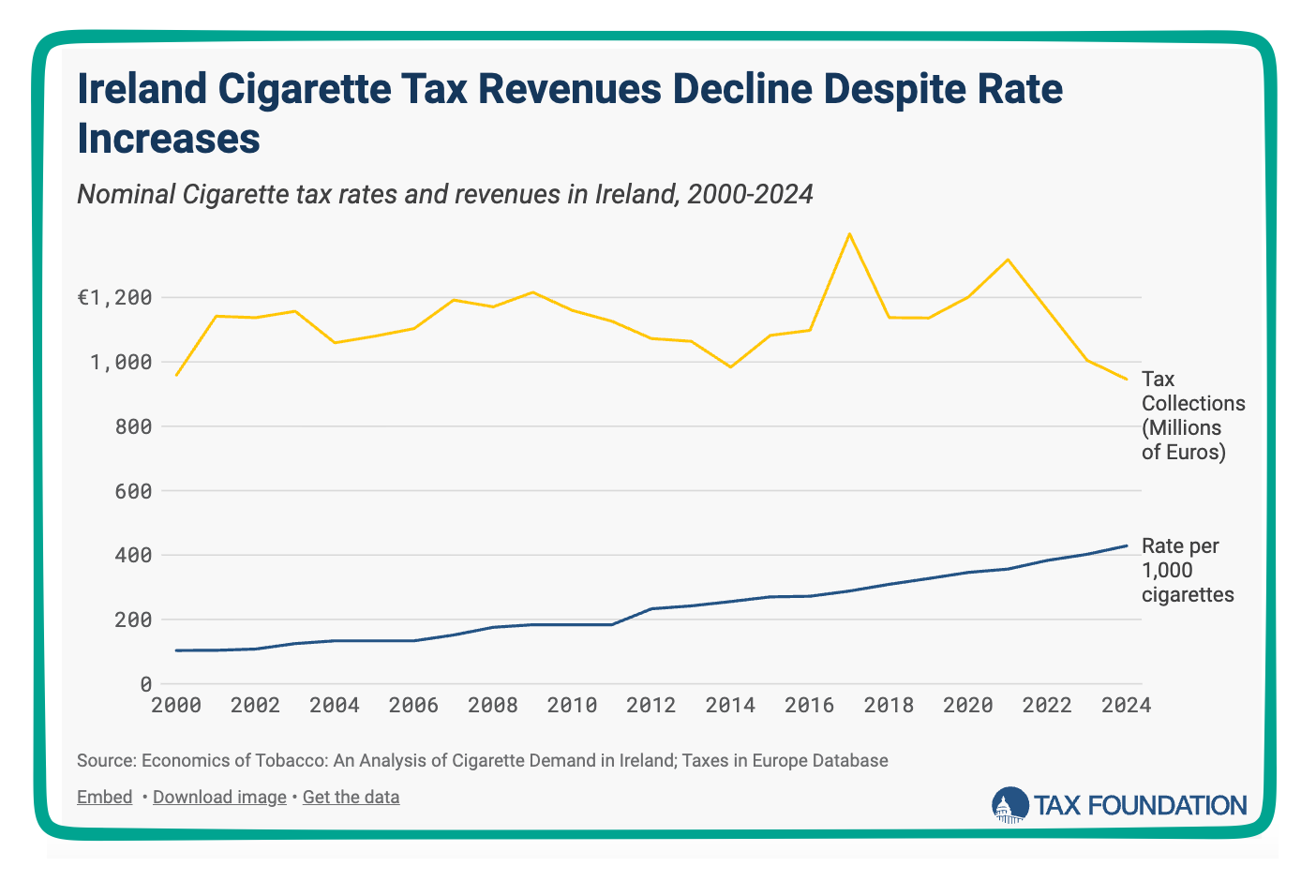
Napoleon III was not entirely correct because a state’s revenue depends on its tax rate. At too high a rate, revenue plunges. Explained with precise numbers by the Tax Foundation, it is all about the price elasticity of demand (PED). While the law of demand says we buy less when price rises, the question is how much less. Called elastic PED, when the decline is steep, then revenue also falls. Consequently, policy makers need to know when our quantity demanded moves from inelastic (prices have little effect) to elastic.

In Ireland, they miscalculated:tobacco tax elasticity
So, where are we?

Returning to our title, to find a tobacco smuggler, we might go to a state with high tobacco taxes.

My sources and more: Thanks to my IMF email for inspiring today’s post. From there, my next destinations were the Tax Foundation and Our World in Data. Then, if you want some confusion, do go to this EU tobacco tax website. And finally, do take a look at the economist that explained it all.


Source link

Leave a Reply

Subscribe to Our Newsletter

Get our latest articles delivered straight to your inbox. No spam, we promise.

Recent Reviews


Virtually every new SUV will depreciate in value over its life as the miles rack up and components start to wear out. However, some of them depreciate much faster than others. At one end of the spectrum, there are some models from the likes of Cadillac, Tesla, and Infiniti, all of which can lose close to two-thirds of their value after just half a decade on the road. That makes them some of the worst-depreciating SUVs on the market. At the other end, there are SUVs like the Toyota Land Cruiser.

The exact resale value of any used car will depend on factors like its trim, condition, and mileage, but on average, Land Cruiser owners can expect a higher trade-in value than most rivals will fetch. According to data from CarEdge, a new Land Cruiser can be expected to lose around 35% of its original value after five years on the road, assuming it covers around 13,500 miles annually.

Estimates from iSeeCars make for equally encouraging reading for Land Cruiser owners, with the outlet estimating that after five years, a new example will lose just 34.4% of its sticker price. Even after seven years on the road, iSeeCars estimates that the average Land Cruiser will still be worth a little over half of what buyers originally paid for it.

The Land Cruiser holds its value well

The estimate from iSeeCars puts the Land Cruiser slightly ahead of average for value retention in the large hybrid SUV segment, and significantly ahead of the overall market average for new SUVs. According to the same data, the average new SUV can expect to lose 44.9% of its value over the same period, over 10% more than the Land Cruiser. That said, a different Toyota SUV is forecast to retain even more of its value.

Since the 2025 model year, both the Land Cruiser and the 4Runner have shared their platform and hybrid powertrains. However, according to current estimates, the 4Runner is the clear winner when it comes to resale value. Data from iSeeCars forecasts that a new, non-hybrid 4Runner is likely to lose only 25.4% of its value after its first five years, and CarEdge predicts almost exactly the same figure. According to the former outlet, a hybrid 4Runner will lose slightly more of its value over the same timeframe, shedding 28.6% on average.

While the 4Runner is the better choice purely for value retention, that only forms part of the equation for most buyers. The Land Cruiser remains appealing thanks to its mix of off-road capability and on-road refinement, with even the base 2026 trim offering plenty of standard features, despite missing out on the luxuries that higher trims include.


Source link