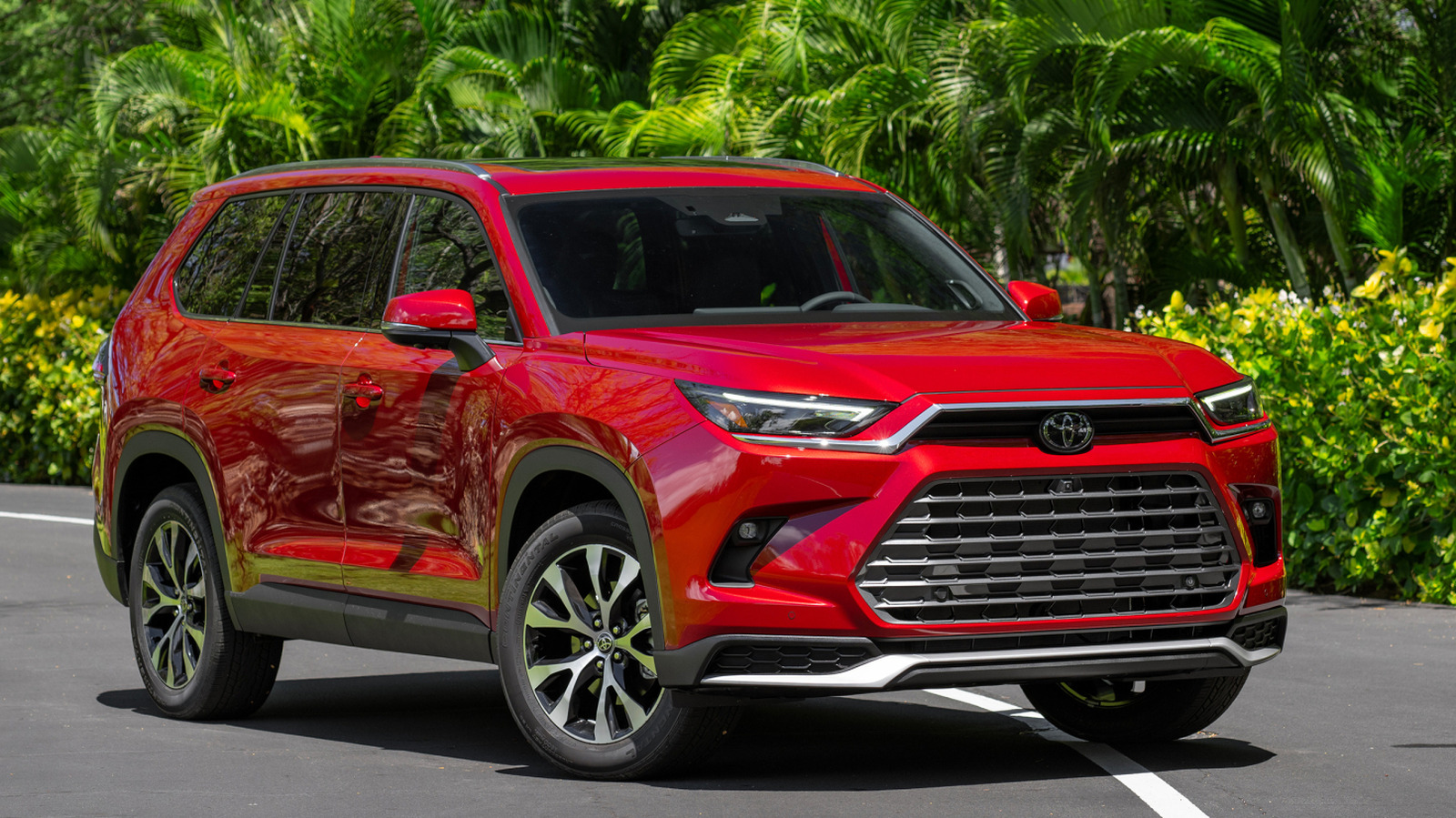
The 2026 Toyota Grand Highlander is a major player in the three-row midsize SUV segment. It gives up to 97.5 cu. ft. cargo capacity, seating for up to eight, and very good fuel economy for its size, all in a pleasing and high-quality Toyota-branded package that has the features many of today’s consumers want. The Grand Highlander can be powered by your choice of three powertrains — a non-hybrid, 2.4-liter turbocharged four-cylinder engine with 265 horsepower, a hybrid that uses a four-cylinder engine and two electric motors to make 245 horsepower, and the most powerful Hybrid Max, which pairs the turbo engine with an electric motor to produce 362 horses. Depending on the model chosen, transmission choices include an eight-speed automatic, a CVT, or a six-speed auto. Front-wheel drive is standard on most trims, with AWD available as an option. Our review revealed that Toyota’s 2026 Grand Highlander Hybrid trades excitement for fuel economy and space.
EPA-estimated mileage of the Toyota Grand Highlander is drivetrain-dependent, with the best numbers of 37 MPG City and 34 MPG Highway posted by the non-turbo hybrid with FWD. The best performance of the bunch comes from the AWD Hybrid Max with the turbo, which in Car and Driver testing sprinted from 0-60 mph in just 5.6 seconds. Pricing starts at $43,855, including delivery.
But there are numerous other three-row SUVs that compete with the Toyota Grand Highlander in our automotive marketplace. Let’s take a closer look at five of them and see how they compare in the ways that matter to the consumers of today.
2026 Hyundai Palisade
The second-generation Hyundai Palisade has been completely redesigned for the 2026 model year. Compared to the Toyota Grand Highlander, the Palisade offers a more spacious interior for its occupants, but there is less overall cargo capacity within that interior with a max of only about 87 cubic feet. Another significant difference is that the Hyundai Palisade’s price of $41,035, including freight, undercuts the Grand Highlander’s price by a not insignificant amount of $2,820. Our first drive of the 2026 Hyundai Palisade reflects that it represents a total transformation, inside and out.
Like the Grand Highlander, the Palisade comes in both non-hybrid and hybrid versions. The non-hybrid pairs a 3.5-liter V6 producing 287 horsepower with an eight-speed automatic, while the hybrid takes a 2.5-liter turbocharged inline four-cylinder with two electric motors providing assist to make 329 horsepower together with a six-speed automatic. As with the Grand Highlander, front-drive is standard and AWD is optional.
The fastest-accelerating Palisade tested by Car and Driver was slower than the quickest Grand Highlander, with the Palisade hybrid doing 0-60 mph in 6.6 seconds, compared to the Grand Highlander’s 5.6 seconds with the Hybrid Max setup. In terms of fuel economy, the Palisade’s best numbers were for the FWD Blue trim, which gets an EPA-estimated 33 MPG City and 35 MPG Highway. That’s a few MPG less than Toyota’s offering in town, but better on the open road.
2027 Kia Telluride
The Hyundai Group made an interesting move to expedite the release of its 2027 Kia Telluride three-row SUV — it did not produce a 2026 model. This let Kia sell down the 2025 models and introduce a freshly redesigned Telluride early in 2026. The 2027 Telluride is on sale now at Kia dealers nationwide.
Even though the Telluride is similar to its cousin the 2026 Hyundai Palisade in that they were both revamped for a second generation, there are some significant differences besides the styling. One of these is the Telluride’s non-hybrid engine, which uses a 2.5-liter turbocharged four-cylinder with an output of 274 horsepower. That’s slightly less than the Hyundai’s V6, But their hybrid versions are identical, with both using a four-cylinder turbo with electric assist to put out 329 horsepower through a six-speed automatic (one of the perks of being under the same corporate umbrella). Front-drive is standard with optional AWD. The quickest version of the 2027 Kia Telluride is the hybrid, which goes from 0-60 mph in 6.4 seconds, one second faster than the non-hybrid, as tested by Car and Driver. As far as space for people and stuff, the Telluride offers slightly more passenger room than the Grand Highlander, but 10 cu. ft. less storage capacity overall.
Our review of the Kia Telluride showed that it provides a big boost in fuel economy. EPA estimates for the Telluride FE model are 34 MPG City and 36 MPG Highway, which trails the Grand Highlander in city driving but exceeds it on the highway. Telluride pricing starts at 40,735 including destination fee, which undercuts the Toyota Grand Highlander by $3,120. That’s a big price difference.
2026 Mazda CX-90
The CX-90 is Mazda’s entry in the three-row SUV competition. It is offered in both non-hybrid and plug-in hybrid (PHEV) versions. The non-hybrid features something unique in this segment — a 3.3-liter turbocharged inline six-cylinder engine with either 280 or 340 horsepower. The plug-in hybrid combines a four-cylinder engine with an electric motor to produce a total of 323 horsepower. Both versions use an eight-speed automatic transmission to send power to all four wheels, as AWD is standard equipment on all CX-90s. It’s just one of the many features that make the Mazda CX-90 stand out from other 3-row SUVs.
As to performance, Car and Driver tested both types of CX-90, with the quickest being the PHEV, which did the 0-60 mph sprint in 5.9 seconds, 0.4 seconds faster than the 340-hp non-hybrid inline six. The EPA-estimated fuel economy of both models is very similar, with the traditional gas engine model getting 23 mpg City and 28 mpg highway, while the hybrid managing 24 mpg City and 28 mpg Highway. One big difference is that the PHEV CX-90 goes 26 miles on battery power alone before the gas engine kicks in.
Passenger and cargo volume in the Mazda CX-90 both lag behind the Toyota Grand Highlander with the latter maxing out at only 75 cubic feet, making the CX-90 less desirable for those who intend to carry the largest loads. Pricing of the Mazda CX-90 starts at $40,830 including destination fee, which represents good value, since all-wheel drive is standard equipment. This represents a savings of $3,025 over the price of the basic FWD Toyota Grand Highlander.
2026 Honda Pilot
The 2026 Honda Pilot has been refreshed with bolder front-end styling and a larger grille that reinforces its macho SUV status. Also new are a quieter cabin, larger display screens, and a power tailgate. The Pilot also continues without a hybrid option — its single drivetrain consists of a 3.5-liter V6 producing 285 horsepower that is mated to a 10-speed automatic transmission turning either the front wheels with the standard FWD or all four if you choose the all-wheel drive option. Our review of the 2026 Honda Pilot reminded us what this 3-row SUV gets so right in terms of capability, features, and functionality.
The Honda Pilot’s performance has been tested by Car and Driver, who found that the Pilot can make the run from 0-60 mph in 6.9 seconds. That’s one-tenth of a second quicker than the non-hybrid Toyota Grand Highlander but 1.3 seconds slower than the Hybrid Max. The best EPA-estimated fuel economy numbers for the Honda Pilot are for the FWD version, which gets 19 MPG in the City and 27 MPG on the Highway. This is comparable to the 20 City/26 Highway of the non-hybrid Grand Highlander, but falls far short of the hybrid’s 37 MPG City and 34 MPG Highway.
As far as passenger volume and cargo capacity, the Pilot offers more overall room for people but less for cargo at just 87 cu. ft., so if your priority is people-hauling, the Pilot could be right for you. The pricing structure for the Honda Pilot starts at $43,890 including destination and handling fees, making the Pilot $35 more expensive than the Toyota Grand Highlander.
2026 Jeep Grand Cherokee L
The 2026 Jeep Grand Cherokee L is the big boy of the badge; it is more than 11 inches longer than the “smaller” but still powerful Grand Cherokee. In fact, our review of the Grand Cherokee stated that it really doesn’t need a Hemi thanks to its mighty engine options.
The power for the Jeep Grand Cherokee L comes from either a 3.6-liter V6 that produces 293 horsepower or a newer 2.0-liter turbocharged four-cylinder mill putting out 324 horsepower. There is no hybrid option. Both engines are mated to an eight-speed automatic transmission, which drives either the rear wheels or all four, with two different AWD systems available. Testing done by Car and Driver established 0-60 mph times of 7.3 seconds for the V6 and 6.6 seconds for the four-cylinder turbo. The best EPA-estimated fuel economy for the Grand Cherokee L goes to the rear-drive turbo four, which gets 21 MPG City and 26 MPG Highway.
In terms of space utilization compared to the Toyota Grand Highlander, the 2026 Jeep Grand Cherokee L comes up short, both in passenger space and cargo-carrying capability. Unfortunately, the extra wheelbase and length of the Grand Cherokee L does not result in any additional space for the passengers or the cargo, compared to the Grand Highlander. When everything is measured, the Grand Cherokee L gives up about 7 cu. ft. of passenger volume and 13 cu. ft. of cargo capacity. Pricing for the 2026 Jeep Grand Cherokee L starts at $42,915 including destination charges. That’s $940 less than the Toyota Grand Highlander.
Methodology
The six three-row SUVs used in this article were selected from vehicles we’ve reviewed here at SlashGear as well as those featured in professional outlets like Car and Driver, relying on a combination of subjective judgments along with objective, in-depth testing of the various vehicles. The EPA website was used for fuel economy numbers, with various manufacturers’ websites used for additional information on these SUVs.

Stephan is the sports journalist for the Maple Grove Report.