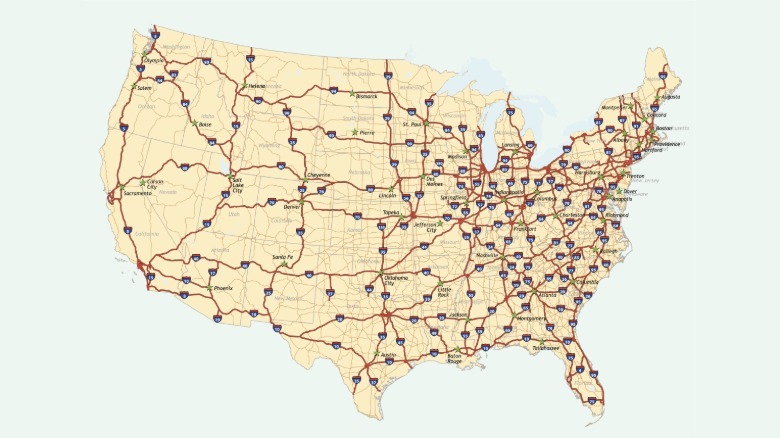

When President Eisenhower signed the Federal-Aid Highway Act of 1956, he set in motion the largest public works project in American history. The interstate system now spans nearly 47,000 miles across all 50 states. Considering the fact that it moves almost $14 trillion in goods every year, it has become the true circulatory system of America. However, commerce is only part of the story. Millions of drivers get on these highways to get to work, visit family, or even take a road trip.
 Jamirae/Getty
There’s a lot to see along the way. These roads cut through some of the most scenic landscapes on the continent: canyon country, alpine passes, large lakes, and open plains with interesting stops and detours. However, not every mile is worth the drive. Some interstates are plagued by traffic congestion, potholes, or stretches that are just boring to drive on for hours nonstop. That said, here are six of the best interstates to drive on and six of the worst.
I-95 (Worst)
Running about 1,920 miles along the East Coast and passing through 15 states, Interstate 95 runs from Florida all the way to Maine. It’s no wonder why some call Interstate 95 the East Coast’s Main Street. It certainly lives up to the name. Interstate 95 is, without doubt, one of the busiest interstates in the country.
One section in Miami sees almost 340,000 vehicles each day so you can expect some delays during rush hour. There’s also regular traffic on this road caused by accidents. A great example is in Virginia, where one truck accident led to a traffic jam that took 36 hours to clear up.
Interstate 95 is also one of the most dangerous highways in the U.S. In 2020, there were 379 deaths on this road, the highest from any interstate in that year. The government has spent billions of dollars repairing and expanding the road, but these projects are taking years to complete. Although that’s not surprising considering it took six decades to complete the highway in the first place.
I-5 (Best)
Interstate 5 is a 1,381-mile highway that passes through California, Oregon, and Washington. It runs the length of the West Coast from Canada to the Mexican border. While you don’t get a view of the Pacific Ocean for most of the ride, Interstate 5 is a scenic route with some fun stops.
If you’re starting off in Washington, this highway cuts through the shadow of Mt Shasta and runs by Skagit River. The southbound stretch through Seattle offers a remarkable view. From the interstate, you can see the Seattle skyline, the Olympic Mountains, Puget Sound, and on a clear day, Mt. Rainier.
When it comes to stops, Interstate 5 puts Pike Place Market, the Seattle Center, and Mount Rainier National Park all within easy reach. When you cross into Oregon, a five-minute detour will bring you to the fork in the road, a large metal fork attached to one of the mile markers. Down in California, you have Disneyland and Old Sacramento with its historic museums.
I-4 (Worst)
The shortest highway on our list, Interstate 4, is a 132-mile stretch between Tampa and Daytona Beach that runs through Orlando. These are three of the largest metropolitan areas in Florida, and carry about 140,000 vehicles every day on some parts of the road. It’s a busy route so it doesn’t take much to cause delays. Accidents and continuous construction rise up to the challenge in that regard.
Near Tampa, the interchange with Interstate 275 has earned the nickname “Malfunction Junction” thanks to the fact it sees about 1,000 accidents per year as of 2023. On top of that, while it’s a short highway, Interstate 4 is actually the deadliest interstate in the United States, when measured by deaths per mile.
Traffic builds around Posner Park, and continues through ChampionsGate and Reunion. And new development along the interstate’s east side has made traffic even worse. The Florida Department of Transportation just finished a seven-year project on this road but has announced another set to finish in the summer of 2031. Hopefully by then you’ll get a smoother ride across the state.
I-70 Denver to Cove Fort, Utah (Best)
Spanning 2,150 miles in total and passing through 10 states, Interstate 70 is one of the longest interstates in the country. However, the stretch worth talking about is west of Denver, where the road cuts through the Rocky Mountains and into Glenwood Canyon, widely considered a scenic route.
Along the way, drivers pass the Buffalo Overlook at Genesee Mountain Park, where bison and elk roam near the highway, before reaching historic mining towns like Georgetown and Idaho Springs, known for local restaurants, rafting, ziplining, and the Georgetown Loop Railroad.
The route then climbs through the Eisenhower Tunnel, the highest point on Interstate 70 at over 11,000 feet, and descends toward Lake Dillon Reservoir and views of the Continental Divide. If you love skiing, you can spot the Loveland, Copper Mountain, and Vail ski resorts right from the road. From there, the drive reaches its highlight at Glenwood Canyon, a roughly 12-mile engineering marvel carved by the Colorado River. This was the last segment of the federal Interstate Highway System that was built, and it opened in 1992.
I-80 (Worst)
Interstate 80 stretches across 2,900 miles and 11 states, from California to New Jersey, making it one of the longest highways in the United States and the second-longest interstate, but its length isn’t the only thing that stands out.
According to a Samsara analysis, Interstate 80 ranks as the most dangerous interstate in the country during winter. The risk builds through the afternoon and evening commute, then peaks again overnight into early morning, when darkness, falling temperatures, black ice, and driver fatigue combine to put drivers at their most vulnerable. These are the same conditions that cause winter weather pileups to spike on interstates nationwide. That danger isn’t spread evenly across the whole route. It’s concentrated in specific segments, particularly in Wyoming, Nebraska, and Iowa, where these conditions hit hardest.
Outside those danger zones, Interstate 80 has a second problem: it simply can’t keep up with the traffic it carries. San Francisco is already known for its bad traffic, but a 3.6-mile stretch on Interstate 80 has become one of the most congested in the country, wasting 600,000 hours every year.
I-84 Western (Best)
To clarify, there are two Interstate 84s in the United States. The first runs east, from Pennsylvania to Massachusetts. We’re more concerned with the western Interstate 84, running 768 miles from Echo, Utah, through Boise to Portland. Interstate 84 is at its most scenic through Oregon, where the road traces the Columbia River Gorge with great stops like Multnomah Falls, Hood River, and the wild west town of Pendleton.
Before reaching Oregon, the drive still has plenty to offer. Coming out of Echo, the road climbs straight into the Wasatch Mountains, and every mile through here leaves you blown away by the scenery. Crossing into Idaho, a short detour off I-84 leads to Twin Falls; the city sits near Shoshone Falls, taller than Niagara, and the Snake River canyon where Evel Knievel once attempted his famous jump. Push on toward Boise, and the road leads into a bustling downtown area, in one of the fastest-growing metro areas in the U.S. From there, I-84 crosses into Oregon, and the final stretch carries you into Pendleton, a town that still wears its western heritage in its wool mills and boot shops, before the interstate presses on toward Portland.
I-70 east of Denver (Worst)
West of Denver, Interstate 70 has some great views, especially of the Rocky Mountains. East of the city, it’s a different story. This stretch of the interstate runs from Denver and cuts through half the continent, passing through Kansas, Missouri, Illinois, Indiana, and three other states before ending near Baltimore, Maryland.
The numbers tell the story. In 2020, Interstate 70 had 134 deaths, or about 6.2 fatalities per 100 miles, according to Stacker’s analysis of the National Highway Traffic Safety Administration’s 2020 Fatality Analysis Reporting System data. In Missouri and Ohio, traffic caused by car crashes and congestion is a major concern, and one section running through St. Louis has even been called one of the scariest roads in the United States, according to drivers.
Indiana drivers have it the worst. In Overdrive’s 2025 Highway Report Card, truckers voted Interstate 70 in Indiana the single worst road in the entire United States, mostly because of its poor maintenance.
I-77 (Best)
Running 610 miles from Cleveland, Ohio, to Cayce, South Carolina, Interstate 77’s highlight is its dramatic climb through the Virginia Appalachians, reaching 3,100 feet at Fancy Gap. On this road, there’s a six-mile climb that gains more than 1,500 feet. Carving the route through the mountainside demanded one of the most ambitious excavation efforts in the entire history of the Interstate Highway System. Runaway truck ramps line the downhill side for safety, while a dedicated climbing lane helps slow-moving trucks heading north.
Interstate 77 takes you through Marietta, Ohio. Sitting on the Ohio River, this is the first settlement in the old Northwest Territory. You’ll find attractions like Campus Martius and the Gothic Revival Castle mansion. The West Virginia stretch adds history and character with stops like Blennerhassett Island, home to a Palladian-style mansion completed in 1800, and the site of Aaron Burr’s alleged plot to invade Mexico. There’s also the Tamarack Cultural Center in Beckley, a showcase of the state’s crafts, food, and culture. Further south, the road passes Bramwell, a West Virginia town known for its 19th-century mansions and the dozen or so millionaires that are said to live there.
I-35 (Worst)
Interstate 35 starts at Laredo, Texas, and stretches 1,568 miles to Duluth, Minnesota. When the road gets to Hillsboro, Texas, it splits into two branches: Interstate 35E heads northeast through Dallas, while Interstate 35W goes through Fort Worth before they connect in Denton and the road continues north.
For years, Interstate 35 has had a bad reputation. In 2019, it was labeled “freeway without a future,” part of a list of highways that, according to the Congress for the New Urbanism, “have reached the end of their useful life.”
Texas is where the problems with this road are more visible. The stretch through Austin between US 290 and Ben White Boulevard is among the most congested in the entire state, costing drivers nearly 600,000 more hours on the road in 2024 alone. This same corridor accounts for about one in four of the city’s road fatalities annually. A single pileup on I-35 in March 2025 involving 17 vehicles claimed five lives, with five survivors requiring critical care. The I-35 Capital Express Central Project is working to address this, but won’t be completed till 2033, so expect more years of lane closures and resulting traffic.
I-90 Seattle to Bozeman (Best)
Going on for 3,021 miles, Interstate 90 is the longest interstate in the country. This road stretches from coast to coast from Seattle to Boston and passes through 13 states. If you’re taking a road trip, the western half from Seattle to Bozeman is where it really comes alive.
The Cascades have long been valued for scenic beauty, prompting a push in the 1990s to conserve the surrounding forested foothills. This helped secure federal protection for the scenic view corridor along Interstate 90 in 1998, making it the nation’s first interstate named a National Scenic Byway.
Leaving Seattle, the highway goes by Snoqualmie Point Park and puts you about an hour from the Snoqualmie Falls. In Idaho, Interstate 90 takes you around the scenic Lake Coeur d’Alene. From there, the route pushes into Montana, where a one-hour detour will take you to Little Bighorn Battlefield Museum, which marks where George Custer made his last stand.
I-10 (Worst)
Stretching 2,460 miles from Santa Monica, California, to Jacksonville, Florida, Interstate 10 is one of the longest and most notorious interstates in the country. It’s also one of the interstates that replaced sections of the historic Route 66, now 100 years old, as America shifted from old routes to the current freeways.
The Louisiana-Mississippi border stretch is one spot where its reputation is well earned. Over 46,000 vehicles cross that state line daily, with rush hour typically seeing the heaviest traffic. It’s not just traffic, either — across three Mississippi counties, I-10 recorded 819 wrecks in a single year, 13 of which were fatal.
It is the kind of road that gets under people’s skin. “I tell all my friends that Interstate 10 is a death trap because there’s always something happening,” Mississippi resident Brian Velasquez said in an interview with SunHerald. “From Diamondhead to the state line, there’s always something, at least twice a month.” The stretch is also riddled with potholes, and infrastructure has struggled to keep pace.
I-15 Montana to Utah (Best)
Running from the Canadian border at Sweetgrass, Montana, down to San Diego, California, Interstate 15 cuts through Idaho, Utah, Arizona, and Nevada across 1,433 miles. Starting in Montana, Helena makes for a natural first stop, a small state capital with a historic downtown featuring Victorian-style buildings and public art.
Crossing into Idaho, you can check out Idaho Falls and the Idaho Potato Museum. From there, the road descends into Utah, passing through Salt Lake City and by the iconic Temple Square. Southern Utah is home to Zion National Park, with its Kolob Canyons section accessible directly off the highway at Exit 40, 40 miles north of St. George. Just past St. George, Interstate 15 carves through the Virgin River Gorge, a 500-million-year-old sandstone canyon so steep and narrow that the original road builders had to be lowered down the cliff faces by rope just to place their explosives.
Methodology
To identify the best and worst interstates to drive in the U.S., we considered the road conditions, safety ratings, and accident and fatality rates. We also looked at the driving experience itself. We considered whether a route offers scenic roads or flat, monotonous stretches. We also checked for iconic stops as well as traffic levels. Driver reviews and Reddit comments gave a ground-level picture of what each route is actually like behind the wheel.

Stephan is the sports journalist for the Maple Grove Report.