“What’s the worst building in Minneapolis, and why is it the Multifoods Tower?”
That’s the question I jokingly asked my friend Vince a while back. He’s one of the Twin Cities’ most dogged local historians, and we sat down at a St. Paul brewery because I needed to pick his brain. I wanted to know, specifically, if the City Center / Multifoods Tower was the worst building in the city and, if not, what competition it had.
We kvetched about architecture for a while and kicked around candidates for Minneapolis’ all-time worst development: a couple parking ramps (disqualified in my opinion), the convention center, HCMC, the (new) Walker Art Center, the University of Minnesota’s Rarig Center, the former Wells Fargo operations center (aka Darth Vader’s mask). In the end, we both agreed that City Center / Multifoods Tower had an undisputed claim to the throne.
Related: The ugliest parking ramp in downtown Minneapolis still stands
The complex, bordered by 6th and 7th Streets South, and Hennepin Avenue and Nicollet Mall, is terrible in so many ways. It combines impact, visibility, centrality and design into an unmitigated behemoth of disastrous urbanism. And it raises the question: How did Minneapolis make such a tremendous error? How did this terrible building get built? What were they thinking?
I dug through the newspaper archive to try and figure it out. Here’s a short history of the City Center / Multifoods Tower monstrosity, as far as I can glean it.
The marriage of hubris and modernist artifice
In the late 1970s and 1980s, downtown Minneapolis was going through a reinvention phase, with a building boom and capital flowing into the city. The decades were a self-destructive time for Downtown – the heyday of modernist self-immolation. There was the tearing down of Block E for surface parking; there was a barely-fended-off plan to cover over Nicollet Mall with some kind of elaborate dome; there were the Minneapolis Convention Center and the Metrodome, mixed bags both. Hubris and modernist artifice came together in the air like a wizard’s curse to create the block that today houses City Center / Multifoods Tower.

In fact, when it was first proposed in the 1970s, the project was supposed to be even larger. Original plans for the City Center were the brainchild of Kenneth Dayton, then CEO of Dayton Hudson, who envisioned a giant urban mall oriented around skyways and parking that could compete with suburban shopping. The original vision would have bridged Hennepin Avenue and occupied the space (technically “Block D”) where the Masonic Temple, Cowles Center, and Gluek’s Bar sit today.
The Minneapolis City Council pushed against that plan, halting it for a while. But by the late 1970s, developers’ interests combined with city leaders’ willingness to demolish historic buildings created a new wave of momentum. Minneapolis chipped in $50 million of taxpayer money toward a $250 million mega-project, a large complex that would occupy the entire block.
What was there before? Notably, there were two legendary cafés, both facing S. 7th St.: the Nankin, Minneapolis’ landmark Chinese restaurant, and the Forum Cafeteria, later known as Scottie’s on Seventh.
Elsewhere on the block were four shoe stores, three clothing shops, two theaters (the Gopher and the Aster), two jewelers, two bars (Ichabod’s and The Bar), two hotels (Radisson Mart and Dykman), two hamburger joints (Marc’s Big Boy and Arby’s), two schools (business and dancing), a glasses shop, an ice cream shop and more besides. Much of the block comprised substantial multi-story structures dating to the early 20th century. Together, they boasted the diverse, small-scale street frontage Minneapolis leaders are so desperate for today.

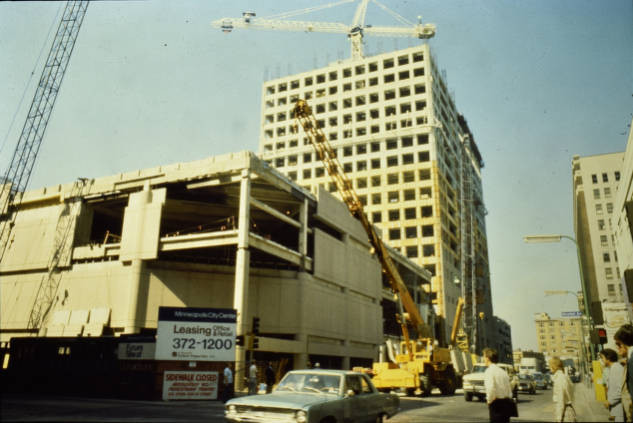
In the block’s place came the massive City Center complex. It was really three main buildings under the umbrella of a single architect: a massive office tower (with International Multifoods Corporation as the main tenant, leasing about 20% of the office space); a hotel, then named Amfac; and a bevy of interior retail anchored by the new location of Donaldson’s, Minneapolis’ other big department store. Altogether, the new complex offered 1.2 million square feet of leasable space, 20% more than its larger neighbor, the IDS Center.
Despite the hefty public investment, the project was designed and controlled almost exclusively by a Canadian development company called Oxford, then a massive player in Downtown’s commercial real estate sector. Oxford owned a half-share of the IDS Center, the innovative Baker Block complex in the Warehouse District, and a bunch of other downtown properties. At one point, they controlled almost 40% of downtown’s leasable space.
Related: Brutalist utopias: New documentary offers redemption for Minneapolis Riverside Plaza
Partly for this reason, the design of the massive complex happened largely behind closed doors. One article claimed that elected officials had seen a model of the project early on, and then received very little information about its evolution for almost three years. There was some public pushback about the number of windows (almost none), the exterior material (which had originally been proposed to be white stone), and the eradication of historic properties (e.g. the facade of the old Forum Cafeteria).
When construction finally began and the design by famous architectural firm Skidmore, Owings, and Merrill, took shape, most people were underwhelmed. The Star Tribune’s architecture critic panned it, correctly saying it paled in comparison to the IDS Center.
“City Center is an example of city government putting all of its eggs in one basket,” said former Council member Tom Johnson, one of the strongest critics of the project. “It was using all its bonding power for one project instead of spreading it out into neighborhoods.”
As best I can tell, however, the tenor of downtown development projects at the time was “old is bad.” By that logic, anything new must be good, and that seemed to be the general vibe on the street when City Center opened up.
It’s best described by a quote from the fellow who ran the Walgreen’s restaurant, back when it existed:
“City Center is going to lighten up Hennepin Avenue… most of the buildings downtown are very very old and they present a very old image. People find it depressing. So the more modern buildings you have, the better.”
The project tapped into a general insecurity in Minneapolis about being labeled “flyover country.” Any big investment offered a salve.
“City Center is a positive statement, a massive statement,” piped a booster Council member, Lou DeMars. “One reason you don’t see the magnitude of development in other cities that you are seeing in Minneapolis is that people here are willing to get behind projects. City Center showed that the city has confidence in downtown.”
In the end, Oxford seemed to do whatever they wished. In addition to Multifoods, one of the city’s original milling enterprises, a host of new retail stores and re-boots of the old businesses were part of the package (like the “new” Nankin Café and the “new” Donaldson’s). It opened and changed the city.
Addition by subtraction?
Today, the building is a colossal dud. The Multifoods Tower is uniquely bad because of a whole bunch of factors, but three jump to mind immediately.
First, there’s the scale. The City Center / Multifoods complex is just huge – a building the size of an entire block made larger by its trapezoidal site. Almost nothing can be quality urbanism at this scale. It overwhelms the city around it and lacks any kind of differentiation.
Then there are the aesthetics. Apart from the hotel, the entire building is made of late-brutalist concrete material that looks like nothing more than a parking ramp. It’s not only ugly, it’s mind-bogglingly boring, lacking even the artistry or sense of purity you might find in earlier gargantuan concrete structures.
Third, and worst of all, there’s the street frontage. Nearly every wall along a sidewalk is windowless, gray concrete. From the street, it looks like a late-Soviet prison complex, designed to repel hordes of zombies. The result is a wildly alienating building that “turns its back to the street” in ways I had not dreamed were possible.
The fourth failure is a bit more retrospective. Apart from the hotel, the building has turned out to be a failure. Donaldson’s Department Store merged with Carson Pirie Scott in 1987 and eventually closed. The Nankin Café lasted until 1999. The “urban mall” vision lasted longer, but that portion of City Center has fared as well as the other downtown urban malls, which is to say, very poorly. Meanwhile, the restaurant spaces cannot seem to keep any of the well-capitalized efforts intact.
In the post-COVID 21st century, the 52-story Multifoods Tower, now known as 33 South Sixth Street, is largely vacant. International Multifoods was acquired by Smuckers in 2004, and is headquartered in Ohio. Years ago, one real estate friend tipped me off to the tower’s vacancy, and that was before Target canceled their office leases early (at great expense).
Much like with Block E, Minneapolis would have been better off leaving the historic buildings in place and redeveloping parcels at a smaller scale, keeping the variety and diversity of land uses in place at the heart of the downtown. Much of the reason why Nicollet Mall is lifeless today is because of the hubristic approach of the last decades of the 20th century, intentionally scraping the street free of fine-grained, historic buildings and replacing them with misguided megaprojects.
My verdict is that City Center / Multifoods Tower has almost no redeeming quality. It would be better to raze it to the ground – addition by subtraction. I almost don’t care what replaces it, but a basketball stadium is as good an idea as anything, as long as it has an active, variegated streetscape along Nicollet Mall. For now, we are stuck with City Center, combining scale, hostility, and prime location into an unsightly package. I can only hope it is not long for this world.
Related