Forget Rome! Americans Can Fly Nonstop To 3 Of The Most Unique Cities In Italy Right Now


Share The Article

Millions of Americans are about to make the same mistake in Italy this summer: fighting shoulder-to-shoulder at the Trevi Fountain and baking in endless lines at the Colosseum.

Rome often feels unavoidable. Not only is it the capital, but it has historically been the easiest Italian destination to reach on a nonstop flight from the U.S.

But that just changed.

If you want to skip the suffocating crowds without sacrificing the authentic Italian experience, airlines have quietly rolled out nonstop transatlantic flights to three of Italy’s most captivating, underrated cities this summer.

Forget Rome! Americans Can Fly Nonstop To 3 Of The Most Unique Cities In Italy Right Now

As much as we love Rome, we’re not sure about you, but we think we might be giving the Eternal City a miss this year… especially now there are nonstop transatlantic flights to 3 of the most unique cities in Italy:

Bari

The gateway to the Puglia (or Apulia) region, Bari is often bypassed by tourists who only use it as a launchpad to reach the famous beach towns of Polignano a Mare and Monopoli. If you’re a seasoned Italy traveler, however, you know Bari is not to be overlooked.

Aerial View Of Bari, Italy

It’s home to Bari Vecchia, one of the largest medieval centers in the country, a literal maze of cobblestones peppered with family-run trattorie and weathered façades.

Basilica di San Nicola, the one big Romanesque church towering above the main square, houses the relics of Saint Nicholas. As in, the actual Santa Claus.

Only a few steps from the cathedral, Via Arco Basso is perhaps the most lively street in Bari: a stage-like alleyway where people’s nonnas stay on the front porch, rolling in the city’s signature earlobe-shaped pasta. If you wanna try them as an actual dish, though, head over to Orecchietteria San Nicola.

Of course, there’s no coming to Bari without exploring the wider Puglia:

Polignano a Mare In Puglia, Italy

Whether it’s the trulli houses of Alberobello, with its distinctive conical-shaped roofs, or the iconic Lama Monachile beach at Polignano, wedged between dramatic limestone cliffs, the heel of the Italian boot is Amalfi’s biggest crown challenger right now.

Fly Nonstop To Bari This Summer

Route Information
  • Airline: United Airlines
  • Aircraft: Boeing 767
  • Route: Newark (EWR) ⇄ Bari (BRI)
  • Flight time: 8h55–10h15
  • Frequency: Monday, Wednesday, Friday, Saturday (summer-only)
Schedule
  • Departs Newark: 3:30 pm
  • Arrives Bari: 6:30 am (next day)
Older Woman Selling Orecchiette In Bari, Italy
Is it year round?

No.

The Newark (EWR) ⇄ Bari (BRI) runs from late spring to early fall (typically late May to early September). Outside this window, you’ll need a connection getting to Bari, usually via Rome or Milan.

Typical price range
  • Economy round trip: $800–$1,400+
  • Premum cabins: $1,500$3,000+

If you’re wondering how safe Italy is to visit this summer, it scores an impressive 91 out of 100 on the Traveler Safety Index: the main tool for gauging safety levels on the ground as it is based off of traveler reports.

Palermo

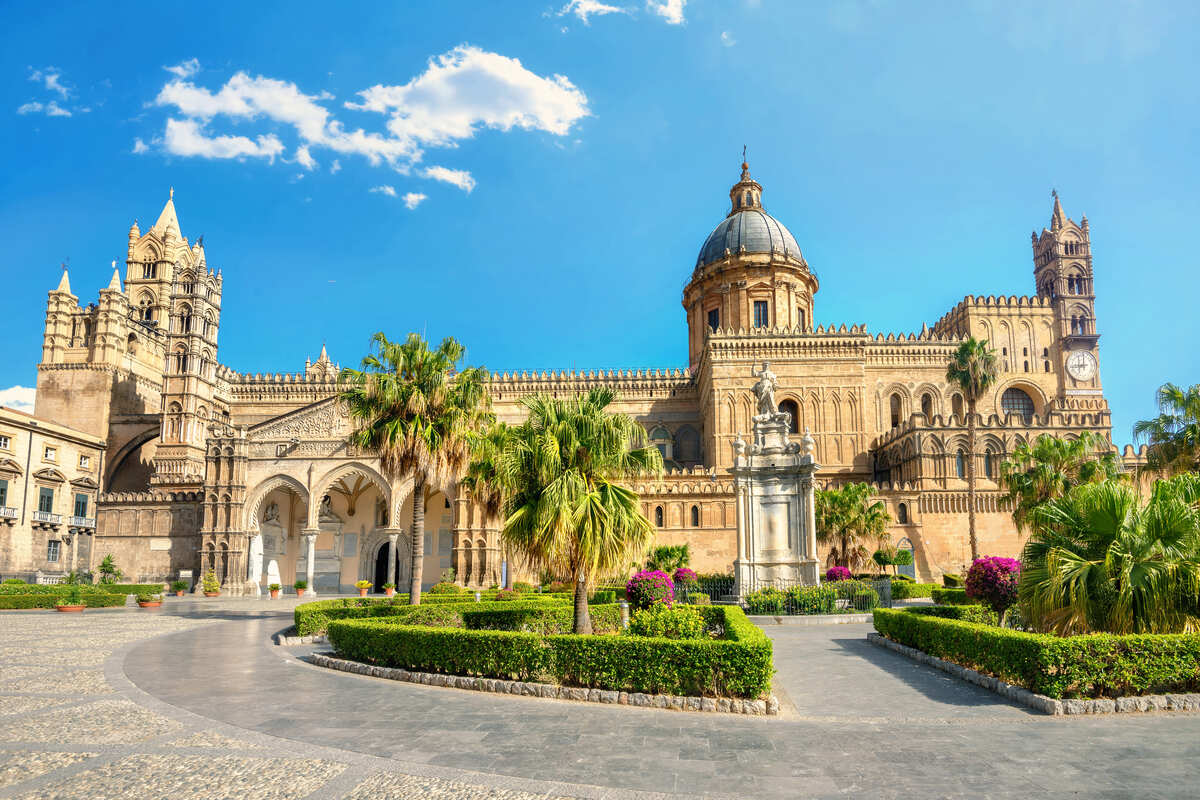
Aerial Angle Of Palermo Cathedral, Sicily, Italy

The capital and largest city in Sicily, Palermo is what can only be described as an attack on the senses. Its labyrinthine Historic Center is one big, organized chaos of crumbling Baroque facades, bustling street markets, hanging laundry, and motorbikers weaving in between.

Ballarò, the oldest of Palermo’s three mainline markets, dates back to the Arab era and it’s a riot of color buzzing with Arabic-Italian dialects and kerbside stalls. The stench of drying fish may be a bit overpowering, but that overflowing pistacchio cornetti make up for it.

Capo is where you go for that pre-lunch arancini game, and some old-school souvenir shopping, and perhaps my personal favorite of the three, Vucciria is part open-air theatre, part backyard party, with bar tables spilling onto the main square and narrow alleys.

Palermo's Piazza Giulio Cesare, Sicily, Italy

Palermo’s also known for its UNESCO-protected Arabo-Norman architecture. As in, a combination of both North African and Norman (as in from Normandy in France) influences—yep, it’s been under the rule of every imaginable empire out there, so talk about a melting pot.

Don’t miss the Norman Palace, with its gold- clad Palatine Chapel and lush royal gardens, and the Cathedral, a fortress-like, fever dream of a structure with elements of Arab, Byzantine, French, and Spanish design intertwined along its facades and embattlements.

Fly Nonstop To Palermo This Summer
From Newark (EWR)
  • Airline: United Airline
  • Aircraft: Boeing 767 (United)
  • Route: Newark (EWR) ⇄ Palermo (PMO)
  • Flight time: 8h20–8h50
  • Frequency: Wednesday, Friday, Sunday
From New York (JFK)
  • Airline: Neos Air
  • Aircraft: Boeing 787 or 737 variants
  • Route (Neos): New York (JFK) ⇄ Palermo (PMO)
  • Flight time: 8h20–8h50
  • Frequency: Tuesday & Saturday
Horse Carriage In Quattro Canti, Palermo, Sicily, Italy
Schedule

Newark (EWR) → Palermo (PMO)

  • Departs Newark: 4.25 pm
  • Arrives Palermo: 6:30 pm (next day)

JFK → Palermo

  • Departs JFK: 5:00 pm
  • Arrives Palermo: 7:20 am (next day)

Is it year-round?

No.

Both routes are seasonal (summer-onlu), and operate from late May through late September/early October. If traveling beyond October—which is a great time to visit Sicily without risking a heatstroke, by the way—you’ll need to connect via Rome, Milan, or other larger European hubs.

Typical price range
  • Economy roundtrip: $800–$1,400+
  • Premium cabins: $1,500–$3,000+

Europe is drastically changing its travel rules this year, from mandatory fingerprinting to their upcoming travel permit targeting tourists… including Americans. Before you fly to Europe this summer, just run a little destination check on the Entry Requirements Checker page.

Catania

Historic City Of Catania In Sicily, Italy During Sunset

Palermo’s the capital and most obvious entry point into Sicily, but Catania is the unapologetic, louder second city. It sits on the island’s east coast, and much like its spiritual sister Naples, it’s shadowed by a soaring volcano, Mount Etna.

It’s not polished like other postcard-ready Sicilian towns like Palermo or Noto, and the hectic local traffic kinda gives Palermo’s own a run for its money, and that’s saying something—but that’s the beauty of it all.

The Historic Center is carved almost entirely from black lava stone, having been rebuilt using materials from Etna following a devastating 1693 earthquake.

It gives Catania a unique, ashy, almost volcanic bordering-on-theatrical color, and the ornate churches, wrought-iron balconies, and grand palazzi only add to the drama.

Seafood at fish market in Catania, Sicily, Italy.

The best way for soaking up Catania’s unmatched vibe is Via Etnea, which runs straight toward the foot of the volcano itself, lined with shops, cafés, and rooftop bars.

Over in Piazza del Duomo, you’ll find u Liotru, the iconic ‘elephant fountain’, a symbol of Catania, and the baroque cathedral itself.

Just beyond the square, you hit La Pescheria, Catania’s legendary fish market, spilling out along a paved waterfront artery they may or may not still fish from.

Vendors shout over splashing buckets of swordfish, tuna, and octopus, while nearby trattorie turn all the morning catch into fresh seafood pasta and fritto misto. For the best pasta alla Norma in town, check out Trattoria del Cavaliere.

Route Information

Aerial View Of Catania, Sicily, Italy
  • Airline: Delta Air Lines
  • Aircraft: Boeing 767-300
  • Route: New York (JFK) ⇄ Catania (CTA)
  • Flight time: 8h55–9h20
  • Frequency: 1 flight per day throughout summer

Schedule

  • Departs JFK: 4:30 pm
  • Arrives Catania: 6:30 am (next day)

Is it year round?

Again, no.

The route is only operational this summer (May to October).

Typical price rage
  • Economy round trip: $800–$1,400+
  • Premium cabins: $1,500–$3,000+

Now take this quiz to find your perfect match!


Step 1 of 3

What is your ideal Italian city vibe?

🌊 A labyrinth of cobblestones and coastal charm

🏛️ A vibrant, chaotic melting pot of historic architecture

🌋 A loud, unapologetic city carved from black volcanic stone

Step 2 of 3

What is your ultimate vacation activity?

🍝 Watching locals roll fresh pasta on their front porches

🛍️ Shopping for street food in historic open-air markets

🐟 Exploring legendary fish markets and eating fresh seafood

Final Step

What is your perfect day trip or landmark?

🏠 Coastal limestone cliffs and conical-roofed houses

🏰 Gold-clad chapels and lush royal palace gardens

🌋 Shopping along avenues pointing straight at an active volcano

🇮🇹

Bari

The Gateway to Puglia

Tap to Reveal Details

Bari

Why it’s a match: You want authentic coastal charm! Bari Vecchia is a maze of cobblestones where local nonnas roll fresh pasta right on their front porches.

Must Do: Visit the relics of Saint Nicholas, then take day trips to see the iconic conical roofs of Alberobello and the limestone cliffs of Polignano a Mare. Fly nonstop this summer from Newark on United!

🍋

Palermo

The Historic Melting Pot

Tap to Reveal Details

Palermo

Why it’s a match: You want a sensory overload! Sicily’s capital is an organized chaos of crumbling Baroque facades, hanging laundry, and incredible Arab-Norman architecture.

Must Do: Get lost in the historic Ballaro and Vucciria street markets for fresh arancini. Do not miss the Norman Palace! You can fly nonstop this summer from Newark (United) or JFK (Neos Air).

🌋

Catania

The Volcanic Beauty

Tap to Reveal Details

Catania

Why it’s a match: You want an unapologetic, theatrical city. Built from black lava stone and shadowed by Mount Etna, Catania gives you a truly unique, ashy atmosphere.

Must Do: Stroll down Via Etnea, see the famous elephant fountain, and dive into La Pescheria to watch fishmongers shout over fresh catches. Fly nonstop this summer directly from JFK on Delta!


Source link

Leave a Reply

Subscribe to Our Newsletter

Get our latest articles delivered straight to your inbox. No spam, we promise.

Recent Reviews


gettyimages-647882122

S847/iStock / Getty Images Plus

Follow ZDNET: Add us as a preferred source on Google.


ZDNET’s key takeaways

  • Staff who use AI can end up with more to do, not less.
  • Think carefully about the tools you’re using and why.
  • Adopt a set of standards and refine your outputs.

The promise of productivity boosts from AI can come with an unwelcome side order of stress. Harvard Business Review found that AI doesn’t reduce work; it intensifies it, leading to cognitive fatigue and unsustainable hours.

While the common perception is that AI can help reduce workloads, allowing employees to focus more on higher-value and more engaging tasks, HBR’s research found that staff using AI worked more quickly and often ended up with more to do, not less.

Also: Forget productivity: Here are 5 strategic shifts that drive real AI value

While we’ve written about how some professionals are finding ways to turn AI’s time-saving magic into a productivity superpower, we’ve also recognized that some employees have started to become tired with the low quality of AI outputs.

Ankur Anand, group CIO at tech recruiter Harvey Nash, said professionals who want to avoid cognitive fatigue must understand how to use AI effectively and its potential risks.

“That focus will help to reduce the noise around the workload that AI creates,” he told ZDNET, suggesting that many people have unrealistic expectations about the productivity boost that AI will provide.

Also: Why I ditched Copilot for Claude in Word, Excel, and PowerPoint – and how you can, too

“Many organizations are telling their people, ‘We want to understand how you’re making an impact with AI,'” he said. “But these professionals are not empowered, which means that using AI adds a lot of pressure, because they need to prove themselves on their own terms.”

If you’re going to make the most of AI at work, then you’re going to have to find an effective balance between completing tasks quickly and producing high-quality work. 

Here’s how the experts believe professionals can ensure they reap the benefits, not the problems, of AI — and they suggest that you’ll need to focus on three core areas: tools, guidelines, and outputs.

Limit your toolset

Alex Read, senior enterprise product manager for data at energy provider EDF UK, told ZDNET that the best way for professionals to reap the benefits, not the challenges, of AI is to be uber-focused on tools that help you produce value in your roles.

While there are thousands of potential AI-enabled services on the market, Read said sensible professionals limit their horizons.

Also: How this travel company’s AI rollout drove a 73% satisfaction boost: A 5-step playbook for your business

In his own role, for example, Read focuses on how AI can help him build a data platform and update information accurately, efficiently, and productively: “Anything outside of that scope is noise for me.”

That sentiment resonated with Nick Pearson, CIO at technology specialist Ricoh Europe, who told ZDNET it’s important to take a step back and think carefully about how an AI tool can help you produce value in your role.

“If you think about the phrase ‘gen AI,’ the tech is very good, by definition, at generating outputs,” he said. “I could go to bed in the evening, set the model to work, and we could have four new IT strategies produced overnight.”

Also: Worried AI agents will replace you? 5 ways you can turn anxiety into action at work

However, quantity doesn’t necessarily mean quality. Pearson suggested it’s important to focus on AI’s blind spots, particularly as most models are trained on preexisting content.

“AI can’t inspire people, per se; it can’t naturally create something new, because it’s actually quite recursive,” he said.

“And the judgment you have to put in sometimes, on top of everything else, whether it be an ethical or a capability judgment, is not there automatically in the technology.”

It’s in this gap, said Pearson, that human experts play a critical role: “We’re toying with that concern as an organization and saying, ‘Where does AI really play an important role, versus where are we upskilling people in areas that AI probably won’t play for a long time?'”

Work to the guidelines

HBR’s research found that an initial productivity surge when AI is adopted can lead to lower-quality work, turnover, and other problems as people work harder rather than smarter.

To correct this issue, HBR said companies need to adopt an “AI practice,” or a set of norms and standards around AI use that help professionals ensure they use AI in a constrained but productive manner.

Also: 90% of AI projects fail – here are 3 ways to ensure yours doesn’t

At EDF UK, Read is part of an internal AI Center of Excellence in enterprise IT, which enables policy for the effective use of AI across the wider organization. 

In addition to Read, who contributes input from a data-use perspective, the group includes other tech representatives, such as the firm’s senior manager of AI, principal software engineer, and principal solution architect.

“The remit of this center is to make sure that, when the federated business units are looking to build, develop, and deploy AI services, they have platforms, guidance, best practices, architectural assets, and materials to guide them on how to safely and efficiently adopt AI and operationalize it at scale,” he said.

Some of the key themes the center considers when assessing AI tools are scalability and reusability, ensuring a proposed service doesn’t replicate one already in use.

Also: 5 ways to use AI when your budget is tight

“All new tools and services related to AI will go through that hopper and funnel to understand scope and ensure the security, regulatory, and ethical side of things are understood,” he said, suggesting that all professionals should use their organization’s pre-existing guidelines to foster an appropriate exploitation of emerging tech.

“The benefit that guided approach brings is that it allows us to be clear in our messaging around what AI services can be used, how they’re used from a use-case perspective, and ultimately, what personas are allowed to use them.”

Refine your outputs

Even when tools are assessed and considered acceptable, there can still be an overreliance on AI outputs. Worse, some professionals can drown in the insights they receive, leading to higher stress and fewer benefits.

Louise Newbury-Smith, head of UK&I at technology specialist Zoom, told ZDNET that one way to ensure your outputs are constrained is to focus on prompting.

“Use simple amendments to be specific, such as ‘Give me the top three things with the biggest impact.’ That approach should guide your prompt, rather than saying, ‘Give me everything you know about this topic.'”

Also: 5 ways to fortify your network against the new speed of AI attacks

Newbury-Smith said the successful use of AI is all about being smart about how it’s exploited, and that effectiveness comes down to enablement and engagement. If a prompt yields too much information, refine it until you get what you need. She said this should still be faster than trying to get answers without AI.

The basic message for professionals is that effective applications of AI are all about you staying in the loop, said Bernhard Seiser, vice president of digital, data, and IT at AOP Health.

Think before you use AI, and think again before you push your outputs around the organization.

“It doesn’t help the business if you get AI-generated emails that are many pages long, and then you need ChatGPT to summarize the text,” he told ZDNET.

Seiser said that while there are certain tasks generative AI is good at and worth using for, in the end, “you need to use your brain.”


Source link