
Starlink Satellites Are Doing A Lot More Than Just Providing Internet


Options in terms of internet service providers haven’t always been plentiful, especially for those in rural America or more remote parts of the world. Satellite internet service first became available back in the late 1990s and has traditionally used geostationary devices. A geostationary satellite can match the rotation of the Earth, basically remaining in the same section of sky continuously. The problem however, is that these geostationary units sit much further out in space, creating latency or delay when receiving and transmitting data.

Conversely, Starlink satellites orbit much closer to earth and form a unified web of thousands called a constellation. Rather than delays of 600ms or more, as with geostationary satellites, Starlink latency is closer to 25ms. As a result, internet has become more widely available and can support high data transfer in places it was previously impossible. This does come at a price though – Starlink will cost you a good amount of money. While its primary purpose is to provide high-speed internet, Starlink has also helped the FBI track down a scammer ring across the globe that was preying on Americans in 2026.

In parts of the world like southeast Asia, criminal organizations have been setting up shop well outside of populated cities, opting for isolated locales, using Starlink equipment. Starlink remained scarce on details in terms of its contribution to the law enforcement operation, but the company did admit on X, that it “proactively detect[s] and disable[s] terminals involved in illegal activity.”

Starlink is also good at detecting wildfires and rainforest protection

Canada has had a very publicized battle with wildfires in recent years, with 2023 being considered the worst yet. According to NOAA.gov, by June 2025, around 6.4 million acres had succumbed to flames, with more than 1,700 fires on record for that year alone. One of the most significant issues is the rate at which a simple spark can quickly wreak havoc. It’s impressive how quickly wildfires can travel across a forest, which is why early detection is key.

Rogers Communications, a major Canadian media conglomerate, teamed up with Starlink to help spot these fires as quickly as possible, even in the most remote of regions. Starlink doesn’t directly detect these wildfires, however it does connect specialized detection equipment, like Pano AI cameras, to authorities. These Pano AI devices take 360-degree pictures in short intervals and are programmed to look for signs of a fire, like smoke.

Swarm, which was acquired by Starlink in 2021, has been used by conservation organizations like Rainforest Connection, which monitors the Amazon for illegal logging operations. Using cutting-edge audio sensors, the sounds of wood cutting machines and engines are picked up in remote areas of the jungle, then transmitted over low Earth orbiting satellite constellations to nearby intervention teams. Although, these satellite systems aren’t without their problems, as Starlink lowered over 4,000 satellites following a near-miss with China.


Source link

Leave a Reply

Subscribe to Our Newsletter

Get our latest articles delivered straight to your inbox. No spam, we promise.

Recent Reviews


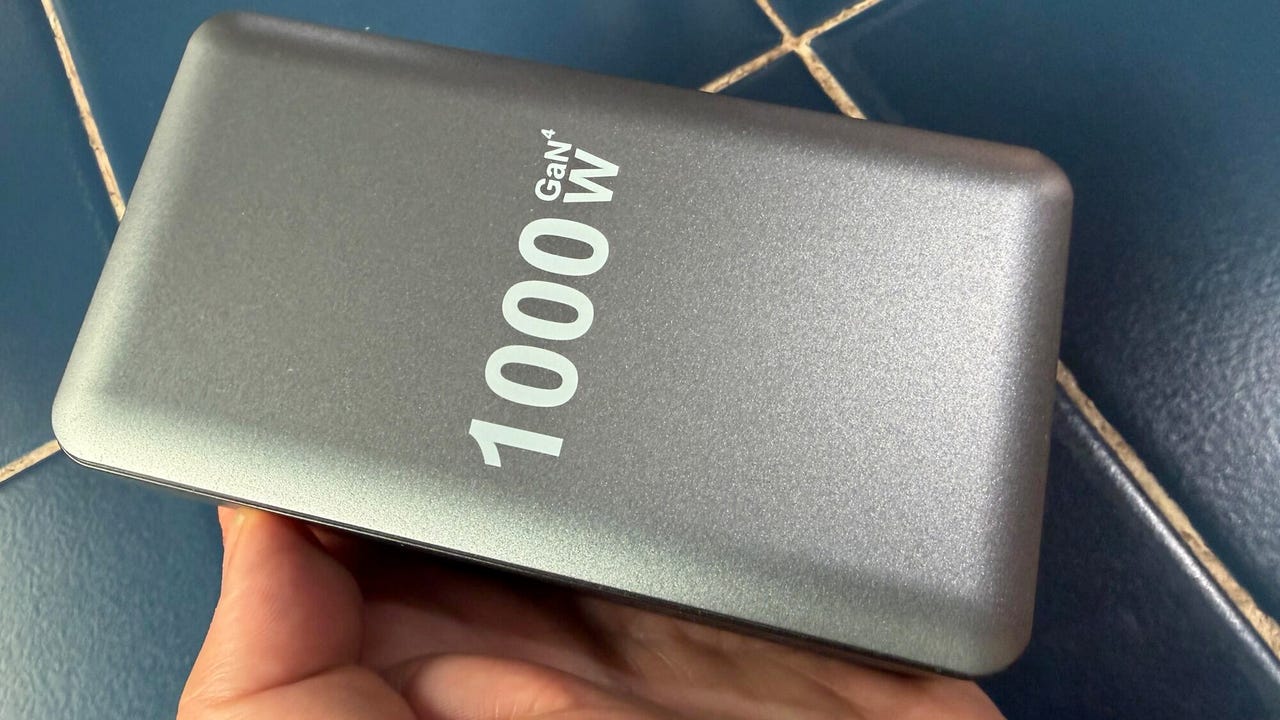
1,000W, 10-port charger for $45... predictably disappointing.

1,000W, 10-port charger for $45… predictably disappointing. 

Adrian Kingsley-Hughes/ZDNET

Follow ZDNET: Add us as a preferred source on Google.


ZDNET’s key takeaways

  • Things that look “too good to be true” invariable are just that.
  • This example got dangerously hot in a short period of time before dying. 
  • There’s no legitimate charger that comes close to delivering on the 1,000W promise.

Being a tech reviewer for a living means that I get offered some very interesting things. Not interesting as in Bugatti supercars or jewel-encrusted Fabergé eggs, but interesting as in “this thing could easily be a fire hazard — want to take a look?”

Also: The best GaN chargers of 2026: Expert tested

Submissively, I often say yes. And I’m glad I did with the most recent pitch, because it was very interesting indeed.

Meet the “interesting” charger

This time around, the thing of interest was a charger that claimed to deliver an incredible 1,000W through its ten ports — four 140W USB-C ports, four 100W USB-C ports, and two 20W USB-A ports. 

The person who bought this charger told me that they’d plugged it in, used it to charge their phone for “a few minutes,” got worried when it became “a little hot,” and unplugged it.

That's a lot of promise... but (spoilers), they don't deliver!

That’s a lot of promise… but (spoilers), they don’t deliver!

Adrian Kingsley-Hughes/ZDNET

The unit was suspiciously light and plasticky, especially given its built-in power supply. Compare this to Ugreen’s Nexode 500W charger, which weighs a hair under 5 lb.

There was also a slight whiff of melty plastic, which made me think that this had been a bit more than a little hot. 

Also: This $4 router reboot timer is the cheap internet fix I didn’t know I needed – and it works reliably

Color me suspicious, but I had a gut feeling that the only way this charger would be able to push out 1,000W would be if it caught fire. 

Turns out I wasn’t far wrong.

How long would it last? Answer: Minutes

Talk is cheap. It was time to test the charger. 

So I plugged it in, turned it on, and started using it. Within a couple of minutes of starting to use it, I noticed a few things:

  • No matter what I tried, I couldn’t persuade the charger to deliver more than about 60W from any of the ports. 
  • As for peak output, I managed to get close to 250W.
  • The power output was very uneven and noisy, fluctuating wildly. The more ports I used, the worse it got.
  • The unit got very hot to the touch very quickly, even under light loads. 
  • But… before I could get the thermal camera out to check how hot it got, there was a pop and the unmistakable smell of “Magic Smoke.” The charger had been sent to Silicon Heaven within minutes.

Annnnd… POP! This is the moment the charger gave up the ghost.

Adrian Kingsley-Hughes/ZDNET

Diagnosis time

Time to take it apart and have a look inside. For an item that plugged into the mains power, this unit was shockingly easy to take apart. 

A thin sheet of easily removable plastic is a that separates curious hands from live AC power.

A thin sheet of easily removable plastic is a that separates curious hands from live AC power.

Adrian Kingsley-Hughes/ZDNET

And even unplugged and broken, it was capable of delivering zaps! If the case came off while this was plugged into an outlet, it could very easily be deadly.

There’s charge still in some of the capacitors, and these could deliver quite a zap despite the unit being broken and unplugged!

Adrian Kingsley-Hughes/ZDNET

After getting inside, the unit was filled with a grey goo that I’d seen in a previous disappointing charger I’d taken apart. This is a thermal paste that’s used to try to dissipate the heat generated by the components. 

It’s not really going to work because it’s sealed in a plastic box with no effective heatsink. It’s a token gesture at best. At worst, it creates a mass that’ll slowly heat up and hold temperature because it’s got no way to get rid of it.

Behold the grey goo!

Adrian Kingsley-Hughes/ZDNET

Next to this goo was a bank of capacitors — the black cylinders in the photo — which were the cause of the failure. They’d clearly overheated, with three of them showing signs of bulging.

The problem!

Adrian Kingsley-Hughes/ZDNET

Well there’s the problem!

I also noticed that two of the components — bridge rectifiers that are used to turn AC mains into DC — have been fixed on an angle to make the touch a metal heatsink. It’s not really an effective way to cool down components.

The bottom line

Another “too good to be true” device bites the dust. It’s not the first one I’ve come across, and it won’t be the last.

Moral of the story here is that manufactures are using big number marketing — in this case 1,000W and masses of ports — to scalewash poor quality products. 

This might be a half-decent product if it was built to deliver 100W, but there’s no end of competition at that end of the market. Silkscreen “1,000W” on the outside, sprinkle in a few reviews that feel scripted and fake, and all of a sudden it’s interesting and exciting… right up until it blows up. 

Also: My top 7 laptop-bag essentials now, after decades of remote work

I know of no 1,000W charger. In fact, the 500W Ugreen Nexode is the highest-power charger that I’ve tested that’s legit. And the price is also legit — $250. 

But it’s built to deliver on what it promises and is packed with safety features, including “tip-over protection,” which cuts the output when the unit tips over and prevents it from falling on its side, where it can’t dissipate heat effectively. Now that’s an attention to safety that I like to see in a product that handles that much power. 

But if you want 1,000W of output, you’ll have to buy two and duct tape them together.


Source link