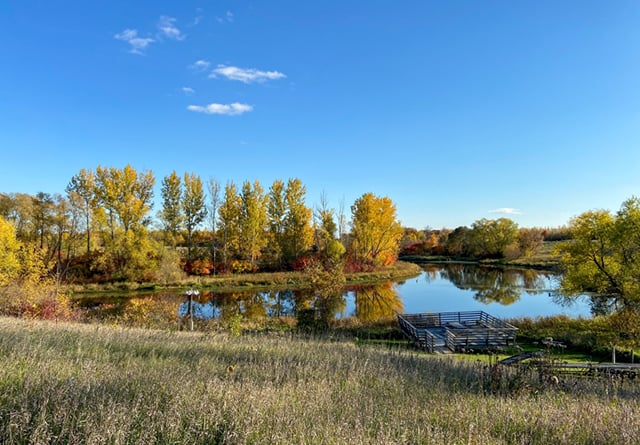
In August 1995, a group of students from Minnesota New Country School in Le Sueur examined northern leopard frogs (Rana pipiens) while walking around a pond in Ney Wildlife Preserve east of Henderson. After noticing eleven frogs with missing or extra legs, they told their teacher, Cindy Reinitz, who called the Minnesota Pollution Control Agency to report the abnormalities. Judy Helgen, a research scientist at the MPCA, received the call and sent Joel Chirhart to Ney Pond on August 15 to investigate the report. Chirhart reported back to Helgen, urging her to come to the pond herself; she did so on August 18.
Related: Studies offer new insights into causes of deformed frogs
On Helgen’s first visit to Ney Pond, she recorded twisted legs, extra legs, missing legs, non-working legs and missing eyes on the frogs she collected. Of the fifty-three frogs she collected that day, 60 percent were deformed in some way. A week later, Helgen’s team collected 137 frogs at the pond, of which 76 percent were deformed. Sarah Malchow from the Henderson Independent News came to Ney Pond to ask Helgen questions about the recently discovered malformed frogs. Her article, published the next week, was one of the first pieces published on the deformed frogs at Ney Pond. Press coverage of the Ney Pond frogs led people from across Minnesota, and beyond, to call Helgen and her team. They reported similar findings, expanding the scope of the investigation outside of Ney Pond.

Helgen coordinated research among an informal group of scientists across the United States and Canada studying the deformed frogs phenomenon. In September 1996, the United States Environmental Protection Agency (EPA) held a meeting of US and Canadian scientists in Duluth on the issue of deformed frogs.
At the meeting, several scientists presented on potential causes of malformations in frogs. Canadian researcher Martin Ouellet suggested pesticides as a potential cause for deformities. EPA scientists Joe Tietge and Gary Ankley proposed that an increase in ultraviolet light (UV) from the thinning ozone layer could be contributing to deformities. New York zoologist Stan Sessions presented his work on parasites that can cause extra limbs in their tadpole hosts if they enter during early limb development. Ken Muneoka, a developmental biologist from Tulane University, described experiments that involved introducing retinoic acid to recently removed tissues. The acid caused extra legs to sprout from the limb bud; the application of other chemicals, meanwhile, could stunt limb growth. He pointed out that the insecticide methoprene (related to retinoic acid and commonly used around the Twin Cities) could cause deformities in animals.
By the end of September 1996, Helgen’s team had received reports of deformed frogs from fifty-five of Minnesota’s eighty-seven counties, in 172 different locations. They were largely concentrated in the wetlands and hard-water lakes of southeastern and central Minnesota. That month, a third data set from Ney Pond concluded that 47 percent of the seventy frogs collected had deformities, which was up from 8 percent in early September and less than one percent in July.
Related: Hidden peatlands are Minnesota treasures that deserve protection
Helgen and her team at the MPCA continued to work on their investigation into the potential causes of the deformed frog phenomenon. In late 1996, media from across the country ran with Sessions’ idea that parasites, a natural cause, were the reason for the frog deformities. They did not point to pollution, a human cause. The Minneapolis Star Tribune attempted to discredit the MPCA’s investigation, claiming that their work was focused solely on pollution as the cause because it benefited them politically.
The National Institutes of Environmental Health Sciences (NIEHS) reached out to Helgen to assist in the MPCA investigation. At the same time, however, the MPCA began to pull back support and funding for Helgen’s team. The MPCA ended its investigation in 2001, and Judy Helgen retired from the agency in 2002. The cause(s) of the deformed frogs phenomenon in Minnesota remains inconclusive.
Bibliography
Clelland, Eva. “Un-Frog-getable: 30 Years Since the Deformed Frogs.” Notes from Ney: The Ney Nature Center Blog, October 4, 2024.
Helgen, Judy. Peril in the Ponds: Deformed Frogs, Politics, and a Biologist’s Quest. University of Massachusetts Press, 2012.
Hemphill, Stephanie. “Deformed Minnesota Frogs Still Largely a Mystery 17 Years Later.” MPR News, July 17, 2012.
Meersman, Tom. “State Plans to Reduce Research on Frogs: MPCA Position Draws Fire from Legislators.” Minneapolis Star Tribune, January 15, 1997.
——— . “Confounded by Frogs: Deformed-Frog Meeting Is Short on Answers, Long on Speculation.” Minneapolis Star Tribune, April 17, 1997.
Rebuffoni, Dean. “Deformed Frogs Prompt Investigation: Students Found Large Numbers of Them in Henderson.” Minneapolis Star Tribune, September 1, 1995.
——— . “Minnesotans Honored for Protecting Environment.” Minneapolis Star Tribune, April 16, 1996.
Santangelo, Mike. “Frog Studies Hopping: A Parasite, Not Pollution, Has Been Blamed for One Deformity.” Newsday, September 16, 1997.
Souder, William. A Plague of Frogs: The Horrifying True Story. Hyperion, 2000.
Related Resources
Primary
Helgen, Judy C., Mark C. Gernes, Susan M. Kersten, et al. “Field Investigations of Malformed Frogs in Minnesota 1993-97.” Journal of the Iowa Academy of Science 107, 3–4. (2000): 96–112.
https://scholarworks.uni.edu/jias/vol107/iss3/12
Helgen (Judy) files, 1993–2012
Minnesota Pollution Control Agency
State Archives Collection, Minnesota Historical Society, St. Paul
Description: The records document investigations by Helgen, the MPCA and others into deformed/malformed frogs in Minnesota and elsewhere from 1993 through 2002, as well as, research done for her book, Peril in the Ponds: Deformed Frogs, Politics, and a Biologist’s Quest.
https://storage.googleapis.com/mnhs-finding-aids-public/library/findaids/gr01081.html
Rosenberry, Donald O. “US Geological Survey. Malformed Frogs in Minnesota: An Update.” USGS: Science for a Changing World.
https://pubs.usgs.gov/fs/fs-043-01/pdf/fs-043-01.pdf
Secondary
Hart, John Fraser, and Susy Svatek Ziegler. Landscapes of Minnesota: A Geography. Minnesota Historical Society Press, 2008.
Lannoo, Michael. Malformed Frogs: The Collapse of Aquatic Ecosystems. University of California Press, 2008.
Lyden, Tom. “Un-Frog-getable: What Happened to Minnesota’s Deformed Frogs?” Fox 9 KMSP, May 10, 2021.
https://www.fox9.com/news/un-frog-getable-what-happened-to-minnesotas-deformed-frogs
Souder, William. “In Minnesota Lakes, an Alarming Mystery.” Washington Post, September 29, 1996.
Zett, Natalie. “Deformed Frogs Still a Mystery: Retired Biologist Recalls Research Was ‘Unpopular and Controversial Every Step of the Way.’” Twin Cities Daily Planet, February 25, 2013.
Web
Minnesota Department of Natural Resources. Northern leopard Frog.
https://www.dnr.state.mn.us/reptiles_amphibians/frogs_toads/truefrogs/northernleopard.html
Minnesota Pollution Control Agency. Home.
https://www.pca.state.mn.us
Related